When U.S. President Donald Trump met Chinese leader Xi Jinping in Beijing on May 15, one of the most closely watched questions was whether he could persuade Beijing to release Hong Kong media entrepreneur Jimmy Lai.
Trump had repeatedly promised during the 2025 campaign that freeing Lai would be “very easy.” Before the summit, bipartisan members of Congress urged him to raise the issue directly with Xi.
He did — but left unconvinced that it would be possible.
After returning to Washington, Trump said Xi promised to “give it serious consideration.”
According to Reuters, Trump told reporters aboard Air Force One that he had raised Lai’s case with Xi, describing it as “a tough one.” He said he hoped Xi would release him, but added that he was “not optimistic.”
Success
You are now signed up for our newsletter
Success
Check your email to complete sign up
Xi’s reported response highlights a broader reality. For Beijing, Lai is not simply a jailed publisher or businessman. He has become one of the most recognizable symbols of Hong Kong’s pro-democracy movement, making his imprisonment politically difficult to reverse without undermining years of official messaging.
In February, a Hong Kong court sentenced the 78-year-old to 20 years in prison under the National Security Law, including charges of conspiring to collude with foreign forces. The lengthy 855-page judgment portrays Lai not simply as an individual defendant but as part of what authorities describe as a foreign-backed effort to challenge Chinese sovereignty over Hong Kong.
Beijing’s reaction to Lai’s activity helps explain why his case has become one of the most sensitive issues in U.S.-China relations.
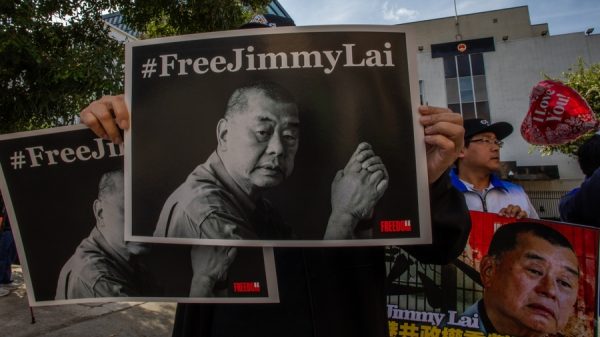
Jimmy Lai: From factory worker to media mogul
Why, then, does Beijing view Jimmy Lai as such a difficult case? Why has the founder of Hong Kong’s now-shuttered Apple Daily been portrayed by Communist China’s state media as a “traitor” and an “American and British agent”?
Lai’s story began far from Hong Kong’s financial district. Born in 1948 in Shunde, Guangdong Province, he fled to Hong Kong illegally at age 12 after a childhood marked by poverty and political upheaval. His father had left for Hong Kong before the Chinese Communist Party took power, and his mother was later imprisoned as the relative of a “counter revolutionary,” leaving Lai to help care for his siblings.
Working as a child laborer in Hong Kong factories, Lai sent half his wages back to his family in Guangzhou. Despite little formal education, he taught himself English with the help of a retired teacher while working at a wig factory, eventually rising to sales manager.
At the time, Lai was known primarily as a businessman, not a political activist. That changed after the 1989 Chinese democracy protests, and that June’s Tiananmen Square massacre.
Lai later described the military suppression of the pro-democracy movement as a personal awakening.
“It was like my mother calling to me from the darkness. My heart opened.”
He financed the production of 200,000 Giordano T-shirts supporting Hong Kong’s solidarity movement with the Beijing student protesters, marking the beginning of his public political engagement.
RELATED:
- Hong Kong Hunter Bookstore Sealed Off, Two People Arrested; Multiple Human Rights Organizations Condemn
- Hong Kong Journalists Face Growing Pressure Under National Security Law, Oxford Report Finds
- Trump Raises Jimmy Lai Case During Meeting With Xi Jinping
Breaking with Beijing
Lai’s break with Beijing became irreversible in 1994 when his magazine Next Magazine published “An Open Letter to the B—— Li Peng,” an attack on then-Chinese Premier Li Peng over the violence at Tiananmen.
As a political hardliner, in 1989 Li Peng had collaborated with then-Chinese paramount leader Deng Xiaoping to sideline more lenient voices in the Communist Party leadership and deploy the military to crush the democracy movement.
Lai’s 1994 article opened:
“Li Peng, you are a national disgrace to China. No, you are the greatest disgrace to our nation.”
In the expletive-laden polemic, Lai continued:
“It is our tragedy that, among the descendants of five thousand years of Chinese civilization, someone like you, Li Peng, could emerge.”
The fallout was swift. Giordano’s mainland business came under official pressure, and Lai ultimately sold his shares at a steep discount.
Looking back, he said he had no regrets.
“As a businessman, you cannot stand up to this regime. Once China’s leaders coerce you, they can coerce you forever. Once they put you in their pocket, they’ll keep squeezing you.”
Lai used the proceeds to launch Apple Daily in 1995, transforming himself from one of Hong Kong’s most successful entrepreneurs into one of Beijing’s most outspoken media critics.
Beyond his publishing business, Lai also supported activists involved in the 1989 democracy movement. Among them was Liu Jun, a leader of the 1989 Guangzhou student protests who later settled in the United States and became an immigration attorney.
Also known as Arthur Liu, his daughter, Alysa Liu, would go on to win two gold medals at the 2026 Winter Olympics in figure skating.