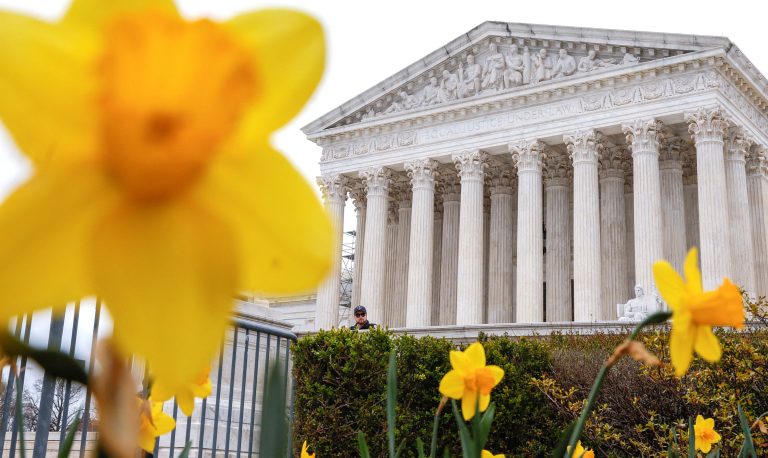
On June 27 (Friday), the U.S. Supreme Court issued a ruling stating that a single federal district court cannot block the enforcement of federal policies nationwide and must limit injunctions to only the parties involved in a given case, dramatically reducing the ability of lower courts to halt executive actions like those issued by President Donald Trump.
This means that lower courts will no longer be able to issue decisions that block the implementation of federal policies, like executive orders issued by the Trump administration, unless under specific circumstances.
The ruling, delivered on the final day of the term, handed the Trump administration a significant victory; clearing a path for the president to more easily implement his agenda and push the boundaries of executive power.
The Court did not rule on whether Trump’s executive order to end birthright citizenship is constitutional. Instead, it focused only on the use of nationwide injunctions. The Court decided that lower courts can’t block federal policies across the entire country unless it’s necessary to give full relief to specific plaintiffs.
In remarks following the decision, Trump called it a “monumental victory,” saying, “This morning, the Supreme Court has delivered a monumental victory for the Constitution, the separation of powers, and the rule of law in striking down the excessive use of nationwide injunctions to interfere with the normal functioning of the executive branch.”
Success
You are now signed up for our newsletter
Success
Check your email to complete sign up
He went on to say that nationwide injunctions against his executive orders were “a grave threat to democracy,” and that the ruling will allow his administration to “promptly file to proceed with numerous policies that have been wrongly enjoined on a nationwide basis.”
READ MORE:
Key elements
By a 6-3 vote, the Court held that “universal” or “nationwide” injunctions — orders from a single district court that block enforcement of federal policies everywhere — exceed the authority granted by the Judiciary Act of 1789.
SCOTUS said that injunctions cannot be applied broadly, but rather only to specific plaintiffs who bring a case, unless broader relief is absolutely necessary to protect their rights.
Courts must now justify any relief that extends beyond the named plaintiffs, a requirement that may make nationwide policy halts much harder to obtain.
This marks a significant departure from past practices, where lower court judges could pause entire federal initiatives with a stroke of a pen, usually in politically charged cases.
The nation’s top court said that while universal injunctions are now off the table, class action lawsuits remain a valid legal mechanism for securing broader relief, however admitted that class certification involves legal hurdles that groups must overcome to challenge federal policies.
The Supreme Court also directed lower courts to reconsider the scope of their current injunctions in light of its decision.
The broader impacts will apply to a wide range of future litigation, including challenges to environmental rules, healthcare policies, education directives, and labor regulations and will place a higher burden on plaintiffs seeking to halt federal actions.
READ MORE:
Going forward
The landmark decision will have sweeping impacts on a number of executive orders Trump has signed, but were blocked by lower courts.
The ruling directly affects the injunction that blocked Trump’s order aiming to end birthright citizenship for children born in the U.S. to non-citizen parents. With nationwide injunctions curtailed, this order can now be enforced more widely unless narrower, plaintiff-specific injunctions remain in place.
Several immigration directives that were halted nationwide including travel bans and asylum restrictions may now see enforcement restored or reinstated partially.
Federal policies related to environmental regulations and energy production, including rollbacks of Obama-era climate initiatives may also face fewer injunctions.
In addition, executive orders concerning healthcare mandates, federal funding conditions, and social programs that had been challenged in a number of jurisdictions could be insulated from sweeping nationwide blocks from lower courts.
Following the ruling, White House Counsel, David Warrington wrote on the official White House website, “Today’s decision restores the proper separation of powers between the branches of government. Ending nationwide injunctions is a tremendous victory for the American people and the rule of law.
“No longer can rogue, activist judges abuse their authority to dictate the executive powers of the President of the United States.”