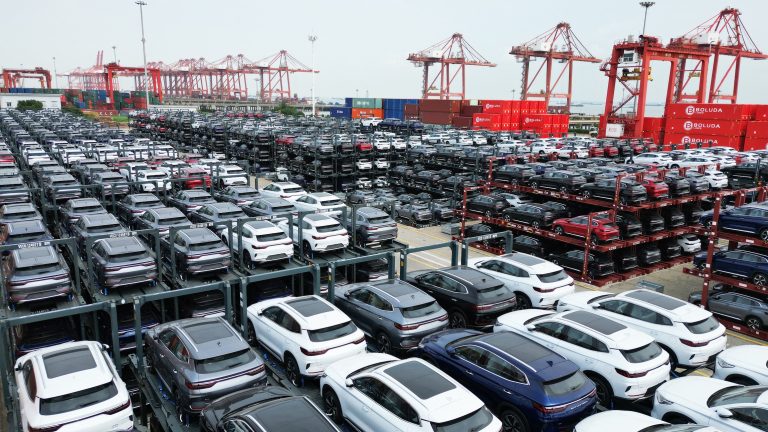
The People’s Republic of China (PRC) has seen its exports rise by 33 percent in just two years, while imports have stagnated over the same period, prompting international accusations of Beijing engaging in unfair economic mercantilism. This trade situation aligns with the Chinese Communist Party’s directive to foster “internal circulation” as well as the trend of falling Chinese demand.
“Internal circulation” (内循环) as a concept appeared in 2020 at the behest of Chinese leader Xi Jinping, and is related to the idea of “dual circulation” (双循环), which was rolled out by the CCP Politburo that May.
The concept stresses making China less reliant on international markets by encouraging domestic consumption of Chinese-produced goods while still remaining open to foreign trade. “Dual circulation” also came several months after the beginning of the novel coronavirus pandemic in late 2019, which caused severe global supply chain shocks and led the CCP to implement draconian “zero-COVID” lockdowns across much of China for several years.
Dwindling Chinese imports and consumption
Earlier in June, trade negotiators from both the American and Chinese sides reached a preliminary framework agreement after two days of high-level talks in London.
U.S. President Donald Trump has expressed optimism about working with Beijing to increase the volume of American exports to China. However, Chinese imports have trended flat in recent months and years even as its exports rise.
- Purges in China’s Guangxi Hint at Rare Earths Smuggling, Factional Struggle
- Shanghai’s Population Crisis Deepens Amid Migrant Exodus, Dwindling Birth Rates
Success
You are now signed up for our newsletter
Success
Check your email to complete sign up
Data from the Netherlands Bureau for Economic Policy Analysis cited by the Wall Street Journal (WSJ) on June 16 shows that between the end of China’s “zero-COVID” lockdowns in late 2022 and the end of March 2025, Chinese imports registered barely any growth, mostly staying below 5 percent. At times, imports decreased, while exports rose by 33 percent in the nearly two-and-a-half year timeframe.
Chinese state data reflects a similar trend.
For example, in the first five months of 2025, Chinese imports totalled 7.27 trillion yuan (about US$1 trillion), down 3.8 percent compared with the same period in 2024, while total imports in 2024 rose 2.3 percent compared with 2023.
2023 imports flatlined compared with 2022, when total imports were 18.1 trillion, or up 4.3 percent compared with 2021.
By contrast, China’s exports grew 7.2 percent in the first five months of 2025 alone, 7.1 percent in 2024, and 10.5 percent in 2022. Exports in 2023 grew just 0.6 percent, due to pandemic recovery shocks.
Looking at other developing economies in Asia, import growth was 11 percent for the 2022–2025 period; meanwhile, U.S. imports rose by 36 percent.
Beijing pushes for bringing supply chains to China and phasing out US tech
The WSJ noted that the growing trade imbalance is primarily the result of China’s industrial policies that heavily fund manufacturing and high-tech sectors, while doing little to boost domestic consumption. Meanwhile, the collapse of the real estate boom has dampened demand for bulk commodities.
In practice, China has been systematically phasing out the need for imported American technological know-how.
Chinese companies are increasingly replacing foreign suppliers with domestic ones to localize supply chains, a trend that accelerated starting with the first round of the U.S.-China trade war. From semiconductors and fighter jets to grain and oilseeds, China is pushing for self-sufficiency to reduce dependence on the West for food, raw materials, and energy.
In September 2022, the State Council issued “Document 79,” mandating that by 2027, all central and state-owned enterprises must achieve 100 percent localization in the “xinchuang” (新创, indigenous innovation) tech chain.
- Cracks in the ‘Iron Rice Bowl’: Chinese Workers, Government Employees See Their Wages Delayed, Benefits Cut
- China’s Subway Boom Becomes a Financial Nightmare as Project Racks Up Trillions in Debt
Products in the “xinchuang” category include computer chips, operating systems, databases, and so on. This directive expanded efforts to exclude U.S. technology, and is dubbed “Eliminate American” (“消A”).
For example, China Harzone Industry, which manufactures civilian and military emergency vehicles and equipment, stated in an April 8 investor filing that it would “vigorously develop domestic alternatives” to imported parts in response to U.S. tariffs.
Chinese imports from the U.S. between late 2022 and May 2025 fell 11 percent, while imports from Japan and Germany fell by 17 and 18 percent, respectively.
Many hardware products from Dell, IBM, and Cisco have been replaced by Chinese competitors. Software giants like Microsoft and Oracle are also losing their previous dominance.
Collapsing real estate and consumer demand
China’s real estate crash has led to a sharp drop in demand for commodities that were once in high demand. Countries like Brazil and South Africa once exported iron ore, copper, and energy to fuel China’s construction boom, which has declined in recent years.
According to Chinese customs, in the first five months of 2025, iron ore imports were 513 million tons, down 5.2 percent year-on-year; coal imports were 147 million tons, down 7.9 percent; and agricultural goods like grain and meat fell 12.5 percent in value.
Crude oil imports rose just 0.3 percent in volume, but dropped 11.4 percent in value, while natural gas imports dropped 9.5 percent in volume and 16.6 percent in value. Imports of timber fell by 13.3 percent in volume.
Chinese purchases of foreign cars plunged by a staggering 32.8 percent, a reflection of the country’s burgeoning domestic automaking industry.
Chinese consumers are also tightening their wallets. The WSJ report noted that concerns about job prospects, falling incomes, inadequate social security (especially pensions, healthcare, and education), and declining property values are all contributing to a reluctance to spend.
Even Western luxury brands such as Louis Vuitton and Porsche — long popular among Chinese elite consumers — have reported sluggish sales in China. At a French parliamentary hearing on May 28, LVMH Deputy CEO Stephane Bianchi said that in the previous three months, Chinese tourists were traveling and shopping abroad less.
‘Buy Chinese’ procurement drive squeezes out foreign suppliers
German medical technology company Dräger reported that its 2024 sales of ventilators and other medical products in China were halved due to Beijing’s “buy Chinese” directive in healthcare procurement.
A Dräger spokesperson observed that the overall business environment for foreign firms in China has been growing more difficult, with the Chinese economy in decline and the authorities affording local companies preferential treatment in public tenders.
An internal document jointly issued by China’s Ministry of Finance and Ministry of Industry and Information Technology in 2021 — known as “Document 551” — stipulated domestic procurement quotas for various types of medical devices.
Among nearly 200 products, the Chinese government stipulated that 137 must have 100 percent of their parts produced domestically; 12 types required 75 percent, 24 needed 50 percent, and 5 types of medical devices were required to have at least 25 percent of their components locally sourced.
The WSJ noted that in 2022, public procurement spending by Chinese state entities exceeded 48 trillion yuan, or US$6.7 trillion.
Backlash against Beijing’s vision of global trade
This March 28, in the backdrop of Trump’s proposed tariff hikes on dozens of countries, Xi Jinping held a meeting with multinational CEOs where he voiced support for the goals of the World Trade Organization (WTO). Xi told the more than 40 executives there that “we need to work together to maintain the stability of global industry and supply chains, which is an important guarantee for the healthy development of the world economy.”
However, Reuters noted that “longstanding unease over China’s tightening regulations, abrupt crackdowns on foreign firms, and an uneven playing field favouring state-owned Chinese companies are also sapping business sentiment.”
George Magnus, a researcher at Oxford’s China Centre and former UBS chief economist, commented in an interview with The Market, a Swiss-German finance outlet, that China’s massive export surplus is straining the global economy due to a lack of reciprocal imports.
Though calling Trump’s approach to the problem as “taking a sledgehammer,” Magnus said the “status quo ante wasn’t sustainable.”
Though other countries such as Japan, Germany, or Korea have also run consistent export surpluses, the sheer size of the Chinese economy is “too big for the world to handle,” he said.
The researcher observed that China has excelled at adaptive innovation, that is, “not just copying, but adapting the stock of knowledge to create good products.”
Furthermore, “they are very good at scaling things up, and therefore, three, they are very good at selling that stuff at low prices,” Magnus said, giving the example of cheap, mass produced quality Chinese electric vehicles.
Fueled by export growth, China’s global trade surplus in goods reached about US$1 trillion last year, almost double the 2020 level.
The trade imbalance is a major reason for U.S. tariffs on China. On April 29, Trump told ABC News that China’s massive trade surplus with America justified the 145 percent tariffs he had levied on Beijing at the time. Those tariffs have since been paused.
Brad Setser, senior fellow at the Council on Foreign Relations and former U.S. Treasury official, noted that China is not a realistic substitute for the U.S. as a global consumption market, given that it is interested in only exporting and not buying.
“China would say it’s not their fault that they’re competitive and that the entire world wants to buy their products,” Magus said.
But, citing the classical economic philosopher Adam Smith, he noted, “ the purpose of exporting is to be able to import. To be able to consume other things. That’s the big thing that’s missing in China.”
“The philosophy behind China’s economic model is pure mercantilism. They make a virtue of export surpluses and accumulating foreign exchange reserves. That’s what’s wrong.”