Have you ever seen a beautiful piece of Indian folk art, colorful, delicate and precise, only to find it gone the next day? You may have thought, ‘What a waste!’ However, in India, this ephemeral art holds a deeper significance. It is not just decoration. It transmits a spiritual message.
In India, creating ephemeral art is a form of prayer, a symbol of celebration, and a lesson in letting go. These delicate patterns, often drawn during festivals or religious ceremonies, remind us of something deeper: everything in life is temporary, and beauty lies in the moment.
About ephemeral art
Unlike paintings in museums or sculptures in stone, ephemeral art is made to be enjoyed for a short while; then allowed to fade, dissolve, or be destroyed. What they leave behind is something more lasting — a spiritual impression.
In India, this kind of art is created daily in homes, at temple entrances, during festivals, and even on public beaches. It is usually made from natural materials, such as sand, flowers, rice flour, or colored powders.
But why make something so beautiful only to lose it?
Success
You are now signed up for our newsletter
Success
Check your email to complete sign up
It may seem like a loss. But in Indian culture, this kind of vanishing beauty holds a sacred message: nothing lasts forever, and that’s what makes every moment so valuable. These temporary images quietly teach us to appreciate beauty without clinging to it.
Let’s take a journey across India to see how different regions express this spiritual idea through ephemeral art.
1. Kolam in South India: A morning ritual of grace

In South India, it is common to see women bending over the threshold of their homes at dawn, drawing kolam patterns with white rice flour. They do it in silence, often after bathing and cleaning the area. These designs, made from dots and curves, are created not just for beauty, but as an offering to the gods.
The rice flour also feeds small creatures like ants and birds, reminding us that our creations can also be an act of kindness and sharing.
2. Rangoli in Maharashtra and Gujarat: Festival of colors

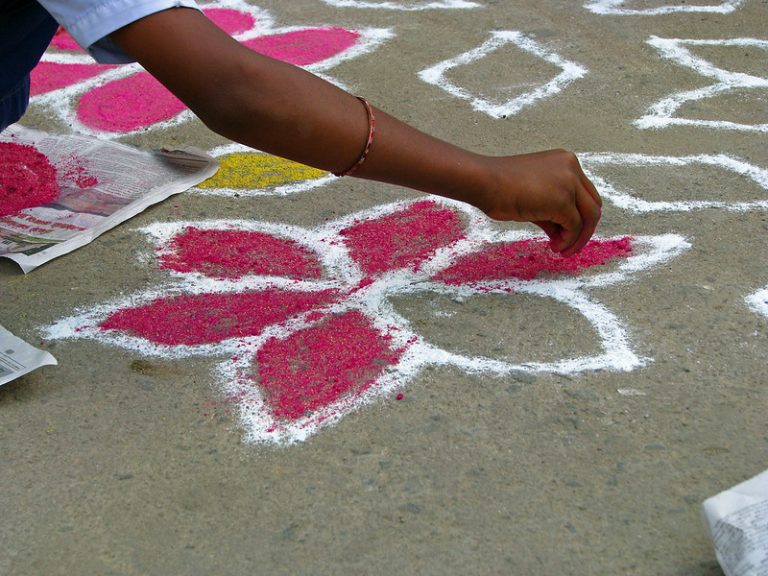
During festivals like Diwali, homes in Pune, Nagpur, and Ahmedabad burst into colour with vibrant rangoli designs. Made with powdered dyes or flower petals, these artworks greet guests and gods alike.
Outside the temples in Pune, artists create massive rangolis as offerings to the gods. Rangoli designs often include symbols like the lotus (purity), the conch (auspiciousness), and geometric patterns that are said to balance energy in the space. Each design takes hours to complete, yet it is gone the next day.
3. Alpana in Bengal: Circles of devotion
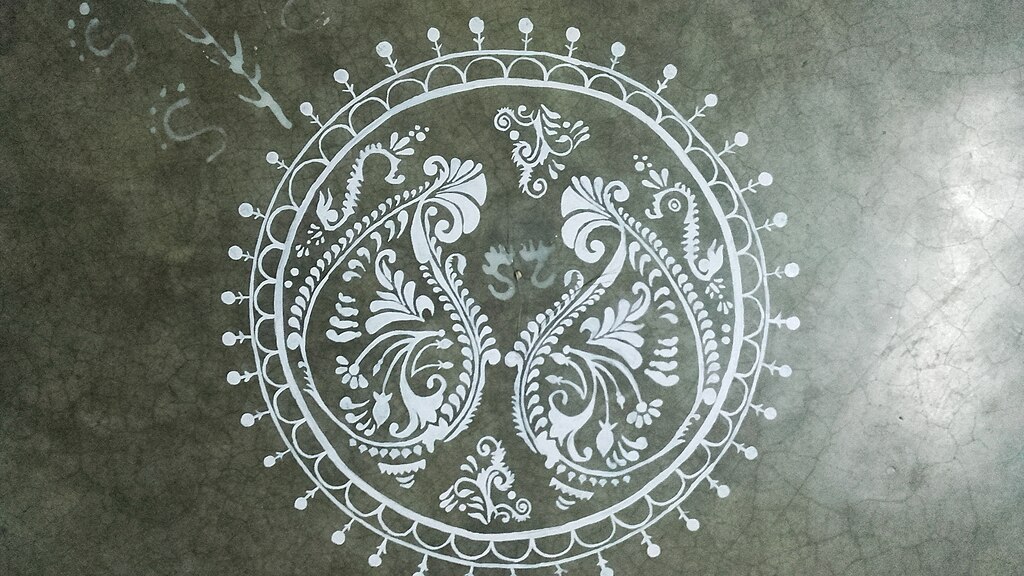
In West Bengal, especially during Durga Puja or Lakshmi Puja, women create alpana designs using rice paste. These white designs are often drawn on the floor around the deity’s altar or on the threshold of the home.
In towns like Shantiniketan, alpana is also used to mark seasonal festivals and community rituals. Students of art and music decorate courtyards with circular designs, often singing hymns while drawing.
Drawing alpana is a meditative, mindful process, each curve laid down with care and devotion. As with other sand arts, it is erased after the ritual, symbolizing the return of the soul to the universe.
4. Aripana – Bihar’s cosmic floor art
In Maithil households of Bihar, Aripana is created during religious and family rituals. Using ground rice paste (called pithar) and sometimes turmeric or sindoor, women draw sacred symbols on freshly cleaned earthen floors.
These designs often include:
- Astadal Padma – an eight-petaled lotus
- Chakras – representing the cosmic cycle
- Footprints of goddesses or ancestors
The designs are not pre-planned, but emerge intuitively, from memory and spiritual feeling. They are drawn slowly, often during devotional singing or chanting.
5. Mandana – Sacred geometry of Rajasthan

Mandana is an art form practiced by rural women in Rajasthan and Madhya Pradesh. Using lime powder and red ochre to paint on mud walls or floors, they are spiritual diagrams meant to attract divine energy. They often include symbols like:
- Swastikas for auspiciousness
- Lotus flowers for purity
- Elephants and peacocks for grace and strength
It is believed that these sacred drawings protect the home, welcome the gods, and balance the natural energies of the space. After the celebration, the artwork naturally fades or is washed away.
6. Sand sculptures in Odisha: Art washed by the sea

While most ephemeral arts in India are two-dimensional, Odisha takes it to another level — with three-dimensional sculptures on the seashore.
At Puri Beach, world-renowned artist Sudarshan Pattnaik creates enormous sand sculptures of deities, messages of peace, or environmental awareness. These sculptures draw thousands of visitors during events like Rath Yatra or World Environment Day. Each sculpture disappears with the rising tide, leaving behind only a memory and a message.
Deeper meaning behind the art
According to India’s ancient wisdom, life is viewed as a passing river, not a still pond. Creating ephemeral art teaches us to:
- Live in the moment
- Love without clinging
- Create without attachment
- Accept change with grace
- Give without expecting something in return
All these Indian folk arts are created with devotion, and erased without regret. This is not accidental. It is a reflection of a timeless spiritual truth: that holding on causes suffering, and letting go brings peace.