By Li Muzi, Vision Times
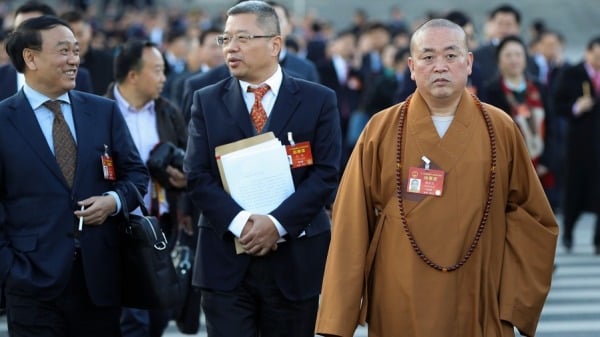
Since the arrest of Shi Yongxin, the former abbot of Shaolin Temple and a “political monk” cultivated by the Chinese Communist Party (CCP), numerous insider accounts have emerged. Recent online rumors claim that Shi had been on alert before his detention, leaving a warning to a friend: If he were ever arrested, never trust the official information released by authorities. Allegations such as overseas money laundering, he reportedly said, were orchestrated by the CCP itself.
On July 27, the Shaolin Temple Management Office confirmed that Shi is suspected of multiple criminal offenses, including embezzlement and misappropriation of temple funds and assets. He is also accused of violating Buddhist precepts by maintaining long-term inappropriate relationships with several women and even fathering illegitimate children.
A tangled web
Shi is now under joint investigation by several government agencies. But the following day, the Chinese Buddhist Association revoked his Buddhist ordination credentials. His secular name is Liu Yingcheng.
On August 8, a widely shared post on overseas social media claimed that a month before his arrest, Shi sent a note to a close friend and lay disciple of Shaolin living abroad. In it, he warned the public to “never believe the official information” alleging offenses such as unauthorized meetings with the Pope or overseas money laundering, insisting that “these are all orchestrated by those above to frame him.”
Success
You are now signed up for our newsletter
Success
Check your email to complete sign up
RELATED: Power, Scandal, and Distraction: Peng Liyuan Falters as Shi Yongxin Faces Arrest
The post alleged that “the meeting with the Pope was arranged by the United Front Work Department, which even assigned personnel to train Shi for several days on how to communicate with the Pope, sow discord between the Vatican and Taiwan, and guide the Roman Catholic Church closer to the mainland.” It also claimed that “those overseas Shaolin cultural exchange centers serve as government fronts.”
According to the post, the friend did not provide extensive details but suggested the operations were tied to an intelligence agency linked to the Chinese military. The so-called “laundered” funds, it said, were used for intelligence activities. With Shi’s military patronage faction now out of power, he too has been removed. The patron in question was not a single person but an entire faction.

From Party favorite to target
Shi, once labeled both a “playboy monk” and a “good cadre of the Party,” held a range of influential posts: president of the Henan Buddhist Association, vice president of the Chinese Buddhist Association from its 7th to 10th sessions, representative to the 9th through 12th National People’s Congress, and member of the All-China Youth Federation.
RELATED: Inside Beidaihe: Xi Jinping Reportedly Strikes a Deal on Terms of His Exit
Netizens reacted strongly, with some commenting, “This is highly credible.” Others wrote, “A Party-controlled monk, whose faith is the Communist Party, ends up fattened and ready for slaughter,” and, “A playboy monk climbing to such a position never relied on Buddhist teachings but rather on worldly ‘passcodes.’ The real rot is not the temple, but those who control the temples.” Another remarked, “It seems the corruption is not just Shi Yongxin, but the entire system itself.”
Wang Youqun, a law Ph.D. graduate from Renmin University of China and former official at the Central Commission for Discipline Inspection — who also served as a speechwriter for former Politburo Standing Committee member Wei Jianxing — wrote in “The Epoch Times” on July 30:
“Under CCP rule, the army belongs to the Party, the government belongs to the Party, businesses belong to the Party, the media belongs to the Party, schools belong to the Party… and religion also belongs to the Party. As the foremost patriarchal temple of Chinese Zen Buddhism, Shaolin Temple naturally belongs to the Party; and its abbot Shi Yongxin is naturally a man of the Party.”
Shaolin Temple scandal
Wang noted that Shi’s rise to become the CCP’s second highest-ranking “great monk” could only have happened with the support of powerful patrons. He identified four major figures behind Shi’s ascent: former CCP leader Jiang Zemin, former Chinese Buddhist Association president Zhao Puchu, former Politburo Standing Committee member Li Changchun, and current CCP leader Xi Jinping.
During Shi’s tenure, the Shaolin martial monks’ troupe was formed, and the temple’s commercial empire expanded rapidly at home and abroad. This occurred under Jiang’s leadership and his later role as “Emperor Emeritus.” After Jiang launched the crackdown on Falun Gong in July 1999, Shi actively backed the campaign, denouncing Falun Gong and using Shaolin Temple to assist in the CCP’s suppression.
Wang attributed Shi’s downfall to three main reasons: Xi Jinping’s inability or unwillingness to protect him, the CCP’s urgent need for funds leading to Shi being targeted, and Shi’s moral corruption under the guise of monastic life — defiling Buddhist teachings and now facing retribution.
Under the CCP, religion is required to serve Party objectives. Monasteries nationwide are compelled to cultivate “political monks,” hold flag-raising ceremonies, make political statements, and participate in united front activities — all at the expense of genuine moral cultivation. Figures like Shi Yongxin, fostered by the CCP, are far from unique in Chinese temples. Some analysts argue that it is the CCP itself, acting as a destructive force, that undermines Buddhism and sows disorder worldwide.