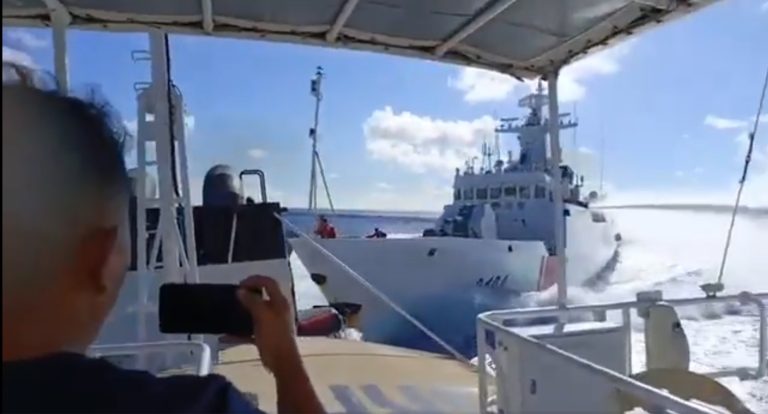
On Monday, Aug. 11, a Philippine patrol boat was chased by a Chinese coast guard ship in a contested part of the South China Sea until a second Chinese vessel cut in, colliding with the coast guard ship and destroying its bow.
Philippine coast guard spokesperson Jay Tarriela shared footage captured by the patrol boat’s crew, showing how the incident transpired.
It displayed how the Filipino boat, BRP Suluan, was being pursued by the China Coast Guard ship, CCG 3104, right before a destroyer of the People’s Liberation Army (PLA) cut right in front of its fellow vessel. The latter slammed into the warship’s port side, stopping them both as the Filipino boat sailed off.
Tarriela described the Chinese coast guard ship’s move as “a risky maneuver,” causing “substantial damage.”
Observed footage of the incident suggests that at least two Chinese crewmembers manning the bow of their ship, China Coast Guard Cutter Nanyu (3104), may have died or been seriously injured in the crash.
Success
You are now signed up for our newsletter
Success
Check your email to complete sign up
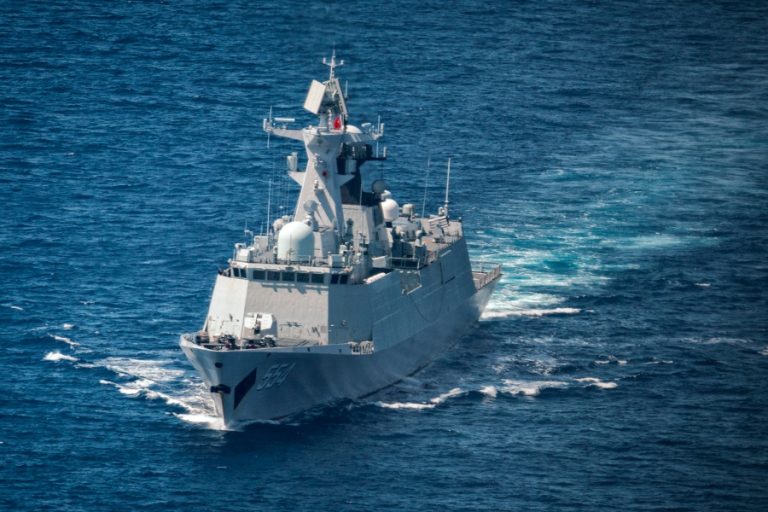
The destroyer involved in the incident was the PLA Navy Guilin (164), of the Type 052D class. This type of ship displaces about 7,500 tons.
“The [Chinese coast guard ship] CCG 3104, which was chasing the [Philippine Coast Guard vessel] BRP Suluan at high speed, performed a risky maneuver from the [Philippine] vessel’s starboard quarter, leading to the impact with the [PLA] navy warship,” Tarriela said in a statement.
READ MORE:
- Chinese Coast Guard Ships Damaged Philippine Vessels With Water Cannons, Officials Say
- Trump Admin Working With Japan to Ensure Reciprocal Tariffs Won’t Stack
- Japan’s 2025 Defense White Paper Names China ‘Greatest Strategic Challenge’
The incident occurred near the disputed Scarborough Shoal, known as Huayan Island in Chinese.
Communist China claims most of the South China Sea and its islands, including areas belonging to or claimed by the Philippines.
Beijing blames Manila
Before the collision, the BRP Suluan was “targeted with a water cannon” by the Chinese ship, only to evade it, Tarriela’s statement added. It was one of many vessels tasked in delivering fuel and supplies to local fishermen in the Scarborough Shoal; part of the coast guard’s larger goal to protect the Philippines’ fishing industry.
Following the incident, China Coast Guard spokesperson Gan Yu told state-owned Xinhua that Philippine ships had trespassed despite multiple warnings, though he did not specify a collision.
“The China coastguard took necessary measures in accordance with the law, including monitoring, pressing from the outside, blocking and controlling the Philippine vessels to drive them away,” Gan Yu said in a statement.
Tarriela claimed that the Philippine coast guard “immediately offered support” to the Chinese coast guard crew. This included rescuing any overboard crew members and medical assistance for those wounded.
Meanwhile, Philippine officials have called for Beijing to comply with international law so as to avoid future incidents.
In a statement, the Philippines’ Department of Foreign Affairs said that it had continued to press “the importance of maritime safety,” willing to cooperate with “relevant parties to draw lessons from this incident.”
The foreign ministry also said on Tuesday (Aug. 12), “Their [the Chinese vessels’] actions not only posed a grave danger to Philippine personnel and vessels, but also resulted in the unfortunate collision between the two Chinese vessels.”
According to PBS, the U.S. deployed two warships on Aug. 13 to the area, acting on Washington’s “freedom-of-navigation” journeys in the South China Sea.
Territorial pressure continues
The collision was the latest in several maritime incidents between China and the Philippines. Beijing’s ships have continued to ram Philippine vessels in the area, dowsing them with water cannons, “60 Minutes” reported last September.
The “60 Minutes” crew observed a Chinese coast guard vessel ram a Philippine ship on a resupply mission in the South China Sea, forcing it to abandon its first stop as Chinese ships shadowed it closely.
Beijing said it had acted “lawfully” to push back Philippine vessels that had “forcibly intruded” into its waters, without referencing the recent collision, as reported by The Guardian.
“The China coastguard will continue to carry out rights protection law enforcement activities in the waters of [Huayan Island] in accordance with the law, and will resolutely safeguard China’s national territorial sovereignty and maritime rights and interests,” Gan Yu said.
Conversely, Philippine president Ferdinand Marcos Jr. said at a news conference that Manila’s ships would “continue to be present” in its claimed territories, exerting its rights to defend the area.