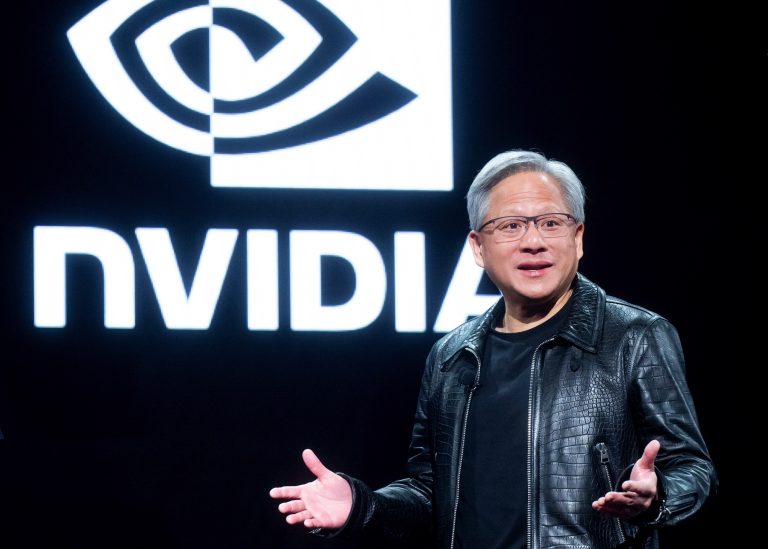
On Friday, Aug. 22, Nvidia CEO Jensen Huang said that the company is in discussions with the Trump administration about developing a new chip tailored for China’s artificial intelligence (AI) market. Unlike Nvidia’s top-performing processors available in the U.S., the proposed chip would be intentionally less powerful, a design compromise meant to comply with strict American export restrictions on advanced semiconductors to China.
Huang made the remarks during a visit to Taiwan Semiconductor Manufacturing Co. (TSMC), the world’s largest contract chipmaker, headquartered in Taiwan.
He said Nvidia is contemplating producing a chip dubbed “B30A” specifically for China’s AI data centers.
“I’m offering a new product to China for… AI data centers, the follow-on to H20,” Huang said, adding, “That’s not our decision to make. It’s up to, of course, the United States government. And we’re in dialogue with them, but it’s too soon to know.”
The chip is a graphics processing unit (GPU), a device used in a number of AI systems. However the B30A is reported to operate at about half the speed of Nvidia’s current top-of-the-line chip the B300.
Success
You are now signed up for our newsletter
Success
Check your email to complete sign up
Huang took the opportunity to praise the Trump administration for recently allowing Nvidia to sell H20 chips to China after suspending shipments in April of this year. The leniency comes with the provision that the company must pay a 15 percent levy to the U.S. government for those sales. Nvidia competitors, Advanced Micro Devices and AMD, are also required to pay the levy on their sales of MI380 chips to China.
RELATED:
- Chinese Nationals in US Accused of Smuggling Millions’ Worth of Nvidia AI Chips to Beijing
- US Considering Equity Stake in Chip Makers for CHIPS Act Cash Grants, Sources Say
- Trump Calls for Intel CEO Lip-Bu Tan’s Immediate Resignation Over China Ties
Shifting trade policies
In a recent agreement, Washington and communist authorities in Beijing moved to ease certain non-tariff restrictions: Beijing authorized the export of rare earth magnets to the U.S., while Washington lifted curbs on advanced chip design software and jet engines.
Huang expressed gratitude that Nvidia was able to continue to sell certain chips to China and insisted that the hardware posed no threat to American national security and could not be used as a “backdoor” into American infrastructure.
“We have made very clear and put to rest that H20 has no security backdoors. There are no such things. There never has. And so hopefully the response that we’ve given to the Chinese government will be sufficient,” Huang said according to the Associated Press (AP).
Meanwhile, China’s internet watchdog, the Cyberspace Administration of China, posted a notice on its website alleging that there are “serious security issues” with Nvidia’s hardware, saying that American AI experts say that the chips have “mature tracking and location and remote shutdown technologies,” and that Nvidia has been asked to provide documentation detailing these risks to Chinese communist authorities.
Huang said he was surprised by the accusation and was discussing the issue with relevant parties in China.
“As you know, they requested and urged us to secure licenses for the H20s for some time. And I’ve worked quite hard to help them secure the licenses. And so hopefully this will be resolved,” Huang said.
READ MORE:
- China’s Nuclear Expansion Boosts Strategic and Tactical Capabilities
- Chinese Vessels Collide While Pursuing Philippine Boat in Contested Waters
- Taiwan’s Movement to Recall Alleged Pro-CCP Legislators Flops
China’s AI independence goals
According to some unconfirmed reports, Beijing is disgruntled over recent comments by U.S. Commerce Secretary Howard Lutinick after he said China is only able to procure outdated chip technology from the United States.
Speaking on CNBC, Lutnick said, “We don’t sell them our best stuff. Not our second best stuff. Not even our third best, but I think fourth best is where we’ve come out that we’re cool.”
Like the United States, China is working towards becoming self-reliant for advanced semiconductors.
Recently China mandated that domestic firms source at least 50 percent of their chips from Chinese producers. Originally piloted in Shanghai, this requirement is now being enforced more broadly as part of a larger push to reduce reliance on American technology.
In addition, The China Integrated Circuit Industry Investment Fund (Big Fund), operational since 2014, has rolled out funding for domestic chipmakers such as SMIC, Hua Hong Semiconductor, and YMTC.
Most recently, the “Big Fund III,” which launched in 2024, allocated upwards of US$47.5 billion to support chip developments on the mainland.
According to TrendForce, Shanghai is targeting 70 percent self-sufficiency in AI chips by 2027, while Beijing has set its sights on complete independence. Guiyang, meanwhile, is aiming for 90 percent domestically sourced chips in its new data centers by the same year.
For now, Chinese firms still rely on Nvidia and AMD chips, but domestic competitors like Huawei’s Ascend 910B, which operates at around 85 percent of the H20 performance, and the Ascend 920, which is still under development, are narrowing the gap.