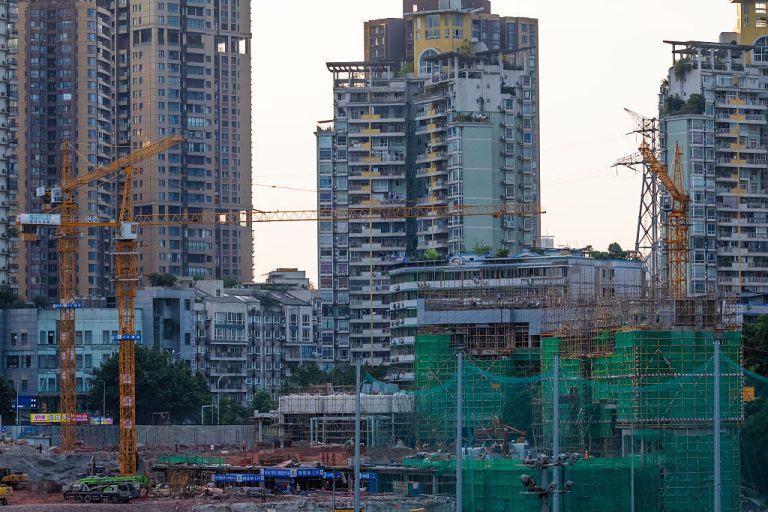
According to the latest July real estate data released by China’s National Bureau of Statistics, second-hand home prices in first-tier cities fell 3.4 percent year-on-year, a 0.4 percentage point increase in the decline compared to the previous month. In second- and third-tier cities, prices for second-hand homes dropped 5.6 and 6.4 percent, respectively.
The figures underscore the ongoing downward pressure on China’s housing market, with even major cities such as Beijing, Shanghai, Guangzhou, and Shenzhen showing clear price declines.
Prominent economists Xu Chenggang and Cheng Xiaonong recently issued stark warnings: China’s real estate sector is on the verge of a complete collapse. They argue that this crisis could drag down the entire economy and potentially plunge China into a prolonged structural recession reminiscent of the Great Depression. Their analyses point to systemic issues, policy failures, and external pressures, sparking widespread concern among analysts and the public alike.
The Institutional Roots of China’s Real Estate Bubble: State-Owned Land and Land Finance
Professor Xu Chenggang, a prominent economist, recently delivered a detailed analysis of the deep-seated causes behind China’s real estate crisis. He emphasized that China is one of the very few countries in the world with fully state-owned land, as enshrined in its constitution. All land ownership belongs to the state, meaning that businesses and individuals only acquire land-use rights, not full property rights. Xu argues that this institutional framework is key to understanding all aspects of China’s real estate market.
Xu notes that China’s modern real estate industry did not exist historically, emerging only in the late 1990s, closely linked to tax reform. At that time, the central government collected most tax revenues, leaving local governments fiscally strained. However, most public expenditures—including infrastructure, education, and healthcare—depend on local government funding, while the central government evaluates local officials primarily on economic growth performance. To fill the revenue gap, the central government allowed local governments to sell or lease land-use rights, creating a system known as “land fiscal finance.”
Success
You are now signed up for our newsletter
Success
Check your email to complete sign up
Under this model, local governments became absolute monopolists in the land market. Xu applies basic economic theory: monopolists seeking to maximize revenue restrict supply to drive up prices. Similarly, local authorities in China restricted land supply through various policies to push housing prices higher, causing the real estate market to balloon into a massive bubble within a few decades. Xu estimates that the total value of China’s real estate assets now exceeds the combined total of the U.S. and EU. Unlike a free market, the Chinese government can intervene to control supply, enforce price regulations, and freeze markets to maintain high property prices.
However, Xu observes that this strategy is now failing. The current market shows a “high prices but no buyers” scenario: although prices are artificially supported, transaction volumes have plummeted, and many developers face bankruptcy risks. Local governments resist letting prices fall, as this would trigger a chain reaction: reduced land revenue and fiscal crises. The situation is compounded by China’s debt-to-GDP ratio exceeding 300 percent, much of which stems from post-2008 stimulus policies. These policies used local government financing platforms to borrow from banks, with land as collateral, creating massive mortgage exposure. A drop in housing prices could shrink bank asset values, potentially causing a financial crisis.
Xu further explains that government attempts at monetary easing, such as increasing money supply, have backfired. Funds return to banks instead of stimulating consumption or investment, resulting in deflation rather than inflation. Weak domestic demand is rooted in high unemployment, demographic challenges, and a large population living in absolute poverty. Former Premier Li Keqiang noted that 600 million people earn less than 1,000 yuan per month, and by international standards (the $5/day poverty line), this number reaches 540 million, largely migrant workers who are treated as “second-class citizens” under the household registration system. Official unemployment statistics do not capture this reality, so actual unemployment is much higher.
Xu stresses that China’s economic growth should not rely solely on cutting-edge technology but should emulate developed countries’ institutional models to improve labor productivity. Currently, wealth distribution is highly unequal: land and financial revenues flow primarily to the government, while citizen income as a proportion of GDP is among the lowest in the world. This results in weak domestic demand and overproduction. Any recovery in real estate depends on employment revival, income improvement, and restored market confidence; otherwise, blind speculation will entail even greater risks.
READ MORE:
- Why China’s Attempt to Force ‘Social Insurance’ Pension Payments Could Backfire
- ‘Living under CCP rule, anyone can become the next victim’: Statements From the Tuidang Movement (July 2025)
Real Estate Death Spiral: Local Debt, Banking Crisis, and Systemic Collapse
Echoing Professor Xu Chenggang’s analysis, Professor Cheng Xiaonong issued an even stronger warning in a recent livestream: China’s real estate sector has entered a “death spiral,” with housing prices, employment, and fiscal revenues collapsing simultaneously, potentially triggering a systemic economic crisis. He bluntly states that China’s economy is not undergoing a cyclical adjustment but has entered a deep structural crisis akin to the Great Depression, marking the permanent end of the “China miracle.”
Cheng explains that China’s economy is heavily dependent on real estate: citizens’ wealth, bank assets, and growth across multiple industries rely on expectations of rising housing prices. However, these expectations have completely collapsed, and property prices continue to fall. He cites examples: in cities such as Beijing, Shanghai, Shenzhen, and Guangzhou, housing prices have fallen to around 70 percent of their original value, and further declines could reduce prices to 30 percent of original levels. He specifically warns Taiwanese investors in mainland China to sell their properties quickly to avoid total losses.
Cheng summarizes that all CCP stimulus policies—such as interest rate cuts and stock market support—have failed due to a “triple confidence crisis:” personal confidence has collapsed, citizens are afraid to spend, and savings rates are soaring. Attempts to expand employment or welfare are ineffective: both state-owned and private enterprises are laying off staff, while local governments have no fiscal capacity. Economic decline appears irreversible and could trigger global financial shocks, though the world may adapt gradually, China will pay a heavy domestic price.
He identifies the root cause of the property crash as supply-demand imbalance: urban housing stock exceeds demand, with enough vacant properties to last until 2050. A Goldman Sachs report shows housing prices have dropped at least 20 percent cumulatively over the past four years, and prices are expected to continue falling over the next two years, with demand for homes down 75 percent compared to eight years ago. Second-hand housing transactions are difficult; although banks offer low-interest loans, residents are too cautious to buy, resulting in many households’ assets turning negative, and a rising number of loan defaults.
Cheng expands the crisis to fiscal and financial sectors: local governments rely heavily on land fiscal finance, but falling housing prices sharply reduce land revenue, causing local debt explosions. Among 31 provinces and municipalities, only Shanghai previously had a surplus, but now all face fiscal strain, often borrowing from each other to stay afloat. Although central government finances are relatively sufficient, they prioritize military spending and repression, growing at 7 percent annually, leaving no funds to support local governments or enhance welfare.
The banking system is also at risk: high leverage and large proportions of mortgage-backed loans mean that a housing crash would shrink bank assets, potentially triggering a financial crisis. Cheng cites other indicators: the Producer Price Index has fallen for 32 consecutive months, and industrial enterprise profits in May dropped 91 percent year-on-year. Major companies are collapsing: electric vehicle maker Neta Auto went bankrupt, semiconductor firm Xingqiyuan implemented unpaid layoffs, online platform 58.com laid off 20–30 percent of staff, and 65 percent of steel companies became “zombie firms.” Unemployment surges: 50 million university graduates are long-term unemployed, migrant workers return to rural areas, and urban homelessness rises sharply.
External pressures worsen the crisis: under a U.S.-China Cold War, trade has been weaponized. Tariff battles have caused exports to collapse. Cheng criticizes the CCP for never treating the U.S. as a partner, instead exploiting trust to steal technology. After five years of this “cold war,” agreements are largely meaningless, foreign capital has withdrawn, and factories such as Foxconn have halted production or laid off workers. Global supply chains are shifting, with ASEAN and India replacing China as the “world factory.”
READ MORE:
- Former Chinese Official Warns of Escalating Transnational Repression by Beijing, Urges Western Response
- China’s Nuclear Expansion Boosts Strategic and Tactical Capabilities
Far-Reaching Impacts of Economic Recession and Future Outlook
The views of the two economists are closely aligned: China’s real estate collapse is the result of accumulated institutional problems, not a short-term adjustment. Xu Chenggang emphasizes that state ownership of land leads to unequal wealth distribution and insufficient domestic demand, while Cheng Xiaonong highlights that the death spiral will trigger both fiscal and financial crises and a surge in unemployment. Current indicators—July CPI decline, falling marriage rates, and inventory backlogs—show no signs of improvement.
Potential consequences are severe: a financial crisis could lead to bank failures, the economic downturn would amplify unemployment (official youth unemployment is 20 percent, with actual rates likely higher), and social unrest could increase poverty levels. Technological development relies heavily on Western imports; with supply cut off in the context of a Cold War, China may struggle to maintain its advanced capabilities. Military spending is prioritized over civilian needs, while institutional reforms remain distant.
Looking ahead, Xu Chenggang believes that falling property prices will continue for years, with first-tier cities potentially stabilizing first—but only with systemic reforms. Cheng Xiaonong is more pessimistic, warning that tomorrow will be worse than today, with little chance of recovery. Experts recommend that residents adopt risk-averse strategies by selling properties, businesses consider withdrawing investments, and the government shift toward institutional learning and improving public welfare.
This warning has sparked widespread discussion online. Commenters have said: “The housing bubble has finally burst, but the cost is enormous.” “I hope the government faces the problem instead of printing more money to prop up the market.” The future trajectory of China’s economy remains a critical topic for ongoing observation.
By Jin Yan
Translation by Janey Huang