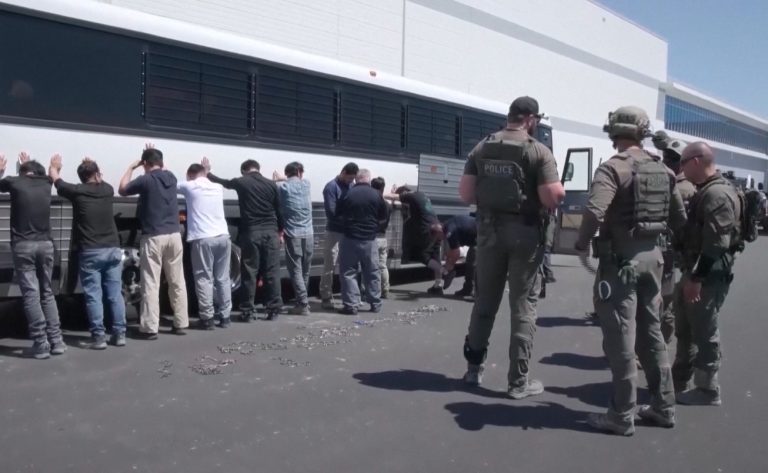
On Sept. 4, U.S. Immigration and Customs Enforcement (ICE) carried out a large-scale raid at a Hyundai facility in Georgia, detaining hundreds of South Korean nationals. The arrests came as the Trump administration is working with South Korea and other countries on major deals aimed at rebuilding and upgrading American industry.
The factory in Ellabell, Georgia, owned by South Korean companies Hyundai and LG Energy Solution, has more than 1,200 employees and has been producing electric vehicles (EVs) for over a year. The EV battery facility remains unfinished.
Out of the 475 foreign nationals arrested at Hyundai’s electric battery plant, more than 300 were South Korean, a spokesperson for the country’s government told NBC News.
According to a statement on Sept. 5 (Friday) by U.S. Attorney Margaret Heap, more than 400 agents took part in the raid, using a search warrant to sweep through the facility. ICE later said that those detained were working or living in the U.S. illegally.
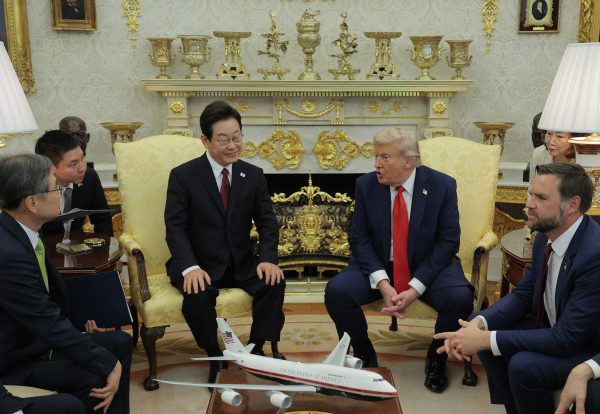
As part of trade negotiations with the U.S., South Korea has pledged hundreds of billions of dollars in investments. U.S. President Donald Trump in late August met with his South Korean counterpart Lee Jae-myung in the Oval Office, where the two had a cordial discussion and Trump thanked Lee for his country’s contributions.
Success
You are now signed up for our newsletter
Success
Check your email to complete sign up
While Trump initially said in comments on the Georgia raid that ICE was “just doing its job” to apprehend “illegal immigrants,” he has since added that foreign investment and talent are welcome, and that the U.S. government should “help them along” with the process of legally bringing in specialists to set up and run their industries.
While details remain limited, South Korean officials said Monday, Sept. 8 that the workers may have overstayed the 90-day limit of their temporary visa waivers.
On Sept. 10, Trump offered to allow the Korean workers detained during the ICE raid to remain in the U.S., but only one accepted the offer, according to South Korean officials. A chartered flight arranged by the South Korean government took the rest home on Sept. 11
Industrial concerns
The mass arrests have become the subject of controversy. Some applauded the move as showing the Trump administration’s commitment to enforcing immigration policy and preventing foreign firms from preferentially hiring non-American staff.
Others view the event as a damaging affront to Seoul — a key U.S. ally and the only major competitor to Communist China in the battery industry — while the alleged labor violations themselves are regarded as the result of a company working under pressure to avoid delays in the face of bureaucratic red tape.
South Korea is a major producer of cars and electronics, and its companies operate multiple factories in the United States. It is also a significant military power and key U.S. ally in the Asia-Pacific region, along with Japan and other countries.
In July, South Korea had agreed to to purchase US$100 billion in U.S. energy and make another $350 billion investment in the U.S. in return for lower tariffs.
According to the Financial Times, it has been an “open secret” that South Korean companies had used the B-1 visa to allow workers to enter the U.S., in addition to the Electronic System for Travel Authorization (ESTA) to accommodate their visits.
However, a senior South Korean official said these companies were put in an “impossible position,” pressured by successive U.S. administrations to invest billions in reviving American industry while being denied the short-term work visas needed to finish projects on schedule, the Financial Times wrote.
“The U.S. government is two-faced,” Chang Sang-sik, head of research at the Korea International Trade Association, told the Financial Times. “It is asking Korea to invest more in the U.S., while treating Korean workers like criminals even when it is well aware that they are needed for these projects to happen.”
Normally polarized between the right and left wings, the mass media in South Korea united to condemn the U.S. authorities’ treatment of their country’s citizens.
Footage from the raid shows workers at the factory put in handcuffs and chained, then marched to waiting buses where they were loaded in and taken away, prompting protests from Seoul and sparking anger among the Korean people.
Following the raid, the South Korean government expressed on Sept. 5 its “concern and regret” to the U.S. Embassy, requesting officials to safeguard the rights of the detained workers.
“In the course of U.S. law enforcement, the economic activities of our investment firms and the rights and interests of our nationals must not be unjustly infringed upon,” Lee Jae-woong, spokesperson for South Korea’s foreign ministry, said.
The raid became the Department of Homeland Security’s “largest ever” enforcement operation on a single site, Steven Schrank, special agent in charge of Homeland Security Investigations in Georgia, said.
Border czar Tom Homan told CNN’s “State of the Union” on Sept. 7 (Sunday) that there will be more efforts to raid workplaces of foreign workers.
“These companies that hire illegal aliens, they undercut their competition that’s paying U.S. citizen salaries,” Homan said.
Charles Kuck, a representative lawyer for the arrested workers, said the “vast majority” of the detained individuals were legally working under the B-1 business visitor visa program.
The B-1 business visa allows foreign workers to stay in the U.S. for up to six months, with expenses covered while paid from abroad. They may oversee projects but not perform labor, though contracts can permit equipment installation, said Los Angeles immigration attorney Angelo Paparelli.
Speaking to Rolling Stone, Tori Branum, Republican candidate for congress in Georgia, claimed she had started the raid by tipping off ICE about the Korean nationals working at the unfinished factory.
“How do I feel about it? Good.” she said. “I have no feelings about the law. What’s right is right and what’s wrong is wrong.”
READ MORE:
- ‘I am deeply concerned’: James Walkinshaw Highlights China’s Human Rights Abuses Ahead of Special Election
- US Proposes Stricter Visa Time Limits for Students, Exchange Visitors, and Journalists
- Rolling Thunder Audio: A Story of Resilience and Community Connection
Aftermath of the raid
South Korean Foreign Minister Cho Hyun traveled to Washington D.C. following the arrests to negotiate “voluntary” departures for the workers, seeking to avoid deportations that could bar them from returning to the U.S. for up to 10 years.
According to Kang Hoon-sik, chief of staff for South Korean President Lee Jae Myung, negotiations were finalized on Sept. 8, and a charter plane was sent two days later to bring the workers back to their country.
As of Sept. 10, the workers were being held at an immigration detention center in Folkston, located in southeast Georgia. South Korean media reported that they would be moved to Atlanta to board the plane.
President Trump, meanwhile, wrote on Truth Social, telling foreign companies investing in the U.S. to “please respect our Nation’s Immigration Laws.”
He has also said he would “look into the situation” and expressed confidence that U.S.-South Korean ties would not be damaged by the incident.
According to workers, officials, and lawyers, many South Korean employees were sent to the U.S. on questionable documents, despite concerns and warnings about stricter immigration enforcement ahead of the Hyundai raid, Reuters reported.
Some Koreans and Korean-Americans have seen the raid as a “betrayal” by the Trump administration, as a headline by the Atlanta Journal-Constitution reads.
“People are very upset about the incident, the arrest of the workers,” Ruby Gould, president of the Korean American Association of Greater Savannah, said, as report by AP. “I’m sure there are some people in fear about this visa situation after they witnessed what’s happened.”
In the suburb of Pooler in Savannah, Georgia, there had been significant growth of population and infrastructure following the Hyundai facility’s construction. According to Pastor Robin Kim, fewer Koreans were out shopping after the raid.
“The people feel like they’re being watched, like they’re being judged by the American people,” he said. “They are scared right now. They don’t want to be trouble.”
Leo Timm contributed to this report.