A new investigation by Financial Times claims that Iran’s Islamic Revolutionary Guard Corps secretly acquired advanced Chinese-made satellite communications equipment through a commercial network based in the United Arab Emirates, raising fresh concerns about sanctions evasion and military cooperation tied to Tehran’s drone and missile programs.
According to the report, the equipment was ultimately transferred to the aerospace division of the Islamic Revolutionary Guard Corps, a branch previously linked to attacks targeting U.S. military facilities in the Middle East. The development adds to escalating tensions among the U.S., Iran, and China.
RELATED: Trump Demands Six Muslim-Majority Countries Sign Abraham Accords as Precondition for an Iran Deal
Chinese satellite equipment routed through UAE
The Financial Times reported that commercial contracts, shipping documents, and satellite tracking data showed that approximately 1.8 tons of Chinese-made satellite antenna equipment were transported from Shanghai to Iran in late 2025 through the UAE emirate of Ras Al Khaimah.
A UAE-based company identified as Telesun allegedly helped facilitate the shipment, which reportedly passed through Dubai’s Jebel Ali port before arriving at Bandar Abbas in southern Iran. The equipment reportedly included a 4.5-meter motorized satellite antenna manufactured by Chinese company StarWin. Customs documents reportedly described the shipment as “antennas and accessories.”
Success
You are now signed up for our newsletter
Success
Check your email to complete sign up
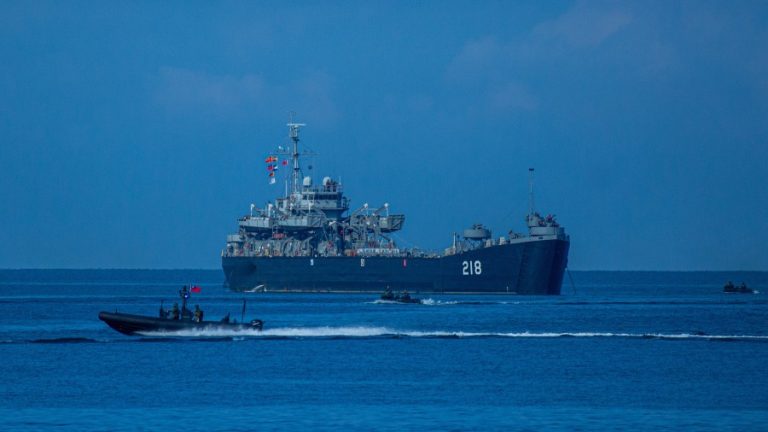
The Financial Times further reported that the Iranian vessel “Rama III,” which handled the final stage of transport, may have transmitted false GPS positioning data to conceal its actual route. Satellite imagery reportedly showed the ship near Shahid Rajaee Port in Bandar Abbas despite broadcasting misleading location information while traveling through the Persian Gulf.
Analysts cited by the newspaper suggested the vessel may have used so-called “spoofing” and other stealth techniques to evade tracking while traversing the area.
US-sanctioned entities tied to procurement network
According to the report, the equipment was ultimately delivered to an Iranian telecommunications company known as EFK, which was allegedly carrying out projects for the Saman Industrial Group.
The U.S. Treasury Department sanctioned Saman Industrial Group in 2023, accusing it of serving as a commercial front for the IRGC Aerospace Force’s Self Sufficiency Jihad Organization — a division allegedly involved in ballistic missile development, electronic warfare systems, and drone programs.
U.S. authorities have previously also accused Saman of using layers of intermediary companies to procure sensitive equipment, including satellite antennas, servo motors, and components that could support drone manufacturing.
The report also noted that the shipping company responsible for the Iran-bound transport, Blue Calm Marine Services, had already been sanctioned by the United States in 2023 for allegedly helping transfer missile-propellant-related materials to Iran’s defense sector.
Concerns over China-Iran military cooperation
The latest allegations come amid increasing scrutiny from Washington over the expanding strategic relationship between Beijing and Tehran. Last month, the IRGC Aerospace Force had secretly obtained access to a satellite launched by Chinese company The Earth Eye and allegedly used it to monitor U.S. military bases and Gulf infrastructure ahead of operations earlier this year, the Financial Times reported.
The U.S. imposed sanctions on The Earth Eye earlier this month and the State Department warned that Washington would continue holding Chinese entities accountable for supporting Iran’s military activities and cautioned that attacks targeting American personnel and allies “will not go unanswered.”
Some U.S. analysts argue that China has effectively become Iran’s most important economic lifeline and external strategic partner. Experts note that while Beijing does not want a full-scale Middle East war that could threaten energy supplies and global trade, China has simultaneously deepened commercial and technological ties with Tehran in ways that indirectly strengthen the Iranian regime.
Simmering tensions
In an April 30 analysis published by the Washington-based Foundation for Defense of Democracies, China program director Craig Singleton and analyst Jack Burnham described Beijing’s approach toward Iran as “opportunistic.”
According to the analysts, China views Iran as a useful anti-American partner capable of distracting Washington and complicating U.S. regional strategy, while Beijing simultaneously seeks to avoid direct confrontation with the United States.
The further report argued that China wants to prevent the collapse of the Iranian regime while also avoiding broader escalation that could destabilize the fragile U.S.-China trade truce and threaten Beijing’s broader geopolitical interests.
As tensions continue rising across the Middle East, the allegations are likely to intensify scrutiny over China’s role in enabling Iran’s military and technological capabilities through indirect commercial networks and sanctioned intermediaries.