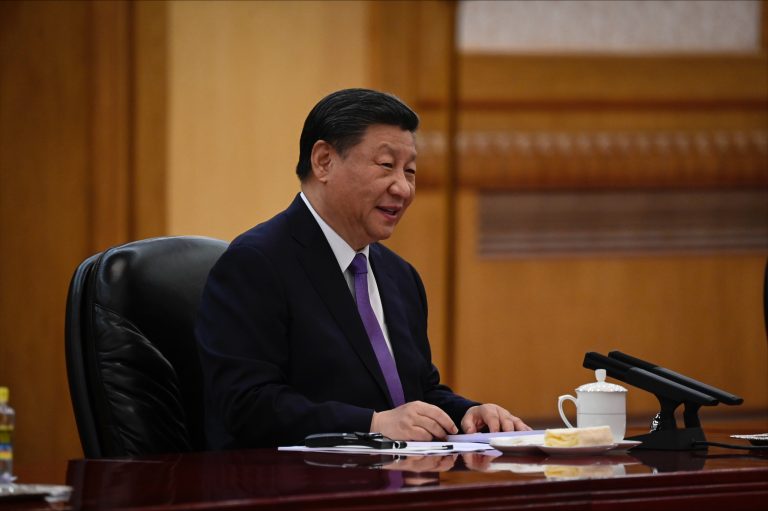
Recent reports claim that Chinese leader Xi Jinping narrowly avoided an explosion while attending celebrations in Xinjiang, despite extensive security measures. Observers say Xi appeared visibly shaken, with a pale complexion and unsteady gait.
Xi’s Xinjiang visit: Uneasy and unsteady
On Sept. 23, 2025, Xi led the central delegation to attend the 70th anniversary celebrations of the Xinjiang Autonomous Region. That day, he met with local representatives and senior military officers stationed in Urumqi, all of whom held ranks of colonel and above.
Footage aired by state broadcaster CCTV reportedly showed Xi walking slowly and with noticeable imbalance, his stride uneven and weight shifted to one side. During the military reception, his face appeared tense and swollen, lacking his usual composure, and he blinked frequently.
On Sept. 24, a user on platform X, “Political Arena (Battlefield) Observation Studio Zhaoming,” described Xi as “filled with worry, face darkened, stress lines prominent, sleepless at night, eyelids swollen to the point of difficulty opening.” The post also noted that Xi lacked the commanding presence he typically displayed, and that Vice Chairman of the Central Military Commission Zhang Youxia was absent — signaling a possible “gradual withdrawal” plan by the leadership ahead of the Fourth Plenary Session.
Reported explosion threat in Xinjiang
Du Wen, a former Inner Mongolia official now based in Europe, alleged on his social media program that Xi narrowly avoided an explosion while in Xinjiang. He explained that security was the primary concern during Xi’s visit. Authorities reportedly moved the celebrations forward to Sept. 25 — ahead of the official Oct. 1 anniversary — and implemented unprecedented measures: restricting civilian movement near key venues, cutting off internet and mobile networks, and deploying heightened security forces across the region.
Success
You are now signed up for our newsletter
Success
Check your email to complete sign up
According to Du, security services intercepted a plot to target Xi and the central delegation with explosives. This prompted the last-minute relocation of the celebration from the newly built Urumqi Olympic Sports Center to the Xinjiang People’s Hall. Originally planned outdoor parades and performances were canceled, and counterterrorism personnel were urgently deployed from across China.
Du noted that CCTV footage showed Xi walking nervously and with difficulty at the indoor celebration, suggesting he was visibly frightened. While the alleged explosive threat has not been confirmed by Chinese authorities, Du considers the information credible.
Historically, major anniversary celebrations in Xinjiang and other autonomous regions, such as Inner Mongolia, Guangxi, Ningxia, and Tibet, are typically held in large stadiums with outdoor parades and performances. Organizing these events usually begins years in advance. For the 70th anniversary in 2025, Xinjiang authorities had constructed the Urumqi Olympic Sports Center, a 305,000-square-meter modern facility with a total investment of 3.8 billion RMB, intended to host large-scale celebrations. The last-minute shift indoors due to security concerns reportedly embarrassed local officials, who had invested heavily in preparations.
According to Du Wen, the Xinjiang government had hoped to showcase a “harmonious, beautiful, happy, and safe new era in Xinjiang” to the world through live broadcasts of the anniversary celebrations. Instead, the alleged explosion incident exposed serious security vulnerabilities.
Du noted that Xi Jinping’s so-called “iron-fist” approach in Xinjiang has not made the region safer; rather, it has heightened the perception of risk and instability.
U.S.-based commentator Tang Jingyuan observed that those seeking to harm Xi are likely far more numerous in Xinjiang than in Tibet, due to the region’s network of so-called “re-education” camps for over a million Uyghurs. Tang noted the widespread suffering, including allegations of organ harvesting and destroyed families, which have fostered deep resentment toward Xi and the Chinese Communist Party (CCP).
Tang also pointed out that Xi’s personal visits to Tibet and Xinjiang are historically unusual. Party leaders rarely travel in person to such sensitive regions, due to inherent risks. For a man in his seventies, Tibet carries risks of high-altitude sickness, while Xinjiang presents potential security threats, including explosions. Yet Xi has repeatedly broken precedent by attending events in both regions.
Tang interpreted this pattern as a deliberate move by the CCP’s top leadership to “expose” Xi publicly. By putting Xi front and center, he becomes the symbolic figure responsible for any failures or controversies. Once the leadership transition occurs, new officials can assume power with minimal personal risk, while Xi bears the blame for past actions.
By Deyan Li, Janet Huang