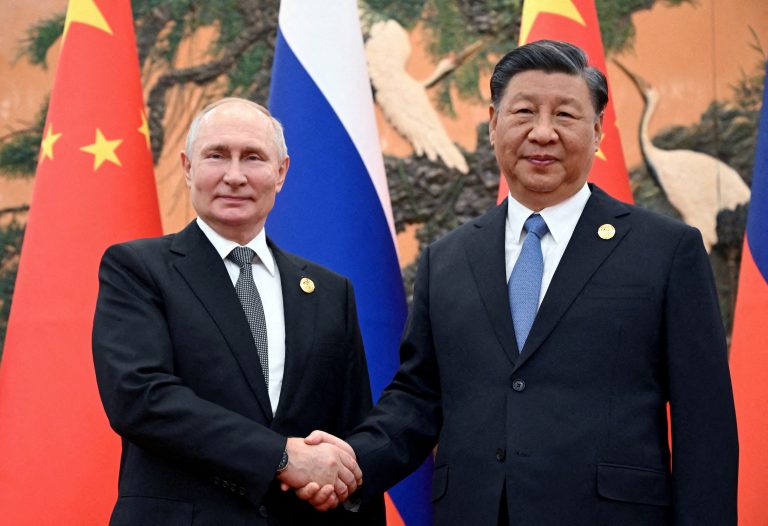
Independent commentator, Edward Wenming, recently discussed how Chinese Communist Party leader Xi Jinping has fallen from once being widely supported, to becoming isolated and besieged both domestically and internationally—racing headlong down what many describe as a self-destructive path. The following are highlights from his remarks.
“Hello friends, I am independent commentator Edward Wenming. On the surface, Xi Jinping’s recent trip to Xinjiang appeared grand, but it could not hide the underlying reality of illness, anxiety, and desolation—nor the clear decline in respect and obedience from his subordinates.
Xi once enjoyed moments of glory, inheriting the absolute power of the CCP mafia along with the immense legacy of forty years of reform and opening. Even if he had taken only a tenth of that wealth to provide universal pensions and welfare healthcare, China could have become a nation with one of the highest happiness indexes, and Xi himself could have become a leader admired by millions.
So what drove him to refuse to spare even a hair for the people’s livelihood? How did he go from being once widely supported, to abandoned by allies, and eventually besieged by the world—charging recklessly down this path of self-destruction?
Xi reduced to a beaten dog
Online whistleblowers revealed that to mark the 70th anniversary of Xinjiang’s founding, a grand gala was originally scheduled to take place at the newly built Urumqi Olympic Sports Center, a venue constructed at great cost for the occasion. However, after security services reportedly uncovered a plot to carry out a bombing attack during the event, the plan was abruptly canceled. Instead, the celebration was moved indoors to the Xinjiang People’s Hall—a humiliating downgrade that many saw as the bitter fruit of Beijing’s endless “stability maintenance” spending. CCTV footage showed Xi Jinping walking in a hurried, uneasy manner. As users on X (formerly Twitter) described, Xi appeared haggard and heavy-hearted: his face gloomy, his brow furrowed, his skin sallow, with deep worry lines etched across his features. His swollen eyelids barely opened, suggesting sleepless nights stretched over many days.
Success
You are now signed up for our newsletter
Success
Check your email to complete sign up
Xi’s trip to Xinjiang mirrored the arrangements of his visit to Tibet earlier in August. Although state media claimed Xi was leading the delegation, the official head was in fact Wang Huning. Even after traveling thousands of miles to attend the anniversary event, Xi did not deliver a speech—he merely showed up, which struck many observers as highly unusual.
Just like his Kunming trip in March and the Tibet visit in August, Vice Chairman of the Central Military Commission Zhang Youxia was absent—marking the third time in a row he did not accompany Xi. Looking back at past official reports, Xi almost always inspected military units on domestic trips, with at least one vice chairman of the CMC in tow. For example, in July 2021, Zhang Youxia personally accompanied him on a visit to Tibet.
The second broken convention relates to Zhang Youxia’s waning displays of respect for Xi. Coverage of Xi in military newspapers and magazines has clearly toned down. While the titles “Chairman Xi” and token pledges of loyalty like “Two Upholds, Four Consciousnesses, Four Matters of Confidence, Two Safeguards” still appear, the overall tone now feels perfunctory, even dismissive. Notably absent are slogans such as “implementing the system of the chairman of the military commission,” and at public events Zhang attends, ritualistic declarations of loyalty to Xi have been conspicuously missing.
Even more striking, the PLA Pictorial has not featured Xi Jinping on its cover for five consecutive months, from April to the most recent August issue. This is highly unusual: ever since Xi consolidated absolute authority at the 19th Party Congress, the military’s flagship magazine consistently showcased images of him speaking at major events, as a way to signal that “the PLA listens to Chairman Xi.” Only in rare cases would another figure take the cover. The sudden disappearance of Xi’s image is widely seen as a telling sign of his declining authority.
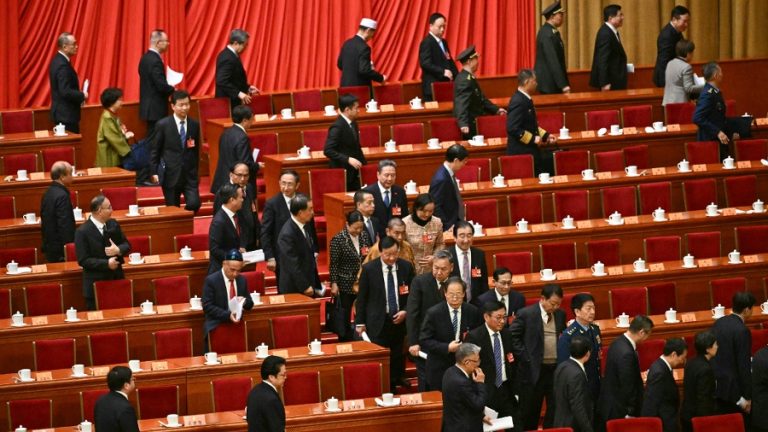
During Xi’s inspection tour in Xinjiang, the body language of senior official Wang Huning appeared unusually defiant. In the CCP’s political culture, standing with hands clasped behind the back, chest out, and head raised while speaking is a posture reserved for the top leader—used by figures such as Xi Jinping or Kim Jong Un. Subordinates are expected to keep their hands to the side or folded in front as a gesture of respect.
Yet state media photos showed Wang standing with his hands behind his back directly in front of Xi, even as Xi raised his hand while speaking—making it look as though the roles had been reversed. In another shot, Wang appeared to wave his hand at Xi in admonishment, still with hands behind his back and a scrutinizing gaze—an outright breach of protocol. In yet another venue, Wang again listened to Xi with his hands behind his back. Compared to his previously deferential manner during Xi’s public outings, Wang’s shift was striking.
The images suggest that Wang Huning was openly showing disdain for Xi Jinping. Commentator Tang Jingyuan argued that the only explanation is that Xi has already lost real power, reduced to playing the mere role of an “actor,” while Wang no longer regards him seriously.
Tang noted that if one listens only to the CCP’s official propaganda, the conclusion is simple: Xi still holds supreme power. But a closer look at the subtle clues inadvertently revealed in official media and elite behavior tells a very different story—perhaps the real truth.
Xi Jinping breaks the CCP mafia’s rules
When Xi Jinping rose to power in 2012, fortune seemed to favor him. Hu Jintao and Wen Jiabao stepped down quietly, removing elder interference and clearing the path for Xi to consolidate authority. Though corruption was rampant, the CCP still sat on the deep reserves of over three decades of reform and opening.
Xi had powerful allies: Wang Qishan in the Party apparatus, Liu Yuan in the military, and the Ye family in intelligence and local governance. By around 2014, Xi had achieved near-total control. At that time, he enjoyed broad popularity and seemed unstoppable, basking in what many called his political “golden hour.”
Yet, once secure at the top, Xi unleashed a series of political maneuvers that shattered the mafia-style rules of the CCP. His governance choices soon pushed China into mounting domestic and international crises.
The CCP, at its core, functions as a mafia-style organization with unwritten codes and internal rules. In the 1980s, Deng Xiaoping pushed for a two-term limit (five years each) for the presidency, aimed at preventing a return to Mao’s one-man dictatorship and lifelong rule. This principle was seen as a cornerstone of the CCP’s “gang rules,” reinforcing collective leadership and regular succession. But in March 2018, Xi orchestrated a constitutional amendment scrapping term limits, tearing down Deng’s safeguard against lifetime rule. At the 20th Party Congress in 2022, Xi further broke the Party’s conventions: at 69, he secured a third term, retained multiple over-aged loyalists such as Wang Yi (then 70), while forcing out figures like Li Keqiang and Wang Yang despite their eligibility. Li Keqiang soon died under suspicious circumstances, while Hu Jintao was forcibly escorted out of the congress hall in front of the world’s cameras. Afterward, the Politburo Standing Committee was stacked almost entirely with Xi’s own loyalists—the so-called “Xi Family Army”—obliterating the factional balance of power that once defined CCP leadership.
Belt and road cash handouts and domestic failures: Squandering China’s wealth
Looking back on Xi’s 13 years in power, many online commentators say his greatest blunder was the three-year “Zero-COVID” lockdown campaign. Under his rule, the coronavirus escaped from Wuhan’s virology labs and spread disaster across the globe, killing and injuring countless people. Xi tried to shift blame onto the U.S. military, but the world was unconvinced.
Then came his arrogant belief that “man can conquer nature.” For three years, his draconian Zero-COVID policy trampled on the rights of 1.4 billion Chinese citizens, crushing the nation’s economy. Once the engine of growth was forcibly shut down, restarting it proved harder than climbing to the heavens. China’s economic decline has only deepened ever since.
There were also the toxic vaccines. Although they were not developed by Xi himself, they were personally directed and overseen by him, and their rollout and spread took place under his rule. After 2020, China’s main COVID-19 vaccines—Sinopharm and Sinovac—proved largely ineffective, while causing serious side effects: blood clots, TTP, kidney inflammation, and the notorious “white lung” syndrome leading to respiratory failure and death (officially blamed on “virus mutations”). Rates of cancer and leukemia spiked among 20- and 30-somethings, with excess deaths far above expectations.
Crematoriums, once serving mostly the elderly, became crowded with the bodies of young people in their 20s and 30s. The entertainment industry alone saw the sudden deaths of numerous well-known figures. In the eyes of many, Xi’s policies claimed more lives in absolute numbers than even Mao Zedong. Mao’s policies killed or starved 80 million people, but over decades. Xi’s disasters were concentrated in just three years—and this time, with the “help” of high technology.
The weight of bloodshed has become unbearable, and retribution has been severe. On July 15, 2024, during the Third Plenary Session, Xi Jinping suffered an unexpected stroke and cerebral thrombosis, collapsing into a coma for two months. When he finally awoke, the world around him had changed—his power had slipped away. To many observers, it seemed nothing less than the hand of divine justice at work.
Xi Jinping’s second major mistake has been the Belt and Road Initiative and the Xiong’an New Area. Marketed as grand international projects, they drained vast sums of money and effectively squandered the economic gains that China had built up over four decades of reform. The costs were staggering. Analysts note that even a fraction—just one-fifth—of the money spent could have funded universal pensions and healthcare, laying the foundation for a far more prosperous China.
Anyone who has lived overseas for some time will notice the difference: in Europe and America, people live with ease, unhurried and unburdened by a desperate urge to make money. Why? Because they enjoy universal pensions and healthcare. They don’t worry about starving in old age or being bankrupted by illness. By contrast, the anxiety level in China is overwhelming. The drive to earn money is relentless, life feels suffocating. Even in Thailand, Malaysia, and Vietnam, universal pension and healthcare systems exist. Why can’t China—after forty years of reform and opening, and with such a massive economic foundation—achieve the same?
The answer, critics say, is simple: first, malicious leaders are unwilling to do good, and second, the money has been wasted, squandered abroad to play the role of a big spender. China could have easily overcome the middle-income trap faced by developing nations. The country had already amassed enormous wealth, achieved near full employment during globalization, and dominated global supply chains without serious competition. With such advantages, simply establishing universal pensions and healthcare would have naturally boosted national happiness and built a solid foundation for domestic consumption. This in turn could have created a massive internal market to complement China’s export-driven economy—one capable of surpassing even the U.S. market. As observers note, former President Trump’s ability to strike down one rival after another came largely from America’s domestic market power: Washington could make or break nations simply by deciding whom to trade with. Had China built such systems, many argue, its internal market could have outgrown America’s within three years. After all, China already had the “world’s factory” status and the GDP base in place.
So why didn’t it happen? Because the money was squandered. Funds were poured into Africa, Cambodia, Myanmar, and Southeast Asian industrial zones. And worst of all, Xi Jinping impulsively launched the Xiong’an New Area, sinking trillions of yuan into what has become nothing more than a desolate graveyard of unfinished construction.
Why? Simply put, Xi Jinping is both stupid and malicious. Much of this, critics argue, traces back to his upbringing and family background. His father, Xi Zhongxun, was a ruthless man. At age 14, Xi Zhongxun allegedly took part in a plot to poison a teacher accused of being “counterrevolutionary.” The plan failed, but several teachers fell gravely ill. By the age of 20, Xi Zhongxun had already been imprisoned twice and even wounded by gunfire. Far from a “normal” figure, Xi Zhongxun was described as a killer, thug, and juvenile delinquent. True to the saying “like father, like son,” Xi Jinping appears to have inherited this legacy of brutality in his very genes. During the Cultural Revolution, Mao Zedong accused Xi Zhongxun of harboring ambitions to seize supreme power, sidelining him for 15 years. And indeed, those ambitions existed—and were passed down to his son. Reportedly, Xi Jinping once said in his youth that “to be a real man is to be a man like Mao Zedong.” After taking power, Xi declared, “thirty years east of the river, thirty years west—now it is my turn.” He viewed his ascent to supreme leadership as repayment of a debt owed to his father by the Communist Party. Once in charge, Xi fully embraced Mao Zedong’s playbook of purges and repression, but with even greater cruelty. Commentator Du Wen argues that Xi, having personally experienced his family’s persecution through wrongful accusations, now seeks revenge by inflicting countless wrongful cases upon others—against the Party itself and against society at large.
According to Du, Xi is not a normal person but one suffering from severe psychological disorders. He is a historical aberration: crushed into the depths of hell by the Party system, only to be elevated by the same system to its pinnacle. His father’s humiliation, his sister’s suicide, his mother’s public struggle sessions, his youth spent in juvenile detention, hunger, despair, cold floors, and chants of “Down with Xi Jinping”—these were not the makings of a loyal Party soldier, but the forging of a vengeful figure cloaked in red, consumed by hatred.
Xi Jinping is not a student of Mao Zedong so much as a mutated offspring of Mao’s totalitarian logic. He is more reclusive, more paranoid, and more ruthless than Mao himself. Whether Xi rules out of a personal desire for revenge is something outsiders may never fully know. But the nickname widely given to him—“the Accelerator-in-Chief”—is no exaggeration. Xi has been propelling the Chinese Communist Party, already steeped in crimes, into becoming a global enemy, ever more isolated on the world stage.
Thus, when a person is young and their worldview is taking shape, the most important lesson is to learn to be human first. Had Xi Jinping possessed even a shred of compassion for the people—thinking beyond his own lust for power—the Chinese people would not be suffering so miserably, and his own fate would not be turning so grim. A bad man can only bring harm to others and to himself; only a person of conscience can both benefit others and secure his own well-being.
Xi Jinping’s third major mistake has been his approach to the Russia-Ukraine war. He chose to back Moscow with what state media described as “unlimited support,” a move that has left China more isolated than ever. Ironically, Russia—China’s supposed ally—has historically done more damage to China than any other country. Since 1949, it has seized more Chinese territory than anyone else. In modern history, it was Russia, not Japan, that killed the most Chinese and forced the largest territorial concessions. By aligning with Vladimir Putin, often described as a warmonger and war criminal, Xi has revealed what critics call a dangerous mix of ignorance and shortsightedness. His choice has soured relations with Ukraine, left China diplomatically cornered, and deepened its isolation. At home, public morale is collapsing, trust in the military is fading, and Xi’s leadership looks increasingly like a failing student’s report card—full of red marks, unfinished projects, and failures. Observers say Xi’s record of wasted wealth and failed policies is already beyond reckoning. Now, he himself faces a tragic fate, abandoned both by the people and, as some put it, by “heaven.” Many conclude that only the dismantling of the CCP can prevent China’s further decline.
Views expressed in this article are the opinions of the author and do not necessarily reflect the views of Vision Times.