The Chinese Communist Party’s disciplinary agency announced on July 15, 2026, that Cai Fuchao, a former deputy head of the Central Propaganda Department who also served as party secretary and director of the State Administration of Press, Publication, Radio, Film and Television, is under investigation for “suspected serious violations of discipline and law,” the Party’s standard formula for a corruption purge.
Cai retired in 2018. His fall eight years later has drawn wide attention, and accounts now emerging from inside the propaganda system describe how it happened. Colleagues and associates reported him en masse, and the case against him is expected to move beyond money to the political charge that he was a “two-faced person,” Party jargon for an official who professes loyalty while privately defying the leadership.
Insiders say corruption is only the opening charge against Cai Fuchao
Word of the investigation moved through the broadcast bureaucracy before the public announcement. A Mr. Li, described as an insider in China’s broadcast system, told the overseas Chinese-language outlet The Epoch Times that staff at the National Radio and Television Administration learned on July 14 that the disciplinary agency was about to announce the case and that meetings were being convened for officials to declare their support.
By Li’s account, the talk inside the system holds that Cai’s problems go beyond ordinary graft. Cai held approval power over the industry and is said to have taken large sums around project funding and license issuance, while installing his own people to control procurement and placing loyalists in cultural publishing and at China Central Television, the state broadcaster. The next step, Li said, is to expose him as a “two-faced person” who executed central directives poorly and was “disloyal to the Party.” For eight years nothing touched him, Li observed; the moment his name was called, the problems all surfaced.
A source in the propaganda system added that several months ago, the disciplinary agency abruptly received multiple anonymous complaints accusing Cai of using his broadcast-system power for profit, centering on “political disloyalty” and abuse of propaganda approval authority.
Success
You are now signed up for our newsletter
Success
Check your email to complete sign up
A veteran media figure, a Mr. Cheng, pointed to a specific revenue stream. Cai took charge of the press and broadcast regulator in 2013, exactly when South Korean dramas and performers were at their peak in the Chinese market, and he is said to have collected payoffs around the import and approval of Korean film and television. Middlemen who felt shortchanged resented him for it, complaining that he ate the meat and left others the soup, and still others reported him for keeping the spoils to himself.
Cai’s career ran through the top of the propaganda system. He served as Beijing party committee propaganda chief from 2002 to early 2011, then as deputy head of the Central Propaganda Department from February 2011, running the broadcast regulator and its successor agency through September 2016, along with the National Copyright Administration.
Cai Fuchao’s patron network runs from the Jiang faction to Wang Qishan
Cai Shenkun, an independent Chinese commentator based in the United States, wrote on X on July 16 that Cai Fuchao’s entire political life ran through the Beijing and central propaganda systems, and that he has long been regarded as an important member of the political camp of the late Party leader Jiang Zemin.
The list of his patrons bears that out. During Cai Fuchao’s years as Beijing’s propaganda chief, the city’s leadership included Jia Qinglin, the Politburo Standing Committee member who chaired the Party’s advisory body, and Liu Qi, the Politburo member then serving as Beijing party secretary. After moving to the central propaganda apparatus, Cai Fuchao worked under Liu Yunshan, the Jiang camp’s key representative in the propaganda system, and later under Liu Qibao, a clear representative of the rival Communist Youth League faction.
Jia Qinglin’s protection mattered at a decisive moment, the commentator noted. When Wu Xiangzhong, a deputy editor-in-chief of the Beijing Daily whom Cai Fuchao had promoted, was investigated for corruption, Cai Fuchao was implicated, and it was Jia who shielded him through it. His 2011 promotion to run the national broadcast regulator, with a seat on the Party’s Central Committee, marked the leap that made his later career.
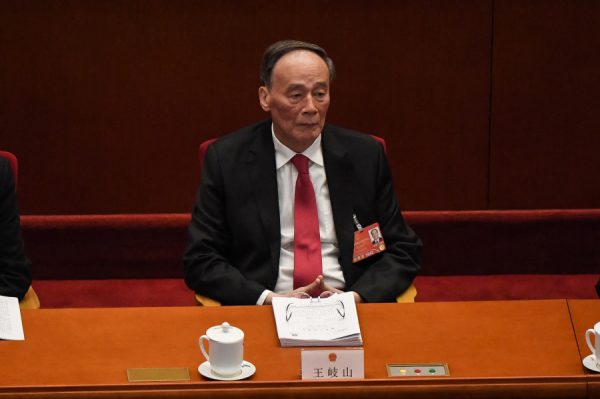
Wang Qishan’s connection runs through the same Beijing years. While Wang served as the city’s mayor in the mid-2000s, Cai Fuchao sat on Beijing’s party standing committee as propaganda chief and took on a concurrent post as vice mayor. Some observers count Cai Fuchao among Wang’s old subordinates, a connection that places his fall inside the ongoing dismantlement of Wang’s network, which has already claimed the former vice president’s closest aides, including his longtime secretary Zhou Liang and inspection-office chief Li Xiaohong.
READ MORE:
- Beijing Installs a Former Spy Official as Political Watchdog Inside Its Foreign Ministry
- Why Do Some Chinese Immigrants in America Still Answer to Beijing?
- China’s Article 63 Sparks Debate Over the Global Reach of Beijing’s Ethnic Unity Law
Cai’s fall extends a propaganda system purge that has run since 2013
Cai Shenkun offered two readings of why a man retired for nearly a decade would suddenly fall. From the Party’s official standpoint, the case demonstrates the machinery Beijing has built in recent years: retirement confers no immunity, investigations dig backward through past tenures, and the “anti-corruption” drive claims no zone is off limits.
The political reading goes further back. Since Xi Jinping took power, the propaganda system has been a standing target of rectification. The purge opened in 2013 with the fall of Li Dongsheng, a former vice president of China Central Television, and widened into the “CCTV nest case” that consumed a string of broadcast officials and on-air personalities, including Guo Zhenxi, Li Yong, Liu Wen, Ye Yingchun, and Rui Chenggang. Cai Fuchao himself gave up the broadcast regulator in 2016, handing it to then-CCTV chief Nie Chenxi, and by early 2018 Xi had installed his trusted media associate Shen Haixiong atop the state broadcaster, completing a deep reshuffle of the propaganda apparatus.
Against that background, the investigation of Cai Fuchao, who long controlled the Party’s press, publishing, broadcast, and film-rights resources, reads as the purge’s further extension into the pre-Xi propaganda elite. A further claim ties him to the purge of the military leadership as well. Cai Shenkun disclosed on his program that, by one account, Cai Fuchao’s son served as a go-between carrying messages between Zhang Youxia, the purged vice chairman of the Party’s top military body, and Wang Qishan. That claim cannot currently be verified.
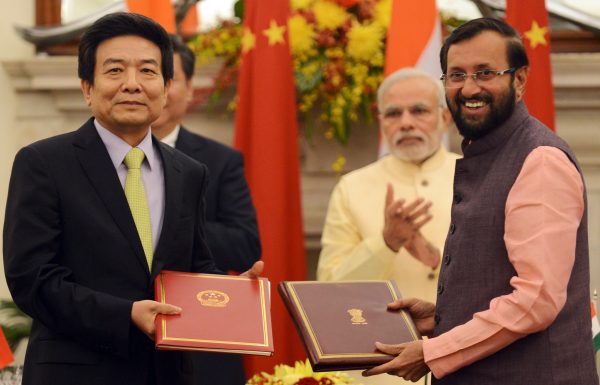
Cai Fuchao participated in the persecution of a Falun Gong practitioner
Cai Fuchao’s record includes direct participation in religious persecution. According to Minghui.org, the U.S.-based website that documents the persecution of Falun Gong, Cai Fuchao took part, during his years as a Beijing vice mayor, in the abduction of Falun Gong practitioner Han Yuheng and his persecution through the forced labor system.
Han was the director of the teaching research office of the education bureau in Qinhuangdao, a city in Hebei province, a backbone teacher recognized as one of the province’s outstanding teaching researchers, and the holder of multiple provincial and municipal honors.
The World Organization to Investigate the Persecution of Falun Gong, an overseas group that tracks perpetrators, had previously issued a notice placing Cai Fuchao under investigation.