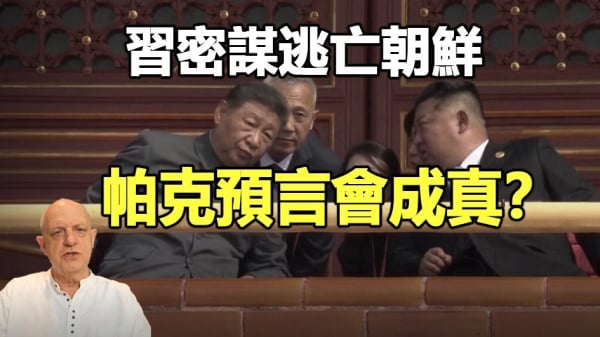
Recent leaks suggest that Chinese leader Xi Jinping is preparing several contingency plans in case of a failed power struggle, with reports indicating he may have three potential escape scenarios. From Sept. 27-30, North Korean Foreign Minister Choe Son-hui visited Beijing at the invitation of Chinese Foreign Minister Wang Yi. This marks Choe’s second visit to China within a month. But now commentator Xiao Shuojia claims that aside from the public narrative of China–North Korea friendship, Choe’s visit allegedly included extremely sensitive back-channel discussions.
The talks reportedly focused on the possibility of Xi fleeing to North Korea if an emergency situation arises around the Fourth Plenary Session of the 20th Central Committee. Sources claim the issue was once again raised after the Sept. 3 military parade held in Beijing’s Tiananmen Square.
RELATED: From Divine Favor to Forsaken by Heaven: Xi Jinping’s Road to Ruin
Why North Korea and not Russia?
The leak states that Xi also considered fleeing to Russia but deemed it “too risky.” If he were forced into exile in Russia, President Vladimir Putin, who’s preoccupied with the war in Ukraine, would face a dilemma regarding Chinese military support: Return Xi to China, risking accusations of betrayal, or shelter him, potentially compromising Russia’s own military position. Due to this uncertainty, Xi reportedly sought a safer alternative via North Korea.
North Korea offers several advantages:
- Geographical proximity: North Korea is the closest sanctuary to Beijing, allowing rapid evacuation via air, land, or sea. Past incidents, such as Lin Biao’s failed escape, have made Xi cautious about northern routes.
- Political security: Unlike Russia, which is under international scrutiny and dependent on Chinese support, North Korea is independent, nuclear-armed, and less constrained by international pressure. The leak notes that Xi reportedly gave Kim Jong-un $100 million as an “appearance fee” during the Sept. 3 parade, strengthening their personal rapport.
High stakes for Xi
Success
You are now signed up for our newsletter
Success
Check your email to complete sign up
The upcoming Fourth Plenary Session slated for October is reportedly critical for Xi, who’s reportedly focused on economic issues, but in reality seeking a venue to discuss succession and power transition. Leaks suggest Xi may relinquish two positions while retaining the presidency, potentially leading to the collapse of the “Xi faction” and exposing him to political purges.
The leaked discussions reportedly cover multiple aspects, including:
• Escape routes: Air, land, and sea evacuation plans.
• Political treatment in North Korea: Xi’s status and protection after arrival.
• Economic guarantees: Potential financial arrangements or concessions to North Korea.
• External messaging: How to explain Xi’s flight to the international community.
The reports portray a high-stakes environment where Xi is actively preparing for worst-case scenarios, highlighting the intense power dynamics and security concerns surrounding China’s upcoming political meetings. Recent reports also suggest that if Xi’s escape route to North Korea is fully secured, he could adopt a tougher stance at the upcoming Fourth Plenary Session, effectively using “retreat to advance” as a strategy.
According to sources, the leak of this information is also meant as a warning to anti-Xi factions: Xi has alternatives — Russia or North Korea — signaling that he is not without options. This is seen as a direct message to his political opponents, a form of “pre-emptive” counterstrike ahead of the plenary session.
Another insider revealed on social media that plans for Xi to step down at the Fourth Plenary Session have reportedly already been verbally communicated to Central Committee members. Former leader Hu Jintao is said to have advised that the adjustments to the plenary leadership are “necessary measures,” and all positions being reshuffled are temporary appointments, to be formalized at the 21st Party Congress.
The leak also claims that Wang Yang is set to serve as acting General Secretary. All four major factions allegedly support Wang, making his transitional leadership non-threatening. Potential candidates for acting Premier include Wang Yang, Hu Chunhua, Chen Jining, and Yuan Jiajun, with Hu Chunhua considered the most likely.
MORE ON THIS: Major Developments in Beijing: Troop Convoys Enter the Capital as Premier Li Qiang Announces ‘Wang Yang Returns’
Tensions simmering
South Korean media reports indicate that Xi was originally scheduled to visit South Korea from Oct. 31-Nov. 1 for the APEC summit in Gyeongju. To ensure his security, the Chinese Embassy in Seoul reportedly booked the entire Shilla Hotel. However, this led to controversy after the hotel unilaterally canceled eight weddings affecting hundreds of guests to accommodate Xi’s stay. While the hotel cited a “state-level event,” no further details were provided, and public speculation quickly linked the cancellations to Xi’s visit.
The incident reignited criticism in South Korea after activists targeted President Yoon Suk-yeol for being “pro-China,” and prompting outrage that ordinary citizens’ weddings were sacrificed to accommodate the Chinese leader’s stay. Since last year, South Korean citizens have staged large protests against perceived “pro-China policies” by tearing up Xi’s portraits and Chinese flags to express opposition to Beijing’s growing influence in the country.
Amid rising protests from South Korean citizens, the Chinese Embassy in Seoul abruptly canceled its lease of the Shilla Hotel in late September. The hotel subsequently announced that scheduled weddings could proceed as planned. Notably, the forced cancellation of Xi’s hotel stay is unprecedented in the history of China-South Korea diplomatic visits.
While Chinese leaders have previously faced protests and resistance in South Korea, the Shilla Hotel has traditionally been the preferred accommodation for visiting Chinese officials. Analysts suggest that this sudden cancellation may be linked to political turbulence trickling down from the top of China’s leadership.
The Fourth Plenary Session of the Chinese Communist Party is scheduled for Oct. 20–23, just a week before the APEC summit. Given intensifying factional struggles among senior officials, observers speculate that the plenary session could have critical implications for Xi Jinping’s political standing. Any perceived weakening of his authority could introduce further uncertainty into his planned visit to the Gyeongju APEC Summit.
U.S.-based political commentator Chen Pokong noted that while the meeting is publicly-framed as an economic gathering centered on improving the country’s infrastructure and real estate sectors, its true focus is personnel arrangements, including the trajectory of Xi’s power and potential succession plans.
Prophecies and predictions
An old Chinese proverb says: “Man proposes, Heaven disposes.” No matter how formidable past regimes may seem, history has shown that political collapse can occur overnight. Predictions regarding the CCP’s fate have circulated for years, including ancient texts like “Tui Bei Tu” and the poems of Huangbo Chan Master, which foretold the party’s demise in the Year of the Snake, 2025.
British clairvoyant and prophet Parker also predicted on Nov. 4, 2023, that China would face a second revolution, attributing it in part to Xi Jinping’s declining health. Parker warned that internal divisions within the CCP could trigger enough turmoil to unseat Xi. In repeated forecasts, Parker predicted the eventual collapse of the CCP and the fragmentation of China into multiple states, including the liberation of Hong Kong and Tibet. He emphasized that only when the lies of communism are exposed will China have a real path forward. Parker added that these events could occur in 2025.
The warning is clear: the end of the CCP may be imminent. Viewers are urged, if they have not yet formally withdrawn from the Party, Youth League, or Young Pioneers, to do so immediately. According to this perspective, the CCP is sustained by its members, and when it falls, those who align with it will share in its fate.
By The Third Eye, Janet Huang
For those wishing to formally declare their withdrawal via email, please kindly send requests to: [email protected]