A wave of rumors emerging online suggests that Xi Jinping and Cai Qi could be forced into retirement due to “age constraints,” sparking intense speculation across Chinese and international media. The leaks go further, claiming Xi and military leader Zhang Youxia are now locked in bitter conflict. Analysts warn that Hu Jintao’s effort to preserve Party stability by replacing Xi through internal processes is nearly futile. Zhang and his allies are portrayed as having no exit—caught between loyalty and annihilation. If Xi is permitted to hold power until the 21st National Congress, many believe he will use the time to flip the balance in his favor.
A hidden threat from the elders
Political commentator Tang Jingyuan points to a series of leaks indicating the CCP’s elder statesmen may already be preparing a secret censure session against Xi—in case he attempts a dramatic backlash. One leak reportedly states that Cai Qi was the only major figure who did not defect to publicly criticize Xi.
Xi’s canceled trip to North Korea added fuel to the speculation: protocol would have transferred the duty to Cai Qi, but when Cai Qi also did not attend, Li Qiang was dispatched as a substitute. Tang comments, “Multiple independent sources reveal a consistent narrative: Xi and Cai are two grasshoppers on the same strand, both destined to fall.”
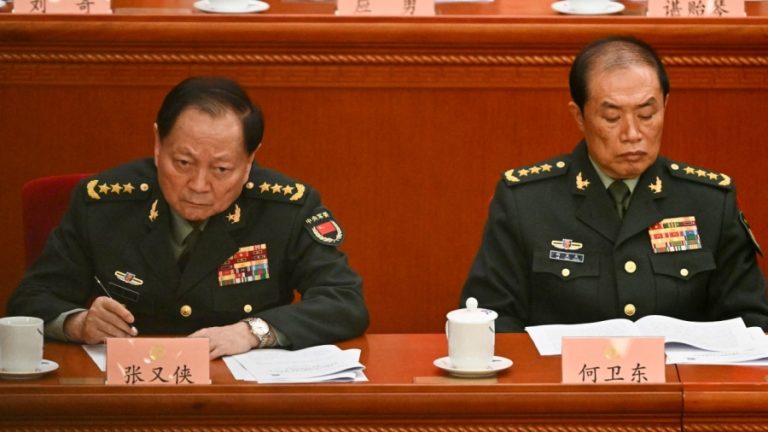
Leaked accounts also claim that Xi and Zhang Youxia’s personal rift has escalated into mutual hostility. During the recent party sessions, observers say Zhang publicly turned his back on Xi, signaling that the division between them may have long become irreconcilable. Since last year’s third plenary session, Zhang has largely appeared in separate events, only briefly sharing a platform after the September military parade.
At China’s 2025 National People’s Congress, a widely circulated screenshot appearing in closing ceremonies reportedly shows Zhang facing away from Xi—without acknowledging his presence.
Success
You are now signed up for our newsletter
Success
Check your email to complete sign up
Tang suggests that Zhang’s purge of Xi’s military loyalists is already underway, with death sentences, detentions, and disappearances rumored to be part of his strategy to consolidate control. In his view, more than a power struggle, Xi and Zhang now confront each other as existential adversaries.
Xi’s extended tenure: The calculated gamble
Insider leaks suggest Xi may remain in power until the 21st Congress before handing over authority. Tang argues this arrangement aligns with the elders’ desire to maintain stability while shielding the system from open turmoil.
“If Xi stays until then,” says Tang, “he can manufacture a comeback at any moment—perhaps triggering a crisis to seize military control.” He notes that preventing Xi’s trip to North Korea may have avoided setting a pretext for such a move. Had Xi traveled, he might have brokered covert deals or provoked incidents enabling him to reassert command as military chief.
Tang draws parallels to Deng Xiaoping’s maneuver to sideline Hua Guofeng via the Vietnam war: using conflict to justify the transfer of military authority. He warns that in the Taiwan Strait, South China Sea, or Korean Peninsula, any orchestrated event could serve Xi as justification for reclaiming power.
“If Xi currently holds symbolic authority but lacks actual control, dragging out the transition only magnifies his advantage,” Tang says. “Every day increases volatility—every day offers him another chance to turn the tide.” He adds that many leaks calling for Xi to stay till the Congress are likely being seeded by Xi’s own faction to serve his strategic interests.
If Xi successfully stage-manages a resurgence, elder leaders may quietly retire under the cover of obscurity. But for Zhang Youxia, Liu Yuan, and allied generals like Zhang Shengmin and Liu Zhenli, failure may be fatal. In failed insurrections, rebelling military figures rarely survive.
Hu Jintao’s balancing act: Preserve without exposing fracture
The commentator known as “Ordinary Voices Beyond the Wall” argues that internal military purges in the CCP have traditionally ended in bloodshed. Most high-ranking officers have fallen to internal purges, not external conflict. The commentator contends both Mao and Xi have shown a preference for political violence—no surrender, no retreat. In that tradition, Zhang cannot allow Xi to retain military authority without condemning his own faction.
Reports suggest that by May this year, the People’s Liberation Army was signaling that Xi must cede power by the Fourth Plenum. If Xi refuses, military actors may have the leverage to enforce it. Hu Jintao, the commentator says, is caught between two imperatives: preserving the Party’s image and preventing open collapse. He prefers internal solutions to avoid showing the world—or the Chinese people—the regime’s existential fractures.
Because Xi has been elevated to near‑god status in the Party’s mythology, removing him directly risks bringing down the entire narrative pedestal. In the eyes of insiders, once Xi loses command of the military, removing him could happen in minutes. But the process has been protracted by careful choreography, owing much to Hu’s desire to maintain legitimacy and conceal systemic weakness.
Zhang Youxia’s faction: Cornered with no retreat
Insiders warn that Zhang Youxia’s faction now sits on a knife’s edge. His earlier purges, allegedly backed by Hu, were limited but radical. Now, according to insiders, leading Xi loyalists in the military—such as Miao Hua, He Weidong, Lin Xingyang—are already neutralized or incarcerated. Zhang Youxia, Zhang Shengmin, and Liu Zhenli are labeled rebels, risking total elimination unless they move decisively.
“The bottom line,” say insiders, “is Xi must step down at the Fourth Plenum. Should he resist, Zhang’s faction must brace for Xi’s counterattack. For career soldiers, losing the initiative means losing one’s life.”
Social media commentator Xiao Shuo Jia points to leaks about a secret mobilization order disseminated to CCP Central Committee members, urging them to reaffirm the “Two Establishments” and denounce any internal dissent. This messaging, in his view, reinforces why removing Xi through internal voting is nearly unviable: the Central Committee is heavily dominated by Xi loyalists. Asking them to depose Xi would be an insurmountable strategic gamble.