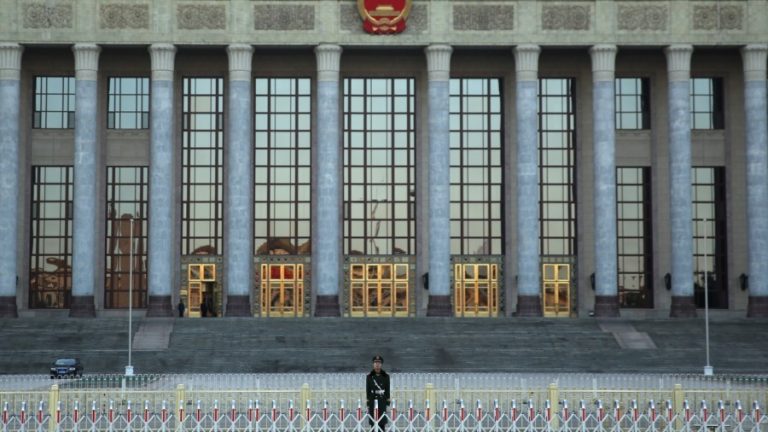
As the Chinese Communist Party (CCP) prepares to convene its Fourth Plenary Session, high-level personnel changes have become the focus of intense speculation.
According to insider reports, Xi Jinping has issued a so-called “mobilization order” through trusted aides, instructing Central Committee members loyal to him to “fight against divisive forces.”
Meanwhile, CCP elders—led by former Party leader Hu Jintao and Vice Chairman of the Central Military Commission Zhang Youxia—are allegedly trying to “poach” Xi’s allies and persuade them to defect.
Various signs suggest that Xi Jinping is now in a weakened political position but remains unwilling to relinquish power.
According to Xiaoshuojia, an overseas Chinese commentator, Xi has recently begun delivering oral “mobilization orders” to his allies—one by one—to ensure their loyalty ahead of the plenum. He reportedly emphasized the need to “uphold Xi’s core leadership” and “safeguard the Party’s unity” against “divisive elements.”
Success
You are now signed up for our newsletter
Success
Check your email to complete sign up
Tang Jingyuan, a U.S.-based political analyst, observed that Xi’s decision to issue oral instructions rather than written ones reflects his deep distrust of his own faction.Tang noted that Xi fears not open rebellion from rival factions but betrayal from within—those who might turn against him at the last moment.
According to reports, senior figures including Zhang Youxia, Hu Jintao, and Wang Yang, a former member of the Politburo Standing Committee, have been working to win over six key Xi allies: Executive Vice Premier Ding Xuexiang, Vice Premier Chen Jining, Beijing Party Secretary Yin Li, Chongqing Party Secretary Yuan Jiajun, Propaganda Minister Li Shulei, and NPC Vice Chairman Chen Min’er.
These six officials span major sectors—from the Party’s central offices to local governments and Xi’s next-generation leadership circle. If even a few of them waver, analysts say, the result could be a domino effect of defections that reshapes the CCP’s internal power map.
Historically, key moments in CCP power struggles have hinged on such last-minute defections. In 1976, Hua Guofeng toppled the “Gang of Four” overnight thanks to the sudden betrayal of military leaders Ye Jianying and Wang Dongxing. Similarly, Deng Xiaoping’s 1980s comeback was made possible by a group of Hua’s subordinates switching allegiance.
Hu and Zhang appear to be following the same strategy today—avoiding confrontation with Xi’s most loyal enforcers while quietly targeting pragmatic mid-level officials whose loyalties are tied to career survival.
Their objective: to hollow out Xi’s inner circle from within.
Persuasion, psychological warfare, and the domino effect
Xi’s die-hard loyalists include Li Qiang, Cai Qi, Li Xi, He Lifeng, Li Ganjie, Ma Xingrui, Wang Xiaohong, and Chen Yixin—figures unlikely to defect.
But others—such as Ding Xuexiang, Chen Jining, Yuan Jiajun, Zhang Guoqing, Yin Li, and Chen Min’er—are seen as opportunists rather than ideological followers. Should Xi falter, they have little incentive to “go down with the ship.”
Hu and Zhang’s reported second step combines persuasion with psychological warfare.They are said to be telling Xi’s subordinates that “Xi’s downfall is inevitable,” citing unrest in the military and growing international pressure.
Those who remain loyal, they warn, could become scapegoats—while early defectors might secure safety or even promotion in a post-Xi order.
The final step is to create a chain reaction. Once a few high-ranking Xi allies show hesitation, others may quickly follow. This “collective defection,” analysts note, is precisely what Xi fears most, as even within his faction unity has always been fragile.
Xi has reportedly intensified loyalty tests—using intimidation, sudden orders, and rumor campaigns to identify wavering subordinates.
Yet his visible anxiety, observers say, only deepens internal doubts: “If Xi were truly secure,” one analyst quipped, “he wouldn’t need to demand loyalty every week.” Ironically, these defensive mobilizations expose Xi’s own political vulnerability.
A psychological standoff inside Zhongnanhai
The anti-Xi bloc’s main weakness, sources say, is their reluctance to leave any trace of an organized coup. They prefer a scenario in which Xi steps down “voluntarily” or transitions out naturally at the 21st Party Congress in 2027.
Xi, however, is using that hesitation to his advantage—buying time and waging psychological warfare.
Though often seen as a poor administrator, Xi has proven adept at intra-party maneuvering. His political ideology, “Xi Jinping Thought,” is enshrined in the Party constitution, shielding him from direct repudiation. Moreover, over 70 percent of the current Central Committee was appointed under his leadership, giving him numerical dominance on paper.
For the elders to succeed, they must first persuade mid-level Xi allies to defect and flip the voting balance at the plenum. Zhang Youxia, as the military’s most powerful officer besides Xi himself, is seen as the key. If Xi refuses to step down, Zhang—who will be due for retirement in two years—risks being purged after losing formal power.
Both sides, therefore, appear to be preparing for a final showdown as the Fourth Plenary Session approaches.
The potential political reshuffle may extend beyond internal factional struggle.
Cai Shenkun, a U.S.-based independent analyst, reported that Xi Jinping and his close ally Cai Qi could both be forced to step down over age limits.
Under the CCP’s informal “seven up, eight down” rule, officials aged 68 or older are expected to retire. Xi, 72, and Cai, 69, both exceed that threshold. Cai, who also serves as Director of the CCP Central Committee’s General Office, reportedly faces growing fatigue due to his workload and age.
According to Cai, during China’s National Day holiday, Organization Department chief Shi Taifeng secretly led a team to Jiangxi Province to vet potential successors.
Jiangxi Party Secretary Yin Hong is said to have emerged as the leading candidate and may take over Cai’s role after the plenum—positioning him for eventual promotion to the Politburo.
While this information remains unconfirmed, sources suggest that multiple key appointments are expected to be finalized during or soon after the meeting.
Major shake-up in the Party’s personnel system
Cai also reported that Ren Weidong, a deputy director in the CCP’s Organization Department, was detained in September by the Central Commission for Discipline Inspection. Ren allegedly confessed to taking and giving bribes involving more than 100 provincial-level officials. Because his office oversaw vetting and promotion of all provincial and vice-ministerial officials, the case could trigger a wide-ranging political purge.
Analysts believe that after Ren’s detention, a large number of provincial officials may be removed or disciplined in the months following the plenum.
Lao Deng, an independent political commentator, claimed that Vice Chairman Zhang Youxia has placed Beijing under heavy military security, with General Liu Zhenli commanding the PLA’s 82nd Group Army to secure the capital and the Zhongnanhai leadership compound.
Military Discipline chief Zhang Shengmin has reportedly tightened control over key power figures—including Defense Minister Dong Jun, Security Czar Chen Wenqing, and State Security Minister Chen Yixin—to ensure that Xi’s loyalists cannot use armed force to resist. Zhang has also ordered all theater commands to cancel leave and enter top-level combat readiness, forbidding any officer from leaving their post.
Although Xi is believed to have lost significant military influence, remnants of his loyalists are reportedly under close surveillance to prevent unrest during the plenum.
Vision Times has not independently verified the authenticity of these claims.Tang Jingyuan noted that on October 6, the PLA’s official newspaper published a commentary acknowledging “growing instability and uncertainty” in China’s security situation.
It urged troops to maintain “a constant state of readiness,” which Tang interpreted as a sign that tensions within the Party and the military have reached a critical point.