By Ivy Ma, Vision Times
WASHINGTON D.C. — On Oct. 3, a special screening of the award-winning documentary “State Organs” reignited debate over one of the world’s most chilling (yet underreported) human rights atrocities: China’s state-run system of forced organ harvesting and the mass killing of prisoners of conscience for profit.
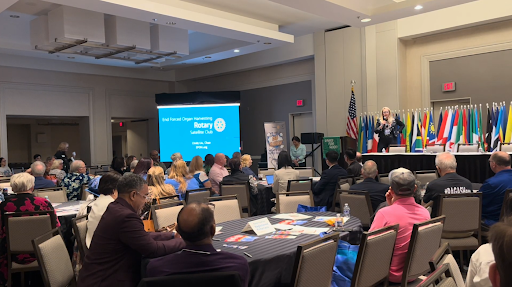
The event, hosted by Rotary Districts 7610 and 7620 in collaboration with the Rotary Action Group Against Slavery, drew an array of doctors, human rights advocates, and survivors. The screening was followed by a panel discussion that urged immediate international action to stop what experts described as “industrialized murder” carried out at the behest of the Chinese Communist Party (CCP) and its state-controlled medical institutions.

‘Every 30 minutes, someone is killed for their organs’
Dr. Andreas Weber, deputy director of Doctors Against Forced Organ Harvesting (DAFOH) and a former transplant surgeon in Germany, shared harrowing statistics with the audience: “It’s estimated that 60,000 to 90,000 organ transplants are performed in China each year using non-consenting victims. That means someone is killed every 30 minutes for their organs.”
Dr. Weber cited data from Tianjin First Central Hospital, which allegedly carried out more than 3,000 liver transplants on children alone — a number he said defies any ethical or medical explanation. By comparison, Eurotransplant, which operates ethically across eight European countries, performs about 70 pediatric liver transplants each year.

Success
You are now signed up for our newsletter
Success
Check your email to complete sign up
“That scale is medically and ethically impossible without killing children,” said Dr. Weber, adding, “Doctors are supposed to heal, not harm. If we normalize this kind of abuse, we’re heading toward moral collapse. Are we really killing others just to live longer?”
‘Finishing this film was also a way of saving myself’
For ‘State Organs’ director Raymond Zhang, making the film was deeply personal. “The most moving moment was my interview with Dr. Zheng,” said Zhang, who described how the teenager in the film was killed to have his kidneys and one eye removed for transplant.
“He told me the person who was harvested in the film was a 17-year-old boy. His parents had paid 10,000 yuan (about $1,400) to get him into the army, hoping to secure his future,” said Zhang, adding, “But the boy didn’t understand the corrupt system [and] he got into conflict with his officers. That alone sealed his fate [as] his blood type matched a high-ranking military officer.”
Zhang added, “During the interview, Dr. Zheng kept going to the bathroom. I heard someone crying behind the door — for a long time. We had to stop. The next day, he told me, ‘I’ve lived under a false name for 17 years. I’ve refused every filmed interview. But after yesterday, all the pressure and fear just disappeared. I felt like I was saved.’”
Zhang reflected on how the documentary changed him as well: “At the time, I didn’t fully grasp what he meant. But after finishing the film, I did. Making ‘State Organs’ was also a way of saving myself.”
RELATED: ‘A Regime Addicted to Blood’: Former PLA Journalist Condemns CCP for Harvesting Organs from Infants
Audience reaction: From shock to resolve
For many in attendance, the screening was an emotional experience that left them shaken and determined to act. “This is like what happened in Nazi Germany, except it’s happening now. And we, as a society, are too distracted to confront it,” said Dr. Sam, a retired family physician.
RELATED: Landmark ‘Falun Gong Protection Act’ Clears House With Unanimous Approval
“This is what happens when the government becomes everything and decides who has value. Americans need to wake up,” warned Kenny Loveless, a 30-year Rotarian.
Amelia, the immediate past district governor of Rotary District 7610, urged attendees to bring the film to their own communities to raise awareness on these atrocities: “We should be advocating for the ‘Falun Gong Protection Act’ and stopping Americans from traveling abroad for unethical transplants.”

“This isn’t a donation. This is extraction. It’s not a back-alley job, it’s run by the government,” said Claudio Brown, who watched the film for the first time.
Alicia Lujan of the Rockville Rotary Club added: “This film shows us how evil the world can be. And yes—it could happen here, too.”
Medical tourism in the crosshairs
Vijay Kowtha of the College Park Rotary raised a sobering point about complicity through global medical tourism: “We call it ‘medical tourism’ — but who’s behind it? These systems are connected globally. You might travel for surgery and unknowingly become part of it.”
Kowtha pledged to showcase ‘State Organs’ at additional events, including an international Rotary youth summit in Argentina.
About the Film
“State Organs” exposes China’s state-run organ transplant system, which targets Falun Gong practitioners, ethnic minorities, and political prisoners. The documentary has won over 50 international awards and is shortlisted for the 97th Academy Awards.