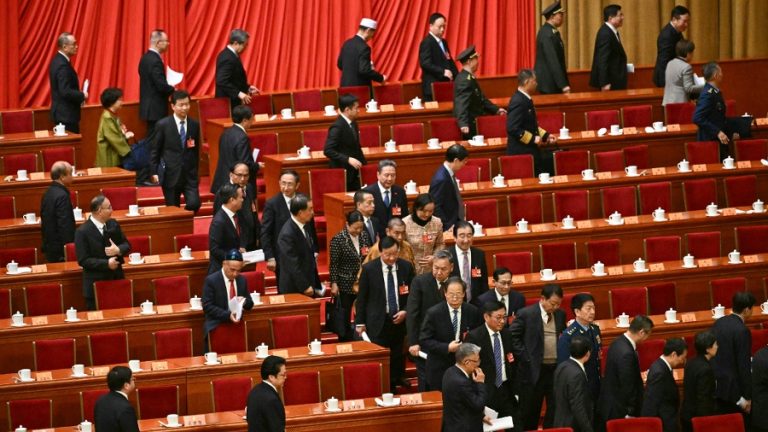
The Chinese Communist Party’s (CCP) 20th Fourth Plenary Session is now days away — and for the first time in years, the question of Xi Jinping’s political survival dominates public conversation.
A wave of unusual developments in Beijing has fueled speculation that China’s top leader may be facing an unprecedented internal challenge.
In recent weeks, the Party’s central media outlets have released a series of articles interpreted by analysts as “succession signals”, while tensions with Washington have reignited following Beijing’s announcement of a new rare-earth export ban.
Observers say the upcoming plenum may no longer be a routine policy meeting, but rather a “life-or-death congress” that could determine both China’s political future and Xi’s personal fate.
Success
You are now signed up for our newsletter
Success
Check your email to complete sign up
Subtle signs in the party’s propaganda machine
State propaganda — long a barometer of power in Beijing — has suddenly taken on an ambiguous tone.
Within a single week, People’s Daily and affiliated outlets published several essays that many commentators read as coded messages favoring potential successors.
- October 13: “Youthful Chapter” (青春华章) — The title’s phonetic resemblance to “Hu Chunhua” sparked speculation that the article was an indirect endorsement of the reformist former vice premier once seen as a rising star in the Party’s “Communist Youth League faction.”
- October 14: “Niu Bole” (The Good Judge of Talent) — In China’s political lexicon, “Bole” refers to a mentor who discovers and promotes talent.
Former Wen Wei Po senior journalist Jiang Weiping argued the piece represented the voice of the Party’s “Elder faction,” signaling support for Hu Chunhua’s possible comeback.
“The use of such symbolic language in central media is never accidental,” Jiang noted.
“When People’s Daily starts hinting at succession, it means internal forces are using propaganda to erode Xi’s legitimacy.”
Analysts across Hong Kong, Taiwan, and the West have compiled these incidents into a broader pattern — evidence, they argue, that rival factions are leaking through the propaganda system to shape a “succession narrative.”
The tactic is not new: Party insiders have long used metaphor and allegory to signal political realignment.
But such open “coded messaging” through official channels has not been seen since the leadership struggles of the 1980s.
“Propaganda is the Party’s mirror,” said one mainland commentator. “When it starts reflecting multiple faces, it means unity is broken.”
Who really holds power: the military or the party apparatus?
In Chinese politics, words and symbolism only go so far.
Ultimately, power depends on who controls the Central Military Commission, the Party’s organizational machinery — including the Organization Department, the Discipline Inspection Commission, and the Propaganda system — and, crucially, the flow of information.
Even if state media uses allegorical language to elevate certain figures, no real transfer of power can occur until the military or the key Party departments have chosen a side.
Historically, major leadership shifts have come not through public debate but through quiet understandings — or sudden decisions — reached among top generals and members of the Politburo Standing Committee.
Observers note that some members of the Elder faction have begun maneuvering within personnel networks. Yet publicly available evidence remains deeply ambiguous:
Some clues suggest Xi has been partially sidelined, while others indicate he still holds enough leverage to resist.
Analysts say this hesitation — the elders’ belief that “protecting the Party means protecting Xi” — has stalled both the military and anti-Xi factions from moving decisively.
In the midst of this internal tension, Beijing has abruptly escalated its confrontation with Washington — announcing a new rare-earth export ban in early October.
At first glance, it appeared to be a strategic move to retaliate against U.S. tariffs and technology restrictions. But political observers saw a deeper motive: Xi’s attempt to redirect domestic pressure outward by provoking a confrontation with the West.
Analyst “Wall Insider”, a pseudonymous Chinese commentator, described the maneuver as a “self-destructive gambit,” arguing that it backfired spectacularly. “Instead of rallying the Party behind him,” he said, “Xi’s escalation convinced more insiders that keeping him in power will only isolate China and hasten economic collapse.”
Washington’s sharp response
U.S. Treasury Secretary Bessent issued an unusually blunt warning after China’s announcement. If Beijing attempted to “weaponize” rare earths, he said, it would “hurt itself before it hurts others.” The U.S., he added, was prepared to coordinate a joint response with its allies to prevent supply-chain coercion.
“This is a losing strategy for Beijing,” Bessent said. “The more China threatens global industry, the faster the world will decouple from it — and that’s a cost China can’t afford.”
Even President Donald Trump, known for his transactional approach to China, took a harsher tone than usual. During a White House press briefing, he declared that the U.S. and China were already in a “substantial trade war,” accusing Beijing of “systematic theft” and “decades of unfair advantage.” “The U.S.,” Trump said, “is simply restoring balance.”
According to analyst Lan Shu, the U.S. response is part of a larger coalition strategy aimed at building a united front against Beijing’s coercive tactics. “As the CCP’s threat to the free world becomes clearer, Western nations are waking up,” he said. “This is no longer about trade — it’s about defending the global order.”
Political economist Wu Jialong agreed, calling the confrontation a “new Cold War.”
“The competition is no longer managed,” he said. “It’s an open confrontation. Technology, finance, supply chains — all are decoupling. Taiwan and Japan are now the cornerstones of America’s Indo-Pacific strategy.”
Wu warned that China’s economic downturn would accelerate, leading to growing domestic instability. “If Xi stays in power, the Chinese people will see no future.”
Internal shockwaves in Beijing
As external pressure mounts, Beijing’s internal politics have grown increasingly volatile.
Exiled commentator Cai Shenkun revealed that former Premier Wen Jiabao had reportedly been granted temporary authority to approve internal Party documents — an extraordinary move suggesting that Xi’s decision-making power had been curtailed.
Analyst Tang Jingyuan interpreted it as “a sign that the central decision-making mechanism under Xi is breaking down.” He added, “It means countervailing forces are now strong enough to bypass him.”
Meanwhile, Premier Li Qiang chaired an economic policy forum on October 15 and invited Xu Qiyuan, author of Facing the U.S.–China Trade Conflict, to lead the discussion — a direct challenge to Xi’s economic prerogatives.
Commentator Jiang Senzhe noted:
“By openly discussing trade strategy, Li Qiang is reclaiming authority that Xi’s loyalists had monopolized. It’s a clear signal that the premier is asserting independence.”
Adding to the drama, Hu Xijin, the outspoken former editor of Global Times, published a rare essay criticizing China’s excessive online censorship, implicitly blaming Xi for creating a climate of fear.
Hu’s remarks contradicted recent directives from the Party’s Cyberspace Administration prohibiting “negative sentiment” on social platforms.
Analysts believe Hu could not have acted alone. “Someone powerful gave him cover,” said Jiang Senzhe. “These public acts of defiance — by Li Qiang, by Hu Xijin — are coordinated signals of resistance before the plenum.”
Three scenarios for the Fourth Plenum
With the plenum approaching, political observers are sketching out three possible outcomes, each with far-reaching consequences:
- Xi is sidelined but not officially removed.
He retains ceremonial titles, but real power shifts to a collective structure led by Party elders and the current premier. Policies return to pragmatism, focusing on economic stabilization and cautious diplomacy. - Xi is forced to step down.
The “Elder faction,” leveraging the plenum’s authority, orchestrates a formal leadership transition. Short-term turbulence is likely, but public backlash minimal — the long-anticipated change would mark the end of Xi’s personal rule. - Xi survives the challenge.
Through foreign-policy crises or military loyalty, he consolidates enough support to crush opposition. His victory, however, would come at a cost: renewed internal fear, deeper isolation, and rising long-term instability.
Analysts describe the Fourth Plenum as a “decisive convergence point” for China’s political future. Unlike routine sessions, this one combines leadership reshuffling, ideological recalibration, and economic crisis management. For Xi, it is an existential test: survival or collapse. For the Party’s rival factions, it is the last realistic chance to act. And for bureaucrats and business elites, it is a moment of truth between self-preservation and loyalty.
“The struggle is no longer behind closed doors,” said one Hong Kong journalist. “Propaganda leaks, policy feints, even foreign conflicts — all are now weapons in a transparent power war.”
A party on the edge
Every indicator points to an escalating showdown:
- The Party’s propaganda machine is leaking signals.
- Economic policy is fractured between competing hands.
- The international environment is turning hostile.
- Military and bureaucratic loyalty are no longer guaranteed.
As one Beijing-based source put it, “The Party has reached the point where keeping Xi means risking collapse — but removing him might collapse it faster.”
Whether Xi is ousted, constrained, or survives, the aftershocks will reverberate far beyond China’s borders.
A weakened CCP will reshape global markets and geopolitics alike.
Editorial Note:
This article summarizes publicly available reports, analysis, and commentary on internal developments within the Chinese Communist Party ahead of the Fourth Plenary Session.
Many claims remain unverified and should be interpreted as political analysis, not confirmed fact.
They are presented to illustrate the mounting tension between Party control, elite factionalism, and international pressure shaping China’s current crisis.