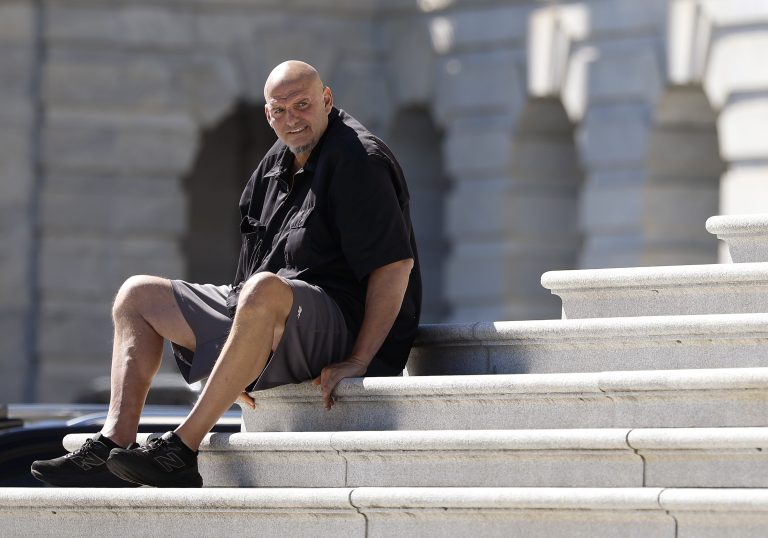
On Wednesday Oct. 22 Senator John Fetterman (D-Pa) told Fox News that he was willing to “pay a price” to end the government shutdown even if it means breaking with his party.
“I am always going to vote country over my party, and if I pay a price within my base, that’s something I am willing to do,” Fetterman told Fox’s Sean Hannity, adding, “I’m not afraid to tell my truth, and if I’m going to pay a penalty, I’m not afraid of that. It’s wrong to shut our government down.”
Also on Wednesday, Fetterman argued on X (formerly Twitter) that the shutdown is hurting millions of his constituents who depend on the Supplemental Nutrition Assistance Program (SNAP) program.
“Shut our government down and America loses,” the senator wrote.”2 MILLION Pennsylvanians depend on SNAP to feed their families. For me, it’s hungry Americans over party. Paying our military over party. Paying Capitol Police and federal workers over party. I choose country over party.”
Fetterman described the ongoing government shutdown as a “failure.”
Success
You are now signed up for our newsletter
Success
Check your email to complete sign up
Impacts of a prolonged shutdown
Currently, programs such as Social Security and Medicare are operating as usual since they’re funded through mandatory spending rather than the annual budget process and essential services tied to national security and public safety — including border enforcement and active military operations — also continue under contingency plans. However, for many Americans, the effects of the prolonged government shutdown are starting to hit home.
Hundreds of thousands of federal workers (~ 750,000) are furloughed or working without pay meaning reduced paychecks and less spending, which is resulting in a ripple effect in local economies.
Travel and transportation disruptions are beginning to emerge as well, with staffing shortages hitting air traffic control and other key federal agencies which is leading to flight delays and other travel issues.
Some national parks, museums and public lands are also closed due to a lack of staffing.
Meanwhile, economists are saying that “the shutdown [is] shaving 0.1 to 0.2 percentage points off annualized inflation-adjusted gross domestic product growth per week,” Reuters reported.
Hundreds of thousands of federal workers will miss their first paycheck on Oct. 24, meaning less spending power in the economy.
Chief economist at EY-Parthenon, Gregory Daco, told Reuters, “There is going to be an impact on the economy.”
“It’s not going to push the economy into recession, but the longer this drags on, the more permanent losses are for Fed workers that may have had to cut back on expenses because they haven’t been paid or because, essentially, while they are expecting retroactive pay, they’re just being more judicious with their finances.”
Negative effects to increase
The nonpartisan Congressional Budget Office offered a similar outlook, noting that the economic impact of the shutdown “will be temporary” but will deepen the longer it lasts.
During the record 34-day shutdown that began in late December 2018, GDP growth nearly stalled in the fourth quarter before rebounding in the first quarter of the following year.
So far, financial markets have largely brushed off the shutdown, though its ripple effects are being felt by government contractors and businesses awaiting permits or certifications.
According to Oxford Economics, roughly $800 million in new federal contracts were at risk of disruption for each business day the shutdown persisted in October, potentially weighing on the labor market.
Bernard Yaros, lead U.S. economist at Oxford Economics, told Reuters, “While contractors can manage through a short-lived suspension of federal activity, a protracted shutdown can significantly impact their cash flow, potentially leading to furloughs, pay cuts, or even layoffs.”
Yaros believes that a delay in government spending could be made up once things return to normal.
“However, the longer the shutdown lasts, the greater the likelihood that some contractors will never recoup all the income lost during the budget impasse,” he said.