Recent overseas media reporting suggests that during the just-concluded 4th Plenum of the Chinese Communist Party (CCP), a record-high number of senior officials were expelled from the Party’s Central Committee. That includes the expulsion of 14 Central Committee members and alternates, following the earlier high-profile announcement of nine People’s Liberation Army (PLA) generals being stripped of both Party and military ranks. The plenum’s timing and scale of purges have drawn intense scrutiny from international observers. Vision Times reporter then interviewed Professor Yuan Hongbing, a prominent legal scholar and critic residing in Australia who frequently reveals insider developments within the CCP leadership.
According to professor Yuan Hongbing — large-scale purges are historically a “normal state” for communist regimes. He points to earlier eras, such as the Stalinist Soviet Union where tens of thousands of officers were removed, and the Cultural Revolution in China when over 10,000 senior military officers were purged in a single year.
“For the CCP’s authoritarian regime, events like this are not unusual — it is, in effect, a regular feature of the system,” Yuan says.
Yuan observes that the current purge links back to two recent major incidents of political disloyalty involving senior military figures such as Miao Hua and Li Shangfu. Within 24 hours of his arrest, Miao along his three political secretaries, confessed that more than 3,000 senior officers above the Colonel level were flagged for alleged political disloyalty to President Xi Jinping.
He Weidong was the first suspect named by Miao Hua, meaning the two are involved in the same case. The current purge is essentially part of the broader investigation and cleanup process linked to the major corruption cases of Li Shangfu and Miao Hua.
Success
You are now signed up for our newsletter
Success
Check your email to complete sign up
Because the case has been ongoing for quite some time, the Fourth Plenary Session of the CCP Central Committee had to provide at least a preliminary explanation to the Party, government, and military. As a result, nine generals were publicly dismissed.
However, the review and purge of more than 3,000 military officers implicated in the case have not yet concluded. This marks a key point in time that highlights the scope of the internal military purge revealed during the CCP’s latest Fourth Plenary Session.
Xi Jinping increasingly isolated — yet still entrenched
Yuan argues the purge also reflects Xi’s political situation. Over 13 years, he has built a vast surveillance and loyalty system across the Party, government and military. At the same time, Xi has relied on the atmosphere of fear created by an unending purge and rectification campaign—now continuing for 13 years—to sustain and reinforce his personal dictatorship. This, despite the severe crises confronting the CCP’s authoritarian system, remains the fundamental political reason Xi is still able to maintain an iron grip on power.
However, the need for recurring mass purges suggests he still lacks the absolute personal loyalty he seeks. “Xi’s reliance on repeated purges is the very proof of his isolation,” Yuan says. Li Shangfu, Miao Hua, and He Weidong case involved senior officers personally cultivated by Xi—members of his own “Xi’s Army”—proving a critical level of political disloyalty.
Even so, Xi’s ability to control the purge relies heavily on two long-time allies from his home province of Shaanxi: Zhang Youxia (Vice Chairman of the CMC and the “First Confidant” due to their fathers’ shared history in the military) and Zhang Shengmin (Secretary of the CMC Discipline Inspection Commission and the direct executor of the investigation).
This latest round of purges targets a group of military officials led by Miao Hua and He Weidong—commonly referred to as the so-called “Southeast Faction.” The campaign is still ongoing and has yet to conclude.
For now, the Central Military Commission has made only a symbolic adjustment—promoting Zhang Shengmin to the position of vice chairman. A full restructuring of the CMC’s leadership system is expected only after the current purge has been completely finalized.
During this process, Xi Jinping—assisted by Zhang Youxia and Zhang Shengmin—has promoted a number of lieutenant generals and major generals to fill the key positions left vacant by the senior officers who have been purged or placed under investigation.
For example, Zhang Youxia’s close associate Zheng Shoudong, formerly a lieutenant general, has now been promoted to take charge of the Joint Command Center of the Central Military Commission (CMC) — effectively the command headquarters of what has become the CCP’s own version of a “Party Guard.”
Xi has also appointed Lt. Gen. Han Shengyan as acting commander of the Central Theater Command, and Lt. Gen. Liang Ping as its acting political commissar. Han is a longtime subordinate of Zhang Youxia, while Liang previously served under Zhang Shengmin.
In addition, Yuan Honggang has been assigned to replace the former commander of the Tibet Military District—he too is a trusted ally of Zhang Youxia. After the commander of the People’s Armed Police was purged, the post was temporarily filled by Lt. Gen. Cao Junzhang, another of Zhang Youxia’s former subordinates from the 13th Army.
Through Zhang Youxia and Zhang Shengmin, Xi Jinping has thus elevated a network of lieutenant generals and major generals to secure control over the critical positions vacated by the purged senior officers.
Among these new appointments are Maj. Gen. Qiu Yang, who now oversees the General Office of the Central Military Commission; Maj. Gen. Zhu Jun, who commands the Beijing Garrison; and Zhu Wenxiang, who serves as deputy commander of the People’s Armed Police.
Most of the officers promoted by Xi come from the former Shenyang Military Region’s 16th, 39th, and 40th Armies—units that were once under the command of Zhang Youxia.
How to interpret the rumor that Zhang Youxia is ‘clipping Xi Jinping’s wings’ in the military
In the interview, Professor Yuan Hongbing also addressed an outside rumor suggesting that Zhang Youxia’s assistance in purging the so-called Xi faction within the military was, in fact, an effort to weaken Xi Jinping’s own power base.
Yuan dismissed this claim, saying it “completely contradicts the actual factional dynamics within the Chinese Communist Party’s military.”
“The so-called Xi faction (‘Xi Family Army’) doesn’t only include figures such as Miao Hua and He Weidong, who come from the 31st Army or the southeastern military regions,” Yuan explained. “The most loyal core of Xi’s military allies actually comes from Zhang Youxia’s faction. Zhang himself is a member of the Xi faction — one of its key pillars. Therefore, the idea that Zhang Youxia is cutting down Xi Jinping’s wings is simply unfounded.”
According to Yuan, the reason for the current purge lies in the investigation led by the Military Discipline Inspection Commission, headed by Zhang Shengmin, which uncovered that Miao Hua and He Weidong had formed cliques and personal networks within the armed forces.
“By exploiting Miao Hua’s position as director of the Political Work Department—giving him power over personnel appointments—they built an extensive network of patronage within the military,” Yuan said. “This forms the main evidence behind the charges mentioned in the communiqué of the CCP’s Fourth Plenary Session, namely that Miao Hua and He Weidong violated the principle of the ‘CMC Chairman responsibility system,’ undermined the Party’s absolute control over the military, and weakened the authority of the CMC leadership.”
Yuan added that these actions represented “the fundamental reason Xi Jinping could not tolerate the Miao Hua–He Weidong faction.”
He drew a historical parallel: “It’s just like when Mao Zedong, at the CCP’s Ninth Congress, had written Lin Biao’s name into the Party Constitution and declared him as his successor. Yet barely a year later, Mao began purging Lin. The reason was that after the Ninth Congress, Lin Biao started infiltrating his own loyalists throughout the Party’s armed forces — a move that violated Mao’s deepest taboo, as it would for any dictator. Likewise, Xi Jinping’s purge of the Miao Hua–He Weidong clique stems from precisely the same logic.”
CCP’s 15th Five-Year Plan emphasizes boosting high-tech development, raising global suspicion
Outside the immediate purge, overseas media note that the 15th Five-Year Plan passed at the 4th Plenum emphasizes massive investment in high-technology sectors, signalling Beijing’s intent to compete directly with the United States in global tech dominance.
Some international observers note that, amid escalating U.S.–China trade tensions and global geopolitical instability, the decision by Xi Jinping’s administration appears aimed at strengthening China’s confrontation with the United States.
In response, Professor Yuan told Vision Times: “The CCP’s current emphasis on what it calls the ‘battle’—not competition—with the United States in the high-tech sector reflects its strategic ambition to gain a dominant position from a technological standpoint,” Yuan explained. “In other words, it seeks to achieve a posture of superiority over the U.S. through advancements in high technology, thereby securing the commanding heights in this global confrontation.”
Yuan pointed out that while the CCP has, in some respects, already gained advantages over the United States in areas such as manufacturing, it still lags far behind in high technology. Hence, the regime has made this field a strategic priority.
“However,” Yuan continued, “this focus on technology is only one component of the CCP’s broader geopolitical strategy — what Xi Jinping calls ‘the East rising while the West declines’ (东升西降).”
Yuan elaborated that Xi’s ultimate goal is to replace the United States as the global lawmaker and rule-setter in international affairs, under the banner of “the CCP’s state power.”
“The so-called concept of a ‘Community of Shared Future for Mankind,’” Yuan said, “is in fact the ideological cloak for the CCP’s totalitarian ambition of global expansion. Therefore, this push for dominance in high technology is merely one facet of Xi Jinping’s grand strategy of ‘the East rising and the West declining.’”
According to reports from mainland Chinese media, the communiqué of Fourth Plenary Session emphasized “promoting the peaceful development of cross-strait relations and advancing the great cause of national reunification.”
For Professor Yuan , this is a cover.
“The so-called ‘peaceful development’ is nothing but a lie,” “The CCP regime continues to send military aircraft around Taiwan and exerts relentless military intimidation. Peace is merely a fig leaf to disguise its intention to invade Taiwan by force. In reality, the CCP has already made it a national policy to resolve the Taiwan issue through military action.”
Yuan further warned that the most likely time window for the CCP to launch a war in the Taiwan Strait would be either in the autumn of 2027 or the spring of 2028 — around the period of the CCP’s 21st National Congress.
Will Trump meet Xi Jinping at APEC to address the Russia-Ukraine war?
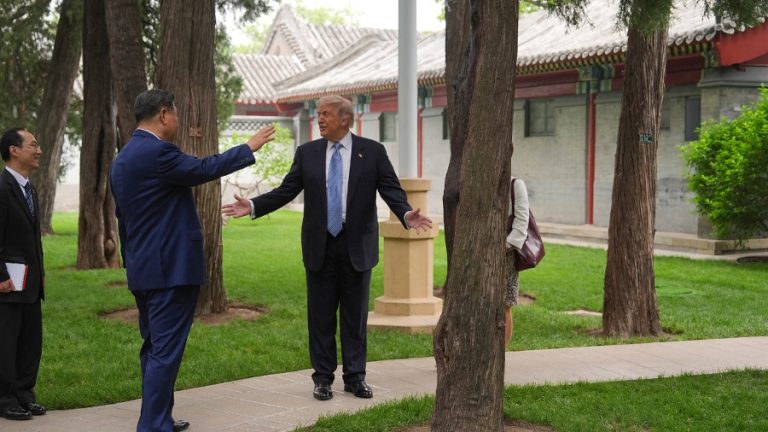
According to reports, U.S. President Donald Trump is scheduled to meet Chinese President Xi Jinping at the upcoming Asia-Pacific Economic Cooperation (APEC) summit later this month. Some foreign media analysts suggest that, facing growing disappointment with Russian President Vladimir Putin, Trump may be turning diplomatic hopes toward Beijing.
Professor Yuan Hongbing commented:
“We all know that Trump initially hoped he could use his diplomacy to end the Russia-Ukraine war and convince Russia to abandon its war ambitions. He even hosted Putin in Alaska with great pomp for this purpose. But the facts show that none of these efforts achieved the desired results.
The reason is that the CCP, Russia, and North Korea have already formed a modern axis of evil alliance. With Iran included, this coalition aims to reshape the post-World War II global order. Russia seeks to reclaim all territories lost after the collapse of the Soviet Union, including all of Ukraine. North Korea clearly wants to extend its totalitarian rule over the entire Korean Peninsula. Meanwhile, Xi Jinping’s CCP regime plans to leverage this axis to take a crucial step in global communist expansion — launching a Taiwan Strait war to conquer free Taiwan. This is the strategic trajectory these three evil axis powers have already decided. Economic pressure alone cannot alter their political strategy.
This represents a fundamental misjudgment on Trump’s part regarding Putin. That is why Trump had to abandon further direct meetings with Putin. As he himself has said, another meeting would no longer have any meaningful effect.
Now, if Trump truly hopes, as some analysts suggest, to use Beijing to pressure Russia into ending the Ukraine war, such a diplomatic outcome is fundamentally impossible. The CCP regime is the core power of this evil axis, and Xi Jinping will not alter his authoritarian state strategy just because Trump repeatedly claims to have a good personal relationship with him. If Trump believes that publicizing a personal rapport with Xi will persuade him to pressure Russia on Trump’s behalf, that would be nothing less than ‘asking a tiger for its skin.’”
By Li Jingru
This article represents the views and opinions of the author and does necessarily reflect the views and opinions of Vision Times.