By Li Jingyao, Vision Times
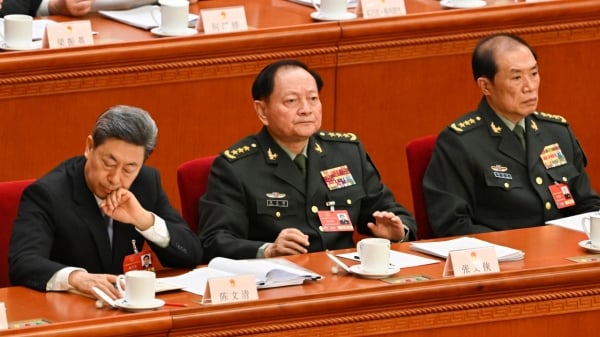
On Nov. 3, the People’s Liberation Army (PLA) held its first nationwide session to study and implement the outcomes of the Fourth Plenary Session of the CCP’s 20th Central Committee. The meeting, held in Beijing and broadcast via teleconference to over 11,000 personnel, featured senior leaders of the Central Military Commission (CMC) — Vice Chairmen Zhang Youxia and Zhang Shengmin, along with CMC member Liu Zhenli.
But analysts noticed that one figure was conspicuously absent: Xi Jinping, CMC chairman and China’s top commander-in-chief. His absence from both the meeting and related directives immediately drew attention, with observers saying the event marked a “subtle but significant political signal” — and what one analyst called “a performance of loyalty on the surface, but a reset of power in substance.”
RELATED: Ex–Vice Chairman He Weidong’s Defense Speech Leaked: Inside the Xi–Zhang–He Power Struggle
A power rift?
According to state mouthpiece “Xinhua News,” Zhang Youxia urged officers to “deeply understand and implement Chairman Xi’s important instructions” and to fully uphold “the spirit of the plenary session’s proposals.” Zhang called on the military to “firmly and consciously uphold the Two Establishes” — Beijing’s formula for absolute loyalty to Xi’s leadership.
Success
You are now signed up for our newsletter
Success
Check your email to complete sign up
Zhang Shengmin echoed the same rhetoric, emphasizing the “decisive significance” of the Two Establishes and the need to strengthen the Four Consciousnesses, Four Confidences, and Two Upholds — political slogans tied directly to Xi’s authority. He reiterated the “Chairman responsibility system,” calling on the entire military to “align thought and action with the decisions of the Party Central Committee.”
Yet despite the show of devotion, Xi’s non-attendance was glaring. For the first time in years, the PLA’s top political indoctrination session — usually presided over by Xi himself — was led entirely by his deputies. Though Xi still retains his titles in an official capacity, analysts believe his grip over the military is loosening, with real authority shifting toward a collective leadership under Zhang Youxia and Zhang Shengmin.
‘Not about loyalty; this is survival’
Political commentator Li Linyi told Vision Times that Xi’s absence likely reflected a compromise reached during the Fourth Plenum. “At this stage, Zhang Youxia and Zhang Shengmin expressing loyalty to Xi is routine,” Li said. “If you look back, even He Weidong — before his fall — was also loudly pledging allegiance to Xi at military meetings. These loyalty displays don’t necessarily mean stability. They often precede a purge — or rebellion.”
RELATED: Hu Haifeng’s Media Surge Signals Return of Party Elders; Zhang Youxia on High Alert
Li added that although Xi, Zhang Youxia, and Zhang Shengmin all hail from Shaanxi Province, “whether they remain united now or in the future is uncertain.”
Commentator Zhang Tianliang agreed, noting that Xi has weaponized anti-corruption campaigns to consolidate control, while Zhang Shengmin — a key executor — has carried out the purges in the PLA. “Zhang Youxia is merely Xi’s tag-along,” he said. “Just as Li Qiang follows Xi in the civilian sphere, Zhang Youxia follows him in the military.”
Independent journalist Wang Jian observed that compared with last year’s Third Plenum military briefing — which included six CMC leaders sitting on six chairs — this year’s setup was reduced to three seats: Zhang Youxia in the center, flanked by Zhang Shengmin and Liu Zhenli. “They kept talking about the ‘Chairman responsibility system,’ but it looked like Xi had nothing to do with it,” Wang remarked.
Another analyst, known as Xiao Shuojia, said the symbolism was unmistakable. “Everyone can see it — the water runs deep here,” he said. “The most crucial figure, Xi Jinping, wasn’t there. That’s the real story.”
“In theory, the CMC Chairman himself should lead a meeting like this,” he explained. “When it’s Zhang Youxia and Zhang Shengmin doing the talking, it means the system is using institutional language to deliver an extra-institutional message.”
He added, “When the military preaches loyalty to the chairman without the chairman present, that’s not unity — it’s separation.”
‘A performance of loyalty; a rehearsal for power transition’
Xiao Shuojia argued that the meeting’s slogans — focused on political loyalty and “upholding Xi’s core status” rather than military modernization or combat readiness — signal something deeper. “On the surface, it looks like support for Xi. But in the CCP’s political grammar, the louder the loyalty, the weaker the obedience,” he said. “What we are seeing is the beginning of de-Xi-fication — the military no longer waiting for his word to act.”
He added, “This was both a show of loyalty and a rehearsal for a post-Xi power structure. They are using Xi’s name to unify the institution — but without Xi at the center.”
Zhang Shengmin’s recent promotion to CMC vice chairman and head of the military discipline commission — following the downfall of He Weidong — continues to raise questions. Notably, Zhang was not added to the Politburo, breaking decades of precedent.
Analysts have debated whether this signals Xi’s attempt to limit Zhang’s political reach or a concession to the military establishment led by Zhang Youxia. Historically, there is precedent: The late general Xu Caihou was appointed CMC vice chairman in 2004 but only joined the Politburo three years later. The delay suggests Beijing may be testing Zhang Shengmin’s loyalty before granting him full political standing.
Cai Qi’s silence speaks volumes
An equally striking anomaly lies outside the military. On the same day as the PLA meeting, Cai Qi — Politburo Standing Committee (China’s top ruling body) member and Xi’s longtime confidant — published an article on Party governance that notably downplayed references to Xi Jinping.
Since March, observers have noted Cai’s subtle distancing from Xi’s personality cult. During a Party work conference earlier this year, his praise for Xi was noticeably restrained. In May, while on an inspection tour in Hebei, Cai omitted the usual phrases such as “the Two Establishes” and “Two Upholds.”
Even more telling: when Xi toured Luoyang, Henan in mid-May, Cai did not accompany him — an unprecedented break in protocol for Xi’s chief political aide. Instead, Cai visited Tangshan, Hebei at the same time, fueling speculation of a widening rift.
Analysts say that if Cai Qi — the man closest to Xi’s inner circle — is showing signs of hesitation, it suggests that Xi’s authority is eroding from within. “If Cai wavers, Xi’s power structure could collapse like dominoes,” one observer noted.
The Nov. 3 PLA meeting was officially billed as an “ideological study session,” but in reality, it showcased a new collective dynamic inside the CMC — one that no longer centers exclusively on Xi Jinping. While the speeches echoed Xi’s slogans, his physical absence and the military’s independent posture hint at a deeper shift underway.
Analysts say the military is now using Xi’s own language to build a post-Xi order — still saluting his name on paper, but no longer at his command.
Editorial note: Views expressed in this article are the opinions of the author and do not necessarily reflect the views of Vision Times.