By Li Deyan, Vision Times
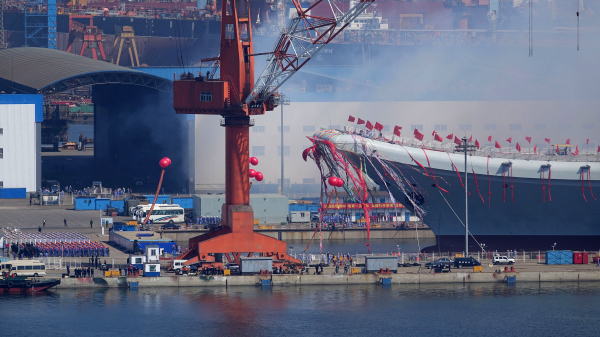
When Chinese President Xi Jinping presided over the commissioning of the Fujian aircraft carrier on Nov. 5, what was meant to be a triumphant showcase of China’s naval might and prowess instead underscored how much his authority has eroded.
Held at a naval base in Sanya, Hainan, the ceremony was led by newly appointed Central Military Commission (CMC) Vice Chairman Zhang Shengmin. Only a small contingent of senior civilian officials attended, including Xi’s powerful chief of staff Cai Qi and Vice Premier Zhang Guoqing.
But the absences spoke louder than the ceremony itself. Navy Commander Adm. Hu Zhongming, Southern Theater Commander Gen. Wu Yanan, and Political Commissar Gen. Wang Wenquan — all key figures in China’s military hierarchy — were missing from the broadcast.
RELATED: Xi’s Tight Grip on Civil Servants Exposes Growing Insecurity Within China’s Regime
Success
You are now signed up for our newsletter
Success
Check your email to complete sign up
Hu has not been seen publicly for months, skipping both the August Army Day reception and the CCP’s Fourth Plenum in October, fueling speculation that he has been dismissed. State media later confirmed that nine senior generals were removed from their posts in mid-October. Wu Yanan also missed the plenum, while Wang, who appeared briefly at that time, has now disappeared as well.
“Xi’s handpicked generals are disappearing one by one,” analyst Li Linyi noted. “Before the regime even faces a real war, its senior command is almost entirely gone.”
The Fujian’s glitz and flaws
The Fujian—China’s first aircraft carrier equipped with electromagnetic catapults—was launched in 2022 and began flight trials in September. With a displacement of over 80,000 tons, it is widely viewed as Beijing’s answer to the U.S. Navy’s USS Gerald R. Ford.
Yet footage from Xi’s inspection told a different story. Sailors were seen sleeping in cramped triple-tier bunks, more reminiscent of a sleeper train than a modern warship. In the mess hall, state TV cameras lingered on rows of ornately decorated cakes. Xi smiled and remarked, “These look very well made.”
Viewers were quick to call out the stagecraft. “No navy feeds its sailors dessert buffets,” one netizen quipped. “Calories and nutrition are strictly monitored for combat units.” Another wrote, “You can’t even sit up in those bunks without hitting your head.”
Even more revealing was the technical demonstration: Xi pressed a launch button to display the ship’s electromagnetic catapult—but the test fired only an empty shuttle, without an aircraft or even a weighted dummy. “So it’s never launched an actual plane?” one commenter asked. “They’re too scared to test it—if anything goes wrong, heads will roll.”
A ceremony marked by absences
Military analyst Shen Zhou said the Fujian’s development was plagued by design compromises. Initially planned with steam catapults, it was hastily modified mid-construction to mimic the Ford class after Beijing saw Washington’s success with electromagnetic systems. “They were designing, researching, and building at the same time,” Shen wrote. “But China still lacks nuclear propulsion and other critical technologies.”
Shen noted that the Ford achieved combat readiness only after 4,000 consecutive fault-free launches. Without similar reliability, he said, “the Fujian remains symbolic, a vessel of propaganda, not power.”
Former U.S. Navy pilot Lt. Col. Keith Stewart echoed that view, observing that the Fujian’s flight deck design restricts simultaneous takeoffs and landings, reducing operational tempo and combat capability.
Signs of a downgrade
Analysts say the event’s deeper significance lies in what it revealed about Xi’s political standing. Commentator Zhou Xiaohui compared the Fujian ceremony with earlier carrier launches—the Liaoning under Hu Jintao in 2012 and the Shandong under Xi himself in 2019—both grand spectacles filled with top leaders and elaborate propaganda.
This time, the differences were striking. According to Zhou and others, six details stood out:
- Missing senior generals: Only CMC Vice Chair Zhang Shengmin attended. Zhang Youxia, Liu Zhenli, and Hu Zhongming were absent.
- Top civilian no-shows: Premier Li Qiang, Executive Vice Premier Ding Xuexiang, and Vice Premier He Lifeng skipped the ceremony.
- No honor guard review: Xi did not inspect troops, a staple of prior events.
- Silenced military leaders: Navy and shipbuilding officials gave no speeches—likely due to the ongoing purge.
- Reduced turnout: Attendance reportedly fell from about 5,000 at the Shandong ceremony to roughly 2,000.
Scaled-down media coverage. In 2019, Xi’s portrait dominated state front pages; this time, only a few small group shots appeared. “The visual downgrade was unmistakable,” Zhou wrote. “It’s not that Xi wanted less spotlight; it’s that the system gave him less.”
Unlike previous military milestones, propaganda coverage of the Fujian ceremony was delayed by two days and stripped of the usual superlatives. “Six years ago, the Shandong’s commissioning led every front page,” Shen Zhou observed. “This time, silence replaced spectacle.”
For a leader once portrayed as the unchallenged “commander-in-chief,” the muted tone and vanishing generals point to a profound shift. Observers suggest that Xi’s shrinking public role, and the nervous atmosphere surrounding the military’s top ranks, reflect an internal power struggle now moving beyond his control.
Editorial Note: This report draws from official Chinese state media, publicly available footage, and independent expert analysis. Some details remain unverified due to ongoing censorship in China.