Commentary by Huang Qing
Why are century-old legacy media outlets like the BBC and The New York Times — once seen as the most trustworthy sources of truth — now facing growing skepticism and criticism? Why have their reports shifted from presenting facts to promoting ideological stances?
There are two core reasons: ideological transformation and the Chinese Communist Party’s (CCP) influence.
To understand how these forces operate, let’s begin with a recent global controversy centered on one of the world’s most famous public broadcasters: the BBC.
Once synonymous with objectivity and fairness, the BBC’s image has been severely damaged in recent years. It increasingly resembles a “player with bias” rather than a “neutral referee.”
A storm triggered by malicious editing
Success
You are now signed up for our newsletter
Success
Check your email to complete sign up
Recently, the BBC came under fire for allegedly “maliciously editing” a video clip of U.S. President Donald Trump’s speech on Jan. 6, near the end of his first term. The BBC reportedly spliced together two separate segments — nearly an hour apart — completely distorting the original meaning.
In the original speech, Trump said: “We are going to walk down to the Capitol and we’re going to cheer on our brave senators, congressmen and women.”
However the BBC edited it to say: “We are going to walk down to the Capitol… and if you don’t fight like hell you’re not going to have a country anymore,” adding in another line from much later in the speech.
The edit turned what was originally an innucuous statement urging supporters to show encouragement for lawmakers into a seemingly violent call to action against Congress. Worse, this edited version was widely cited by media outlets worldwide and even used as evidence in subsequent political charges and impeachment proceedings against Trump.
The editing incident wasn’t an isolated case, but reflected the BBC’s growing “stance-first,” ideologically driven reporting style.
For example, during the Israel–Hamas conflict, the BBC falsely reported that Israel bombed a Gaza hospital, but later retracted the claim when the evidence failed to support it.
Structural weaknesses: How the CCP exploited the gaps
According to Chinese pro-democracy activist Tang Baiqiao, the BBC’s unique operational model, powerful yet weakly supervised, created vulnerabilities that Communist China has exploited.
The BBC is neither fully governmental nor private. Its funding mainly comes from the UK’s mandatory “TV license fee,” which gives it enormous resources and near-autonomous power. To preserve editorial independence, Western media often uphold a “firewall principle,” preventing government interference. Yet, Tang argues, this firewall has ironically become the perfect opening for CCP influence.
The CCP’s infiltration operates mainly through two channels: Personnel placement and financial sponsorship.
By focusing on professional qualifications during hiring, Western outlets inadvertently allow pro-CCP individuals—highly competent but politically aligned—to rise within their ranks. Tang cited the example of Zhang Jing, son of the People’s Daily’s chief U.S. correspondent, who became director of Voice of America’s Asia-Pacific division. Once inside, such figures can gradually shape narratives from within institutions like the BBC, VOA, and Deutsche Welle.
While mainly funded by license fees, the BBC can still accept external sponsorships. This gives the CCP a direct channel to exert financial influence.
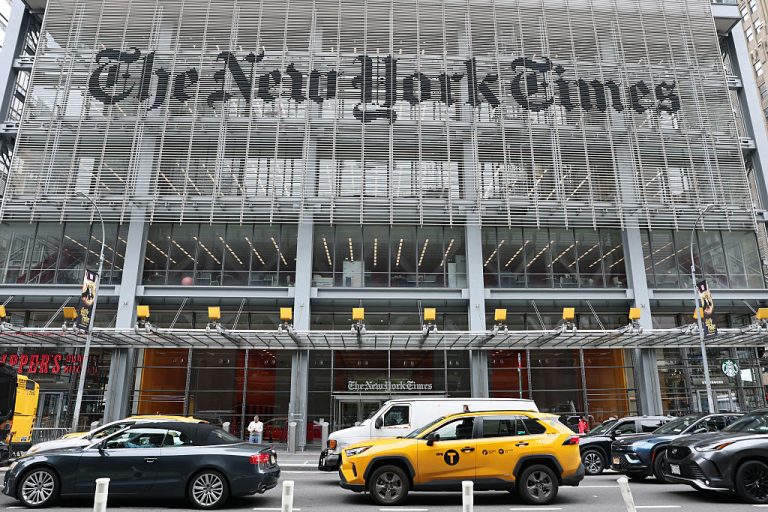
How the CCP ‘tamed’ The New York Times
Tang recalls that when he was first interviewed by The New York Times in 1992, reporters like Nicholas Kristof were known for their firm willingness to call out Communist China. Their reporting on the 1989 Tiananmen massacre earned them the Pulitzer Prize, making the paper a prime target of Beijing’s hostility.
The turning point, Tang says, came around the 2008 Beijing Olympics, when the CCP launched a global media influence campaign aimed at reshaping international opinion.
The strategy was clear: target and “tame” the most outspoken media organizations first. This done, the rest would follow.
Chinese enterprises began pouring advertising money into the Times and other Western outlets. As traditional print media struggled financially, these ads created economic dependency and fostered editorial compromise.
As one World Journal editor put it: “Without Chinese ad money, we’d have gone under long ago.”
When ads alone weren’t enough, Beijing allegedly used intermediaries — sometimes wealthy foreign “fronts” — to buy large stakes in media companies. Once they became major shareholders, control of editorial direction followed.
For Western “China correspondents” who needed to report from inside the country, the CCP’s control over visas became a powerful lever. Reporters who wanted continued access often had to soften their tone.
In the early 2000s, The New York Time had been wooed by former CCP leader Jiang Zemin, who even personally visited the Times’ office in Manhattan.
Kristof himself later described Xi Jinping as a “reformer,” citing the trivial reason that Xi’s daughter XI Mingze had studied at Harvard.
For Tang, this marked a fundamental ideological shift at The New York Times.
The creation of the Times’ Chinese-language edition deepened the concern—it became, in Tang’s view, a platform for CCP narratives, staffed largely by individuals with ties to China’s state apparatus.
The final straw: A killed investigation
In 2012, a veteran New York Times reporter spent over six months investigating offshore wealth tied to CCP elites. She approached Tang with thick files, seeking help verifying complex ownership structures. The piece was described as “a nuclear bomb” aimed at Beijing’s corruption network.
But just before publication, the story was abruptly killed due to “tremendous pressure.” The journalist, heartbroken, told Tang their editors had suppressed the piece. What could have been the pinnacle of her career was buried forever.
Though the BBC and New York Times differ in details, their trajectories reveal a troubling pattern: when left-wing ideology merges with external political and financial pressure, even the world’s most respected media institutions can be corrupted.
The decline of Western century-old media marks the end of an era and the dawn of a perilous “post-truth age,” where information’s value depends less on truth than on its emotional impact and alignment with ideology.
How can ordinary citizens navigate this fog?
People must recognize that ideological bias has seeped into every corner of the information ecosystem—from Google search results and Wikipedia entries to the data behind modern AI systems.
Tang Baiqiao’s experience illustrates this well: his English Wikipedia page once prominently labeled him a “well-known Trump supporter” — a politically charged tag used as a smear in today’s media climate.
Editorial note: Views expressed in this article are the opinions of the author and do not necessarily reflect the views of Vision Times.