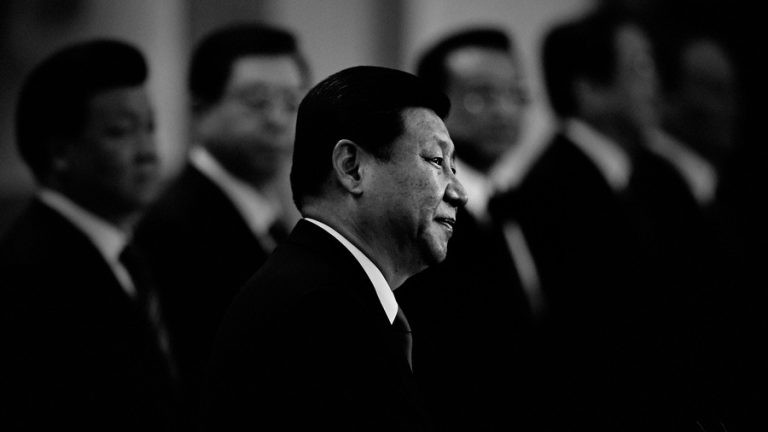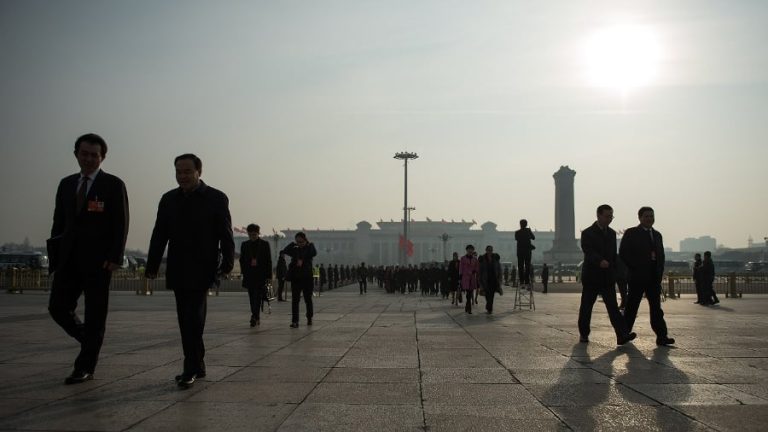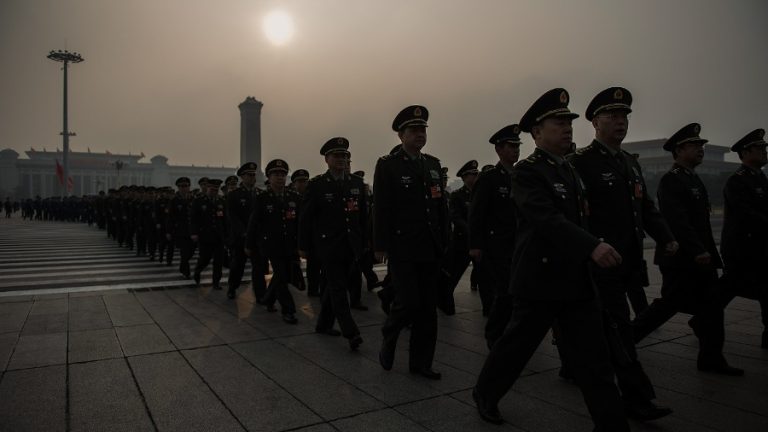
China’s military just wrapped up a ten-week program that confined hundreds of senior generals at a Beijing military academy and cut them off from the outside world. Analysts say Xi Jinping used the program to break the military’s top ranks from their loyalty to Zhang Youxia, the recently purged vice chairman of the Central Military Commission, and force them to pledge allegiance to Xi instead.
China’s military newspaper reported on June 24, 2026, that the first class of the program ran from April 8 to June 16 at the National Defense University in Beijing, China’s top institution for training senior military officers. Participants studied Xi Jinping’s political theory, watched warning films about military corruption, resang the Communist revolutionary anthem “Three Rules of Discipline and Eight Points of Attention,” reviewed party discipline and military regulations, recited their party oaths again, and used morning exercise periods to drill basic marching formations, according to the newspaper’s own account.
U.S.-based political commentator Li Muyang said on his online talk show that these details make clear this was no ordinary class. He described the program as a long, brutal purge that Xi personally launched against hundreds of the Chinese military’s most senior officers, comparable to the political rectification campaigns Mao Zedong used to root out disloyalty within the Communist Party.
The program ran 70 days in total. Lieutenant generals and major generals from across China’s armed forces were confined to the university campus in western Beijing for the duration, fully cut off from the outside world, with no social contact and no personal activities permitted. Officers spent the period studying military discipline in a format the newspaper described as combining expert coaching, group study, and individual self-study. They took notes, wrote reflection essays, and gave presentations, with particular emphasis on absorbing what the report called the “spirit” of Xi’s opening speech to the class.

The training program echoes Mao’s Yan’an Rectification Movement
The confinement program follows the same template as Mao Zedong’s Yan’an Rectification Movement of 1942 and 1943, when Communist Party cadres were gathered together for what was billed as study sessions but amounted to a political inquisition sorting the loyal from the disloyal. The Cultural Revolution ran the same tactic in wave after wave of “study classes” that kept Communist Party officials in a state of constant fear, and military rectification drives in the 1980s followed a similar playbook. Xi has now revived that model for China’s current generation of senior military leadership.
Success
You are now signed up for our newsletter
Success
Check your email to complete sign up
Officers in the class had to identify the political lines they could not cross and the punishments waiting if they did, according to the military newspaper’s report.
They were required to sing “Three Rules of Discipline and Eight Points of Attention,” a Communist revolutionary song whose central message, Li Muyang noted, is that every action must obey orders from above. He argued that Xi Jinping deployed this dated propaganda song to remind military leaders that they answer to the chairman of the Central Military Commission, the body that controls China’s armed forces and that Xi himself chairs. The anti-corruption films and study of disciplinary penalties served the same purpose, Li said: plain intimidation, telling officers that if they had done anything wrong, they knew it, and they should confess before they were caught.
Hundreds of lieutenant generals and major generals, men who command troops rather than march as recruits, were made to line up during morning exercise and drill basic formations they had not practiced since their earliest days in uniform. Li Muyang called it a deliberate act of public humiliation that doubled as a test of loyalty to Xi Jinping.

A power struggle inside China’s military forces generals to break with Zhang Youxia
China’s military newspaper described the ten-week program as an effort to improve capability. Li Muyang said the reality was obvious to any careful observer: more than two months of closed confinement was severe enough to invite comparison to the mass internment camps China has built in Xinjiang to detain Uyghurs and other Muslim minorities. Calling it a training class, he said, was a generous label for what amounted to imprisoning hundreds of generals together, subjecting them to forced loyalty indoctrination, and running a political review in which every officer had to pass muster.
Li connected Xi’s personal role in the program to the downfall of Zhang Youxia, vice chairman of the Central Military Commission, and Liu Zhenli, chief of the commission’s Joint Staff Department. Their removal probably had little to do with corruption, the official reason the CCP typically gives for purging senior officials. It looked more like the opening move in a fight by Xi Jinping to defend his grip on the armed forces after his control over the military ran into serious trouble.
Once the party announced that Zhang and Liu had fallen, Xi confronted the biggest problem facing him inside the military: knowing who could still be trusted. Zhang Youxia was one of Xi’s childhood friends, and even he had proven disloyal, leaving Xi deeply anxious about loyalty across the officer corps. A deeper investigation risks dragging in the military’s entire senior leadership, since Zhang spent decades building his network inside the armed forces and most of today’s top generals owe their promotions to him. Leaving those officers uninvestigated carries its own danger: Zhang’s former subordinates could regroup and turn on Xi later, leaving him worse off than before.
Caught between the two risks, Xi Jinping settled on a middle path. He gathered hundreds of generals into total confinement at the National Defense University and used public humiliation to force them to shift their allegiance from Zhang Youxia to himself.
Li Muyang said how the situation unfolds from here remains to be seen. He added that when a person defies natural order and pushes too far, retribution eventually catches up with him.