Commentary by Yuan Bin
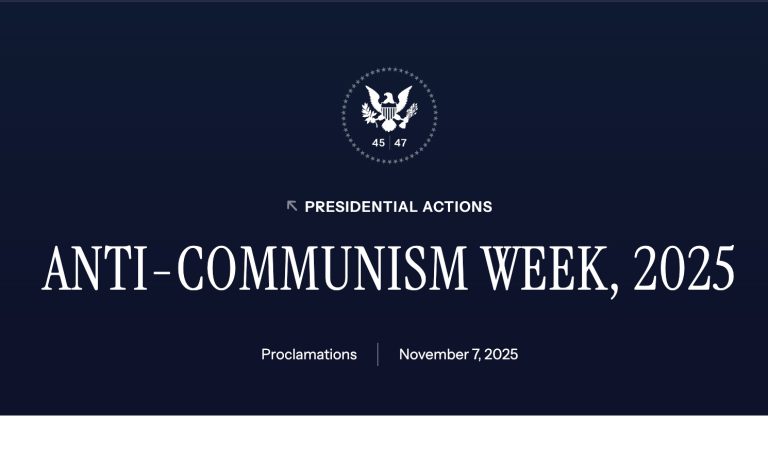
On Nov. 7, U.S. President Donald Trump signed a presidential proclamation designating Nov. 2–8 Anti-Communism Week so as to honor the hundreds of millions who perished under communist regimes, as well as reaffirm America’s commitment to freedom, human rights, and faith in the face of “the devastation caused by one of history’s most destructive ideologies.”
After the Cold War, wariness against communist ideology gradually faded from American politics. But since Trump’s election, the United States has gradually awakened from its earlier illusions about the Chinese Communist Party (CCP), restoring anti-communism to the national stage. The new proclamation further solidifies this stance.
Across continents and generations, communism has wrought devastation upon nations and souls. More than 100 million lives have been taken by regimes that sought to erase faith, suppress freedom, and destroy prosperity earned through hard work, violating the God-given rights and dignity of those they oppressed,” the proclamation states.
“For more than a century, communism has brought nothing but ruin. Wherever it spreads, it silences dissent, punishes beliefs, and demands that generations kneel before the power of the state instead of standing for freedom. Its story is written in blood and sorrow, a grim reminder that communism is nothing more than another word for servitude.”
Success
You are now signed up for our newsletter
Success
Check your email to complete sign up
Trump emphasized: “As we honor their memory, we renew our national promise to stand firm against communism, to uphold the cause of liberty and human worth, and to affirm once more that no system of government can ever replace the will and conscience of a free people.”
Defining the ‘new Cold War’ in political terms
Although the proclamation did not name China directly, its language unmistakably points to the CCP.
“Erasing faith” corresponds to Beijing’s persecution of religious groups such as Christians and Falun Gong practitioners; “suppressing freedom” calls to mind the CCP’s censorship and imprisonment of dissidents; “destroying prosperity earned through hard work” reflects the regime’s replacement of market vitality with state control.
Trump’s strategic intent is clear: to redefine the CCP as the central adversary of the free world and elevate economic rivalry to a clash of civilizations and values. This suggests a decisive framing of the “new Cold War” — one not limited to trade, technology, or military power, but a contest between freedom and tyranny.
The proclamation also warns against the “persistence of tyranny in new forms” despite the end of the Cold War and the collapse of the Soviet Union 34 years ago.
“New voices now repeat old lies, cloaking them in the language of “social justice” and “democratic socialism,” yet their message remains the same: give up your freedom, place your trust in the power of the government, and trade the promise of prosperity for the empty comfort of control.”
Trump pledged that the United States will reject this “evil doctrine” and that America will “remain a Nation founded on the eternal truth that liberty and opportunity are the birthrights of every person.”
This is clearly aimed at the growing far-left movement within the United States, particularly the rebranded socialist ideas gaining traction among younger generations. Trump views this as the weakening of America’s internal defenses—that anti-communism must be both an external and internal struggle, confronting ideologies that promise equality while stealing freedom.
Unlike the McCarthyism of the Cold War era, this is more a moral recalibration—an effort to prevent the spread of “soft totalitarianism” within academia, media, and Big Tech’s algorithmic censorship.
Symbolic weight for a global coalition
Trump’s choice to issue the proclamation on the anniversary of the 1917 communist revolution in Russia, as well as just months ahead of America’s 250th Independence anniversary carries symbolic weight. While warning against the ravages of communist ideology and rule, it also emphasizes the founding values of the United States at a critical time.
Over the past two years, American allies Japan, Poland, the Czech Republic, and South Korea have increasingly aligned in their China policies, forming a de facto “freedom front.” Trump’s proclamation provides this alliance with a boost in moral legitimacy and narrative.
In this context, the future alignment of democratic nations will not merely be one of interests, but of values as the United States reestablishes faith in freedom as a cornerstone of its global diplomacy.
“We honor the victims of oppression by keeping their cause alive and by ensuring that communism and every system that denies the rights to life, liberty, and the pursuit of happiness will find their place, once and for all, on the ash heap of history,” the proclamation adds.