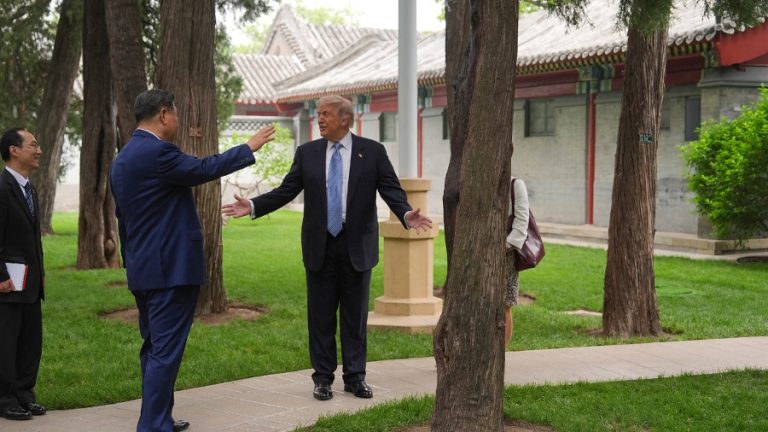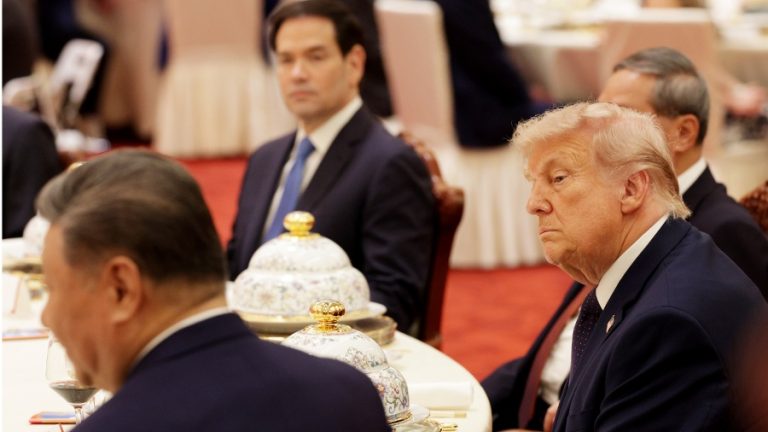
At the G7 summit held in Canada on June 17, when President Trump arrived late and entered the venue, he faced the leaders of various countries who were already seated and blurted out: “I’m the boss.”
The entire room immediately burst into laughter. Later, Trump explained that it was merely a joke — a playful remark intended to lighten the atmosphere. He even said that he himself did not expect the phrase to spread around the world.
Whether Trump likes to be the “boss” is a matter of public opinion. But at least within the framework of democratic politics, even if a president calls himself “the boss,” people understand that it is only a joke. This is because power is constrained by institutions: presidential terms are limited, the media can criticize the president, opposition parties can provide oversight, and voters can ultimately remove him from office through elections.
Does China’s ‘supreme one’ equal Xi’s ‘supreme one?’
However, in Beijing’s political context, “the boss” has never been a joke. For Xi Jinping, “the Supreme One” (一尊) is not merely a title bestowed by others; rather, it is a political reality that the entire system has continuously shaped.
On July 5, 2018, Xinhua News Agency quoted Xi Jinping as saying that the Communist Party Central Committee is the brain and the central command hub, and that the Central Committee must possess the authority to be “the sole arbiter and the final decision-maker.” As a result, people online began using terms such as “Xi the Supreme One” (习一尊) as a nickname.
Success
You are now signed up for our newsletter
Success
Check your email to complete sign up
Therefore, when the news broke, comments quickly appeared on platforms such as X (formerly Twitter) and Weibo, including phrases like “China’s ‘Supreme One’ was hit” and “Xi the Supreme One won’t be able to hold out for long.” A building called “Zun” (尊, meaning “supreme” or “revered”) being hit naturally acquired political implications in China in 2026.
Over the past decade and more, Xi Jinping has not only dismantled the collective leadership model that had taken shape within the Chinese Communist Party after the reform and opening-up era, but has also pushed personal power to a level not seen since Mao Zedong by amending the constitution to remove presidential term limits. From the “Two Establishes” (两个确立) to the “Two Safeguards” (两个维护), from enshrining “Xi Jinping Thought” in the Party charter and the Constitution, to officials at all levels displaying expressions of loyalty resembling a personality cult, the CCP has already formed a de facto structure of “one supreme authority” (定于一尊).
But the issue is that Xi’s political ambitions clearly do not stop within China’s borders. Today, Beijing is attempting to extend this logic of “one supreme authority” into the international arena.
From domestic control to global control
The Law of the People’s Republic of China on the Promotion of Ethnic Unity and Progress, which officially took effect on July 1, 2026, is the latest example.
The provision that has attracted the most international attention is Article 63, which states: “Organizations and individuals outside the territory of the People’s Republic of China that carry out acts against the People’s Republic of China that undermine ethnic unity and progress or create ethnic division shall be held legally responsible in accordance with the law.”
This means that Beijing has, for the first time, explicitly asserted through a dedicated law its authority to pursue legal accountability against individuals and organizations overseas. From a legal perspective, this represents a typical claim of extraterritorial jurisdiction.
The problem, however, is who defines what constitutes “undermining ethnic unity” or “creating ethnic division.” In democratic countries, legal concepts generally have clearly defined boundaries. Under the Chinese Communist Party system, however, such concepts often possess a high degree of political flexibility.
Would supporting the preservation of Tibetan culture count as an offense? Would speaking out in support of Uyghur human rights count? Would advocating Taiwan’s sovereignty and independence count? Would criticizing the Chinese Communist Party’s ethnic policies also count? The answer, clearly, lies in Beijing’s hands.
For this reason, the United States and the European Union, in a rare simultaneous move on July 2, expressed serious concerns over the law, criticizing its extraterritorial application as potentially violating principles of international law and warning that it could become a new tool for transnational repression. The U.S. State Department further stated explicitly that the United States would protect individuals within its territory from intimidation, harassment, and coercion by foreign governments.
Amnesty International has pointed out that the “unity” promoted by this law does not, in essence, refer to harmonious coexistence among different ethnic groups. Rather, it requires all groups to align themselves with the Chinese Communist Party’s political line. The law could provide a new legal pretext for the transnational suppression of overseas dissidents, ethnic minority activists, and human rights advocates.

‘Transnational repression’: Xi Jinping wants the world to listen to the CCP
If Mao Zedong’s era pursued “world revolution,” then what Xi Jinping is pursuing today is another form of global influence. This influence is not about exporting communist revolution, but about exporting the CCP’s authority to define what is politically acceptable.
In Beijing’s narrative: The Xinjiang issue cannot be discussed; The Tibet issue cannot be questioned; The Hong Kong issue cannot be criticized; The Taiwan issue must only be addressed under the principle of “One China”; Even the political positions of overseas Chinese are expected to remain aligned with Beijing.
In recent years, from overseas “police service stations” to the monitoring and pressure campaigns targeting overseas dissidents, Hong Kong democracy activists, and Xinjiang and Tibetan activists, Western countries have increasingly used one term to describe this phenomenon — “transnational repression.”
In recent years, countries including France, Canada, the United Kingdom, and the United States have investigated or shut down organizations suspected of being linked to China’s overseas police networks, believing they may have been carrying out Beijing’s directives on foreign soil.
The introduction of the Law on the Promotion of Ethnic Unity and Progress is, to some extent, an attempt to provide legal cover for such cross-border political activities.
In other words, Beijing is no longer satisfied with demanding that Chinese citizens obey the CCP; it hopes that the entire world will accept the CCP’s political red lines.
‘Elementary-school PhD’ and the expansion of power to the world
What lies behind this is actually a deeper political logic. In the modern international order, sovereign states are equal to one another. But within the political culture of the Chinese Communist Party — particularly in Xi Jinping’s recent narrative of the “great rejuvenation of the Chinese nation” — Beijing is not merely the political center of the PRC; it is portrayed as an authority whose views must be respected, and even obeyed, by overseas Chinese communities and the international community.
As a result, we have seen Beijing demand that multinational companies label Taiwan according to Chinese standards; require foreign airlines to modify the names displayed on their websites; pressure overseas films, independent media creators, and academic institutions to comply with China’s political red lines; and now even attempt to use Chinese law to constrain the speech and behavior of foreigners.
This is no longer ordinary great-power diplomacy, but rather an impulse to expand political jurisdiction beyond its borders.
True leadership comes from respect, not intimidating the world
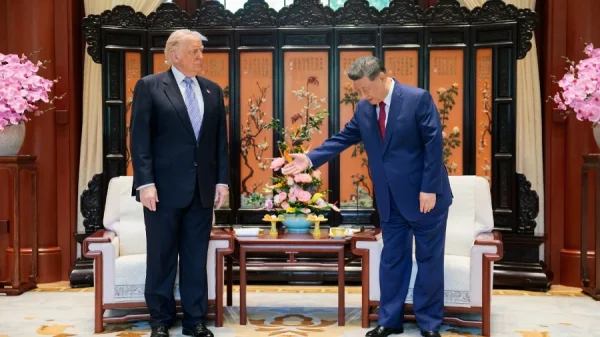
When Trump said “I’m the boss” at the G7, it was a joke shared with the world. No one truly believes that the U.S. president can order the leaders of other countries around. Xi Jinping’s issue, however, is precisely the opposite. He has never publicly declared, “I am the boss of the world.”
Yet judging from Beijing’s policies and legal arrangements in recent years, it is gradually sending a message to the outside world: not only must Chinese people accept the CCP’s political definitions — the world should accept them as well.
Trump’s remark “I’m the boss” ultimately remained just a joke. What Xi Jinping seeks is a serious global experiment in establishing “one supreme authority” (一尊) — from China’s “Supreme One” to a “Supreme One” for the world.
By actually drafting and implementing the Law on the Promotion of Ethnic Unity and Progress in an attempt to bind sovereign nations around the world, Beijing has, in the words of an old Chinese saying, “eaten the heart of a bear and the gall of a leopard” — meaning it has become extraordinarily bold and reckless. This will inevitably provoke opposition from the entire world. The beam that sticks out first will be the first to rot — in other words, the one who stands out by asserting supreme authority will become the first target of resistance.
(This article represents only the author’s personal views and opinions and does not necessarily reflect those of Vision Times.)