By Li Jingyao, Vision Times
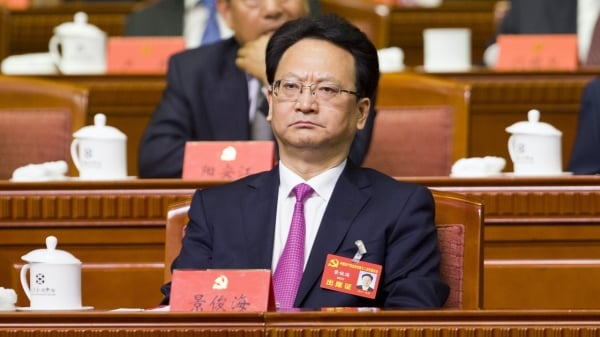
Fresh turmoil is unfolding within the Chinese Communist Party’s (CCP) top ranks following the recent detention of Xi’an Party Secretary Fang Hongwei. Multiple sources now claim that former Jilin Party Secretary Jing Junhai — long regarded as a fiercely loyal “house servant” of Chinese President Xi Jinping — has been taken away by the Central Commission for Discipline Inspection (CCDI) for “questioning.”
Analysts say the real target is not Jing himself, but Xi Jinping’s younger brother, Xi Yuanping, who allegedly oversaw the family’s sprawling political and financial interests across Shaanxi and beyond.
RELATED: Wong Kar-wai’s Leaked Audio Criticizing China’s One-Party Rule Pulled From Weibo
Jing Junhai snatched up by CCDI
Anti-CCP commentator Jiang Wangzheng alleged on Nov. 11 that Jing Junhai “was taken away this afternoon by the CCDI and sent to the Beidaihe Training Center for interrogation.”
Success
You are now signed up for our newsletter
Success
Check your email to complete sign up
Citing leaked internal information, Jiang claimed that Jing had leveraged his influence in Xi’an, Xixian New Area, and high-tech zones to facilitate personnel promotions and project deals during his stints in Beijing and Jilin — but that his true role was “taking bullets for Xi Jinping’s younger brother, Xi Yuanping,” who operated in Shaanxi under the aliases Bai Yu, Bai Ye, and Boss Bai.
RELATED: Hu Jintao Strikes Back: Xi’s ‘Dragon Vein’ Base Collapses as Hu Haifeng Flees to Xi’an
Another outlet, “Wall Street Today,” echoed similar claims, claiming that investigators had already sealed Jing’s residence and office. According to its reporting, Jing’s case intersects with the murky political lineage of senior officials Zhao Leji and Li Zhanshu, whose Shaanxi power networks long predate Xi Jinping’s rise.
Though Jing was quietly shifted in September 2024 to a lower-profile role as deputy chair of the NPC Education, Science, Culture, and Health Committee, sources say this was merely to “buy time” before the CCDI moved in.
A system built on fear
Commentator “New Highland” described Jing’s downfall as a reflection of the Party’s “absurdity and brutality.” He noted that Jing was long the model of a servile loyalist — fawning over Xi’s lineage and aggressively asserting political fealty — yet simultaneously presided over wasteful mega-projects and grassroots suffering. Most notably, he spearheaded the expansion of Xi Zhongxun’s mausoleum into an enormous estate of more than 40,000 mu, displacing farmers and livelihoods across Shaanxi.
RELATED: Beijing Pushes Loan-Driven Consumption: How Xi Jinping Is Undermining China’s Economy
“Loyalty built this way becomes a double-edged sword,” he wrote. “The moment one depends too much on a single ruler, he becomes the easiest target.” He added that Jing is merely “another pawn on the bloody chessboard,” warning that more “Shaanxi generals” may soon recognize that loyalty is a commodity, and too much of it can kill you.
Political analyst Tang Jingyuan said the focus on Jing stems from what he represents: The inner machinery of the Xi family’s power. For more than a decade, he explained, Xi Yuanping operated as the de facto “steward of the imperial clan,” overseeing the Xi family’s commemorative projects, political alliances, and extensive influence across Shaanxi and Gansu.
A fall from grace?
“Jing Junhai rose by building Xi Zhongxun’s massive mausoleum,” said Tang, adding, “His fall is a critical barometer of the Xi family’s fortunes.”
Jing’s case broke publicly at the same time as those of Fang Hongwei and Yue Huafeng — a cluster Tang says is not coincidental. “All of them were Xi Yuanping’s agents,” he said. “Investigating them inevitably leads to Xi Yuanping.”
Tang added that Xi Yuanping’s reach has expanded far beyond ceremonial family affairs. According to his sources, Xi Yuanping became a shadow operator inside the powerful National Security Commission — a body that touches “nearly every domain of state power.” That expansion opened channels to major state-owned enterprises, several of whose top executives are reportedly now under investigation.
“Xi Yuanping has become the next target. The sword is pointing directly at him,” said one commentator.
A broader contraction of Xi Jinping’s power
Analyst Lei Ge argued that Jing’s downfall underscores the accelerating erosion of Xi Jinping’s authority. He pointed to several recent signs: Xi’s loss of influence over the aerospace sector, the purge of Peng Liyuan’s Shandong network, and the sidelining of Xi’s Tsinghua-affiliated protégés. Personnel control — the core of CCP power — has shifted toward Hu Jintao’s longtime ally Shi Taifeng, who now dominates the Party’s Organization Department.
Producer Li Jun echoed the sentiment, saying Xi’s allies “are falling one after another,” while none of the recent promotions appear to favor Xi’s faction. “It seems both Party and government personnel power have slipped from Xi’s hands,” he said.
Even foreign observers have noted the shift. Tang Jingyuan added that investigations into Xi Yuanping’s circle are being framed using Xi’s own term — “cleansing toxic influence” — only now “it is being used against him.”
The Mausoleum that made, and doomed, Jing Junhai
Born in 1960 and raised in Baishui, Shaanxi, Jing Junhai spent years in propaganda work. His political ascent began in 2012 when, as Minister of the Central Propaganda Department, he oversaw the massive expansion of Xi Zhongxun’s mausoleum in Fuping County. What began as a 15-mu memorial site ballooned into a 40,000-mu megacomplex — “the largest mausoleum in world history,” overseas media quipped.
The project was completed in September 2015, just as Xi tightened his grip on power. Jing was rewarded with senior roles in Beijing and later Jilin, where he served as governor and then Party secretary before being demoted to a symbolic NPC position in 2024.
Now, analysts say, that same monument — built to glorify Xi’s lineage — may mark the grave of Jing Junhai’s political career, and possibly much more.