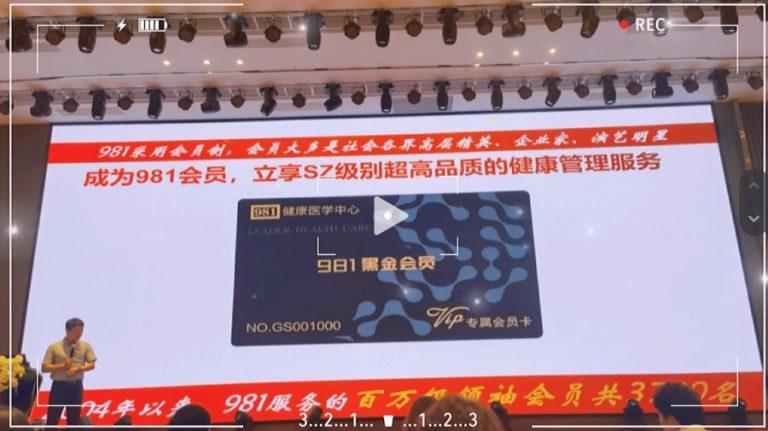
As public debate swirls around what Chinese leader Xi Jinping openly told Vladimir Putin — that humans in this century may live to 150 — several domestic biotech firms are stoking speculation that such longevity goals may not be far off. Their statements have reignited widespread attention toward the controversial “981 Chief Health Project,” a program long-rumored to focus on extending the lifespans of Chinese Communist Party (CCP) elites.
According to U.S. media reports, Liu Qinghua, chief technology officer of Lonvi Biosciences, dismissed skepticism surrounding Xi’s “150 years” remark, saying: “Living to 150 is absolutely realistic. It will become reality within a few years.”
Liu added that advancements in longevity science are progressing rapidly. “In five to ten years, no one will die of cancer,” he claimed.
Founded in 2022, Lonvi Biosciences established a laboratory in a Shenzhen commercial complex and developed an anti-aging capsule based on grape seed extract. Earlier research by Shanghai scientists found that a natural compound in grape seeds — Procyanidin C1 (PCC1) — could delay aging in mice and extend their lifespan by 9.4 percent.
Lonvi promotes its product as part of a “comprehensive health system,” claiming that, when combined with healthy lifestyle habits, it could help people live to 100 or even 120 years.
Success
You are now signed up for our newsletter
Success
Check your email to complete sign up
China’s booming longevity market
Not everyone is convinced. Critics argue that human lifespan is ultimately determined by natural limits, and that any attempt to extend it artificially “defies the order of heaven.”
Shanghai-based company Time Pie, which began as a dietary supplement brand, now organizes scientific conferences and publishes a magazine titled Slow Aging, Living Well.
Its co-founder, Gan Yu, said that longevity was once a niche topic among wealthy Americans, but that more Chinese citizens now have both interest and financial means to pursue it.
At a recent international conference in Shanghai, domestic and foreign scientists presented anti-aging research, while vendors promoted collagen creams, herbal tonics, cryogenic chambers, and pressurized oxygen pods — all marketed as ways to slow aging.
Another Shanghai firm, Rui Jian Future, says “technology can stop aging.” It invites customers to test its so-called “anti-aging magic box” — a chamber chilled to minus 128°C. Participants reportedly last only seconds before rushing out, shivering uncontrollably.
In Chengdu, healthcare company Chunshang operates what it calls the world’s largest “longevity hospital.” It promotes a concept called “Immortal Island,” described as a luxury medical resort offering blood analysis and preventive care. Founder Li Dale declined to specify where such an island might be located, saying only that it would be “an exotic location dedicated to long life.”
Meanwhile, Immortal True Dragon Fund, a Singapore-based investment group led by Chinese national Wang Boyang, is exploring business opportunities in cryogenic preservation, 3D-printed organs, and “whole-body replacement” — concepts that critics warn could cross ethical boundaries.
Dr. David Barzilai, founder of Barzilai Longevity Consulting in the United States, cautioned that treatments proven effective in animals rarely translate directly to humans.
He cited the case of rapamycin, a compound that significantly extends lifespan in mice but has uncertain effects on healthy adults.
Barzilai noted that while Beijing increasingly prioritizes longevity research, “strong political will does not guarantee high-quality science or successful application.”
The Shadow of the ‘981 Chief Health Project’
The surge of interest in anti-aging has revived memories of a viral 2019 WeChat video promoting the so-called “981 Chief Health Project,” which claimed it could extend the lifespans of senior Party leaders to 150 years. The video was swiftly deleted.
According to earlier online descriptions, the “981 Project” was established in 2005 and reportedly was comprised of three subprograms:
- “Health Promotion Project” (Eternal Youth)
- “Youth Regeneration Project” (Rejuvenation)
- “150-Year Longevity Project” (Lifespan Extension)
The project was said to involve institutions such as the PLA General Hospital (301 Hospital) and the Academy of Military Medical Sciences.
Public records show that 981 Health Technology Group was founded in Beijing’s Haidian District in March 2014, with Zhao Wei as chairman and Zhang Bo as general manager.
Its subsidiaries include 981 Beijing Health Medical Center, 981 Health Technology (Hainan) Co., Ltd., and 981 Tumor Prevention and Rehabilitation Center.
Promotional materials boasted of “decades of elite healthcare experience,” claiming to have served “more than 3,000 top-level members” since 2004. Advertising slogans on Douyin read:
“Health to 88, longevity to 150 is no dream,”
“Explore 981 — life renewed for the elite,”
“For those who pursue eternal youth.”
Public outrage over ethical boundaries
Social media users reacted with alarm. One commenter wrote: “Someone called to ask about body-part replacements — the staff asked what age parts he wanted! Are these spare parts grown like leeks?”
Another said: “You’re using young people’s lives to prolong the old and powerful — that violates the laws of heaven.”
Others questioned the morality of such programs, writing: “What’s a ‘high-end client’? Every life has equal value.”
Australian legal scholar Yuan Hongbing told The Epoch Times that since the Mao era, the CCP has maintained a secret healthcare system for top leaders. He described the 981 Project as an “upgraded version” of this network under Jiang Zemin and Hu Jintao, linking its evolution to the expansion of China’s organ transplantation industry.
Yuan claimed that the program serves a dual purpose — generating profits for elite power circles and supplying organs to senior Party officials — while also being used to influence foreign elites through illicit medical favors.
The World Organization to Investigate the Persecution of Falun Gong (WOIPFG) has cited data from Chinese state media showing that after the CCP began persecuting Falun Gong in 1999, organ transplants in China surged dramatically.
WOIPFG data based on Chinese state media reports indicate that between 1999 and 2006, liver transplants skyrocketed from 135 cases over two decades to more than 15,000 in just eight years.
Human rights advocates now warn that the alleged organ supply chain has expanded beyond Falun Gong practitioners to include ordinary citizens, particularly youth and children. Millions of disappearances reported each year have left families across China desperate for answers.
By Cai Siyun