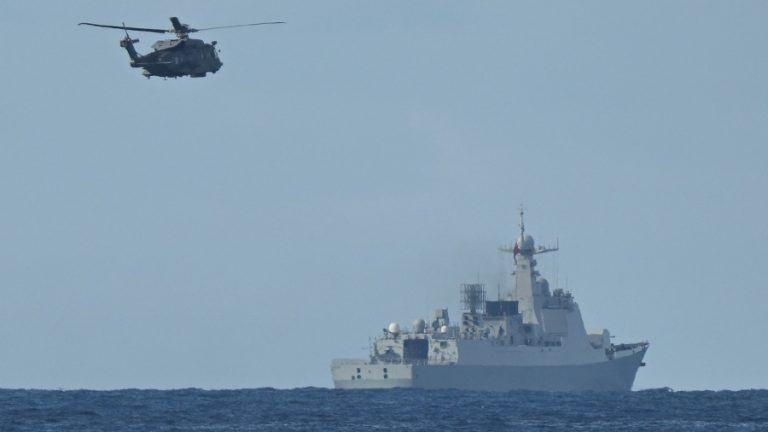
China has deployed more than 110 vessels along the First Island Chain, setting a new record high. According to Taiwan’s Director-General of the National Security Bureau (NSB), Tsai Ming-yen, Beijing has stationed around 100 naval and coast guard vessels across the East China Sea, Taiwan Strait, and South China Sea, while an additional four PLAN task groups are operating in the Western Pacific, including the South Pacific, waters south of Amami Ōshima, and east of the Philippines. Overall, the scale of Chinese naval deployments has been increasing.
Meanwhile, in response to the Chinese Communist Party’s increasingly severe military threat, Taiwan’s military has announced the restoration of “anti-communist patriotic education” for the first time in 24 years.
Chinese naval deployments increase; four PLAN task groups operating in the Western Pacific
According to Taiwan’s Central News Agency (CNA), National Security Council Secretary-General Joseph Wu said on July 4 that China has deployed more than 110 vessels along the First Island Chain, marking a historic high.
Responding to the development, NSB Director-General Tsai Ming-yen said that the period from July to September is the PLA’s regular peak season for theater-level military exercises. The NSB will continue monitoring related developments, observe whether this year’s routine PLA exercises exhibit any new characteristics, and compare them with previous drills to determine whether any new operational patterns have emerged.
Addressing the large-scale mobilization of Chinese naval forces, Tsai said that China has deployed approximately 100 People’s Liberation Army Navy (PLAN) and China Coast Guard vessels throughout the East China Sea, Taiwan Strait, and South China Sea.
Success
You are now signed up for our newsletter
Success
Check your email to complete sign up
He added that, as China enters its annual military exercise season, four PLAN task groups are currently operating in the Western Pacific: one in the South Pacific, two south of Amami Ōshima in Japan, and one in waters off Santa Ana, east of the Philippines. As a result, China’s overall maritime deployment has indeed shown an upward trend during the current exercise season.
Regarding joint China–Russia military exercises, Tsai Ming-yen said that China and Russia conduct one to two joint exercises annually. Their purpose is to demonstrate the two countries’ strategic geopolitical cooperation and to counter the denial-and-defense posture established by U.S. allies along the First Island Chain. As such, the exercises reflect the broader strategic rivalry between the United States’ Indo-Pacific alliance network and the China–Russia partnership. Taiwan’s National Security Bureau will continue exchanging intelligence with its international partners to closely monitor related developments.
Asked about footage recently released by Chinese state media showing PLA exercises at the Zhurihe Training Base, where a building resembling Taiwan’s Presidential Office Building appeared in the background, Tsai said the NSB has been monitoring the matter closely.
He noted that the PLA has constructed mock-ups of Taiwanese urban buildings at training facilities in northwestern China. Some of these facilities also feature replica foreign naval vessels used as targets for missile testing.
Tsai added that Taiwan’s National Security Bureau is able to monitor China’s missile test launches through technical intelligence and surveillance capabilities. By assessing the damage caused during these tests, the agency can evaluate the accuracy and target destruction effectiveness of Chinese missiles.
READ MORE:
- China’s Ethnic Unity Law Sparks Concerns Over Extraterritorial Reach
- Taiwan, Beijing Clash Over AIT Director’s Comments on Cross-Strait Status Quo
Restoring ‘anti-communist patriotic education’
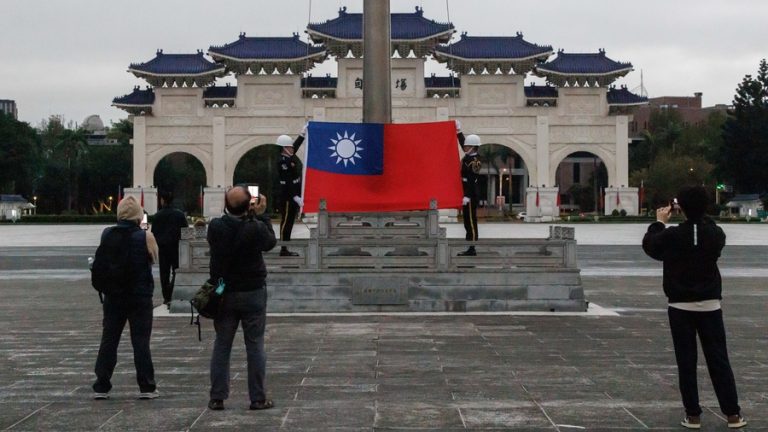
Meanwhile, in response to the escalating threat posed by the Chinese Communist Party (CCP), Taiwan’s Ministry of National Defense (MND) announced on July 5 that the military will restore “Anti-Communist Patriotic Education”. The program is intended to strengthen graduates of Taiwan’s eight military academies in their understanding of friend-versus-foe distinctions, with a particular focus on recognizing enemy threats and reinforcing the military’s mission of why they fight and whom they fight for.
According to Taiwan’s Liberty Times, the 2026 Joint Graduation Ceremony of the Three Armed Services and Eight Military Academies was held on the morning of June 30, with President Lai Ching-te presiding over the event. On July 1, Chief of the General Staff Admiral Mei Chia-shu delivered a keynote address on the “2026 Anti-Communist Patriotic Education” program at the Fuxinggang Campus of National Defense University. On July 2, Mainland Affairs Council Minister Chiu Chui-cheng and National Museum of History Director Chen Yi-shen lectured on related topics. On July 3, National Security Council consultant Huang Chung-yen analyzed the Chinese Communist Party’s recent tactics and methods of conducting cognitive warfare against Taiwan.
The Ministry of National Defense (MND) said on July 5 that, in order to instill patriotic values and reinforce military commitment among graduates of Taiwan’s military academies, the armed forces have conducted a dedicated educational program each year before or after the graduation ceremony since 1965. The program’s name has changed several times over the years. In 2002, it was renamed from “Anti-Communist Patriotic Education” to simply “Patriotic Education.” This year, however, the original title has been reinstated.
The ministry explained that the change reflects the increasingly severe military threat posed by the CCP toward Taiwan, along with Beijing’s intensified United Front infiltration efforts and gray-zone activities. As graduates of Taiwan’s military academies form the backbone of the armed forces’ junior officer corps, the ministry said it is essential that they clearly understand the country’s national security challenges and fully appreciate their mission of “why they fight and whom they fight for.” Consequently, the military has restored the “Anti-Communist Patriotic Education” program beginning this year.
According to the MND, the revised curriculum places greater emphasis on understanding enemy threats. Lecturers include senior officials from the Mainland Affairs Council, National Security Council, Ministry of Justice Investigation Bureau, and the military’s Military Intelligence Bureau, as well as scholars from Academia Sinica. The courses cover the government’s cross-strait policy, the CCP’s military threat to Taiwan, cognitive warfare, infiltration and recruitment operations, and the expansion of authoritarian influence. The objective is to cultivate a clear understanding of friend and foe among graduates and prepare them to fulfill their mission of defending the nation and protecting its people.