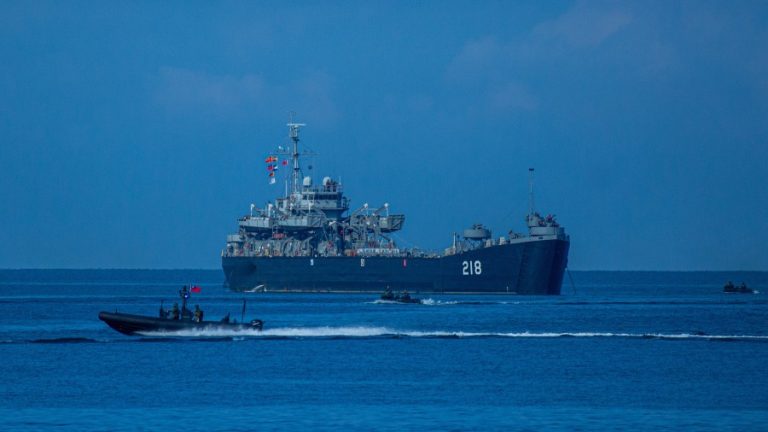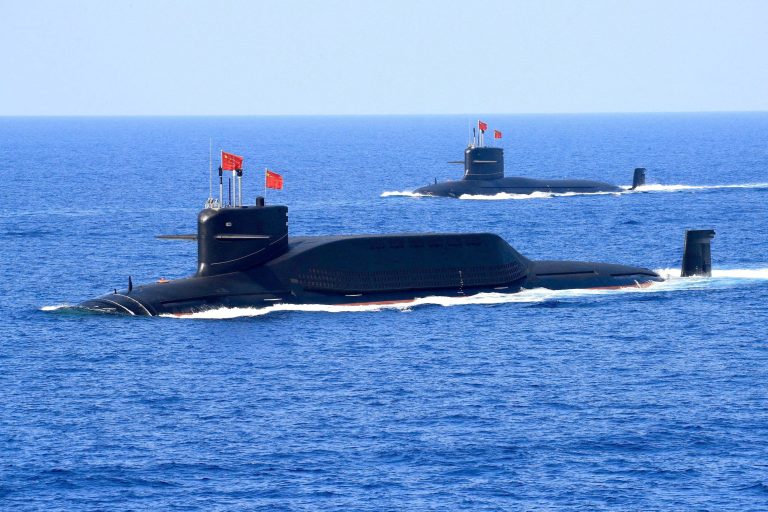
A nuclear submarine of the Chinese People’s Liberation Army (PLA) Navy test-fired an intercontinental ballistic missile (ICBM) in the Pacific Ocean on Monday, July 6, during the large-scale RIMPAC 2026 naval exercise led by the United States.
The launch came just hours after Beijing notified several Pacific island nations of the planned test, according to China’s state-run Xinhua News Agency. It marked China’s latest strategic missile test over the Pacific since it last launched an ICBM into the ocean in September 2024.
It is only the second time that China has successfully test-fired a submarine-launched ballistic missile (SLBM) into open ocean, the first time being in 1988. The Chinese government did not disclose what type of missile was tested or the submarine used to launch it.
Most Chinese SLBM tests are conducted with the main flight path being over the country’s land territory.
SLBMs are a major part of the so-called “nuclear trident,” referring to strategic nuclear weapons fired from submarines, land-based silos or launchers, and bombers. Nuclear missile-carrying submarines in particular are a key aspect of nuclear deterrence because a country that possesses them has a greater chance of retaliating even in the event of a massive nuclear first strike by an enemy power.
Success
You are now signed up for our newsletter
Success
Check your email to complete sign up
According to one American defense expert, the timing of the launch carries significant geopolitical implications because it coincided with the region’s largest multinational naval exercise led by the United States.
Grant Newsham, a senior fellow at the Center for Security Policy and the Japan Forum for Strategic Studies, told Vision Times that the launch provides China with the same operational benefits any military gains from testing a strategic weapons system. More importantly, however, he said the test should be viewed through a political and psychological lens, with Beijing seeking both to demonstrate its military capabilities and to intimidate potential adversaries.
RECENT COVERAGE
- Russia Begins Production of Su-35S Fighter Jets for Iran, Report Says
- Iraq Arrests 67 Officials in Sweeping Anti-Corruption Campaign
- Why Chinese Defense Minister Dong Jun’s Absence From International Forums Is Making Headlines
“Keep in mind that RIMPAC 2026 is ongoing in and around Hawaii. China was not invited and the nations that are participating are actual or potential US allies and partners in a fight against China,” Newsham said.
Hosted by the U.S. Pacific Fleet, the 30th Rim of the Pacific (RIMPAC) exercise is the world’s largest international maritime warfare exercise. It is being held from Tuesday, June 24, through Friday, July 31, around the Hawaiian Islands and Joint Base Pearl Harbor-Hickam. This year’s theme is “Partners: Integrated and Prepared.”
According to Newsham, the missile launch was intended in part to warn regional countries against moving closer to Washington.
“Most countries won’t be swayed. But some will be,” he said.
Governments express concern over missile launch
The United States, Japan, Australia, New Zealand, and Taiwan all criticized the test, while Beijing said the launch should not be overinterpreted.
While still dwarfed by the combined size and strength of the U.S. military and allied forces, the Chinese PLA has been rapidly expanding in recent years, becoming arguably the primary power in the Asia-Pacific area.
In particular, the PLA has added hundreds of nuclear warheads and missiles to its strategic arsenal, with U.S. authorities saying that China could have more than 1,000 nuclear bombs of all types by 2030.
U.S. State Department spokesman Tommy Pigott said, according to Reuters, that Washington had monitored the launch of the intercontinental ballistic missile, which landed in the South Pacific Ocean.
“We continue to urge China to engage in meaningful arms control discussions,” Pigott said.
Japan, Australia, and New Zealand were notified only shortly before the launch, Reuters reported.
- Satellite Images Reveal Expansion of China’s Nuclear Infrastructure in Sichuan
- Russia’s Top Leadership Approved Secret Training Mission to China, Sources Say
The test came “in the context of a rapid military buildup by China, which is lacking in the transparency and reassurance as to intent that the region expects,” Australian Foreign Minister Penny Wong told reporters during a news conference in Fiji.
Newsham argued that the missile launch was also directed at Pacific island nations. He noted that it came shortly after Fiji and Australia signed a mutual defense agreement and amid reports that Taiwan could be invited to attend the Pacific Islands Forum (PIF) later this year.
“China is angry that Taiwan might be invited to attend the PIF [Pacific Island Forum] meeting later this summer in Palau,” he said, adding that Australia had also recently signed another security agreement with Vanuatu.
The 55th Pacific Islands Forum Leaders Meeting is scheduled to be held in Palau from Aug. 30 to Sept. 4.
According to Newsham, the missile was launched into waters covered by the Treaty of Rarotonga, also known as the South Pacific Nuclear Free Zone Treaty, which established a nuclear-weapon-free zone across much of the South Pacific.
“So sending this missile into the Southern Pacific — a ‘nuclear free zone’ as the Pacific Nations see things and agreed to in the Treaty of Roratonga is a shot across the bow to all Pacific Island nations — and Australia and New Zealand as well. Beijing is saying, ‘we’re not happy and we will cause you trouble if you don’t behave,'” he said.
Newsham also noted that the missile test coincided with the China-Russia Joint Sea 2026 naval exercise in Qingdao, which began on July 6 and is scheduled to conclude on July 13. In his view, the overlap underscores the increasingly close security and political relationship between Beijing and Moscow.