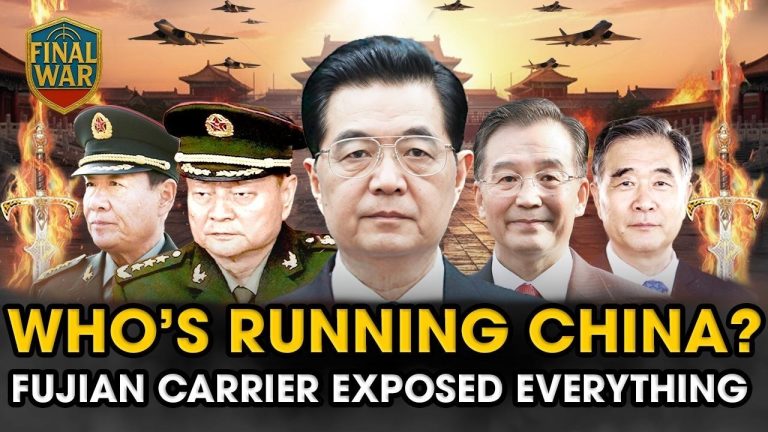
To watch the full episode, please click on the FinalWar’s official YouTube channel here.
Who is really ruling China right now? Behind the walls of Zhongnanhai, vast political currents are shifting, and according to newly-surfaced evidence, the Chinese Communist Party’s (CCP) Fourth Plenary Session marked far more than a routine Party meeting.
As host Katherine Hu opens in the newest episode of FinalWar, the central question is simple but seismic: “Who actually holds the reins of power in Beijing right now?” At stake is not only the fate of the Yu Menglong case, but the future of the Chinese political system itself.
Hu reminds viewers that FinalWar is built only on confirmed intelligence — never rumor — and that this episode is “critical.” She notes that behind the staged antics of polished headlines and choreographed speeches, there is something much deeper at play. “These questions matter. Because they don’t just define the fate of the ‘Yu Menglong case,’ they define whether the Chinese people can finally break free from the structure that has ruled them for decades,” says Hu.
RELATED: He Weidong and Miao Hua Purge Signals Deep Military Turmoil in China
The quiet return of Hu Jintao
Success
You are now signed up for our newsletter
Success
Check your email to complete sign up
The biggest surprise, according to Hu, is not Xi’s behavior, but Hu Jintao’s. The former leader, long seen as a withdrawn elder, has re-emerged as the paramount force shaping the transition. Outwardly, Xi still appears. In reality, Hu explains, his presence is camouflage: A staged “illusion of control” meant to preserve Party stability.
Katherine Hu says Xi now resembles “the disgraced emperor,” while Hu Jintao acts as “the retired emperor now returning to restore order.” His guiding instinct, of “never airing out the family’s dirty laundry,” is why Xi’s resignation was never formally announced. Instead, the elders allowed him to remain on stage while power moved elsewhere.
Hu Jintao’s influence is backed by the generals he once promoted. Most significant among them is General Zhang Youxia, now described as “the single most powerful man in China’s military today.” Katherine Hu states plainly that “today, the Chinese military takes orders only from Hu Jintao.”
This reality explains why Xi has not publicly resisted. Hu alone had the stature — and the loyal commanders — to enforce the demand that Xi relinquish control of both Party and military leadership.
A new decision-making core
Since June 2025, a little-known organ — the Central Party Decision-Making and Coordination Body — has quietly replaced the Politburo Standing Committee (Beijing’s top ruling body) as China’s true center of power. It now oversees the Party, the government, and the military. Hu outlines its structure as:
- Wen Jiabao — overall coordinator
- Wang Yang — running daily Party affairs
- General Liu Yuan — acting Chairman of the Central Military Commission
Behind them operates what insiders call the “shadow council”: Hu Jintao and Zhang Youxia, who meet privately with Wen and make the final calls. In institutional terms, power now rests on a “triple-pillar structure”: Hu Jintao as Party authority, Wen Jiabao as administrative authority, and Zhang Youxia as military authority.
Its purpose is transitional: Steer the system back toward Deng-era pragmatism, stabilize the economy, and guide China toward the 21st Party Congress in 2027, where Hu Jintao’s protégé Hu Chunhua is expected to formally take the helm.
Hu Chunhua’s emerging role
While the CCP maintains a façade of order, internal signals point clearly toward Hu Chunhua’s elevation. After the plenary session, Standing Committee members published signed articles — something unheard of since Xi centralized power. But Hu Chunhua went further: He published his piece before all of them, despite holding a lower rank. “We must earnestly study and implement the spirit of the plenary session,” Hu starts off with.
But Hu asks: Who exactly is included in this “we”? Her analysis is that Hu Chunhua’s article “read less like a subordinate’s praise and more like a leader’s inaugural tone,” laying out the next Five-Year Plan as if preparing the blueprint for succession.
State media has also begun promoting the phrase “Chunhua Qiushi” — a wordplay clearly designed to introduce him to the public as a future leader. In CCP propaganda, nothing is accidental.
Xi edited out
For many analysts, the clearest sign of Xi’s fall came not from speeches, but from a pair of dueling Xinhua reports separated by exactly 41 seconds. At 6:32 p.m. on Nov 3, state mouthpiece “Xinhua News” published a report on the military’s study session featuring Zhang Youxia. It still referenced Xi-era slogans such as “resolutely uphold the Two Establishes.”
But 41 seconds later, a second near-identical story appeared, but the slogan was gone. The phrase “Two Establishes,” defined in search results as: “To establish Xi as the core of the Central Committee and of the entire Party. And to establish Xi Thought as the guiding ideology of the new era.”
This was the political DNA of Xi’s personal rule, notes Hu. Its deletion signaled the symbolic end of his leadership.
A ceremony gone wrong
Xi’s appearance at the commissioning of the Fujian aircraft carrier should have been a triumphant display. Instead, it exposed his weakness. Hu lists four anomalies, including:
- A two-day delay in state media reporting, breaking decades of precedent.
- The wrong official presided. Zhang Shengmin hosted the event; Zhang Youxia did not attend.
- Only one full general was present—a stark contrast to the six at the Shandong commissioning.
- Key rituals were canceled: No honor guard review, no engineer group photo, no red carpet.
The images released, with Xi surrounded by only a handful of deck crew, spoke to his isolation.
The system moves on
By now, Xi has effectively stepped aside. Decision-making rests with Hu Jintao, Wen Jiabao, and Zhang Youxia, while daily execution is handled by Wang Yang, Hu Chunhua, and Liu Yuan. The Party’s architecture has already shifted toward collective leadership. Hu Chunhua is positioned as the next general secretary in 2027.
Yet the larger question remains: can this transition truly hold? Hu closes the episode with three unresolved questions:
- Will the peaceful transition envisioned by the elders truly happen on schedule?
- Will the new leadership answer the voices of millions who still long for freedom and dignity?
- And will they carry out the hardest task of all — to lead China through a peaceful transformation of its system?
To watch the full episode, please click on the FinalWar’s official YouTube channel here.