By Li Jingyao, Vision Times
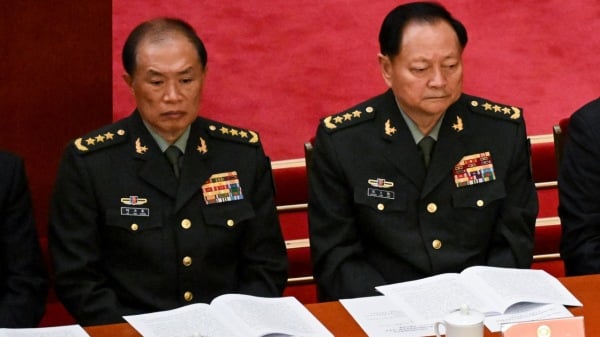
As the Chinese military undergoes its most severe purge in decades, President Xi Jinping’s loyalists are being driven out in droves as reports say Zhang Youxia now effectively “rules the army.” To further muddy the waters, now a shocking commentary by state mouthpiece “The People’s Daily” (PLA Daily) has warned that unless “rotten elements” are weeded out, the military risks facing “gunfire.”
In Beijing’s political lexicon, such language is almost never used unless a real armed threat is involved. The article has intensified speculation that the PLA recently faced an attempted mutiny, internal confrontation, or a foiled armed move.
RELATED: CCP in Crisis: Internal Control Ramps Up as Japan Signals Taiwan Support
On Nov. 13, the PLA Daily released a commentary titled: “The More Thorough the Anti-Corruption Fight, the More Solid the Centenary Foundation — Deepening Political Rectification and Advancing Integrity and Discipline (Series 2).” According to political analysts, it signals further rifts within the CCP’s top echelons.
A scathing piece
Success
You are now signed up for our newsletter
Success
Check your email to complete sign up
The piece argued that probing the corruption cases of He Weidong and Miao Hua was essential to preserving the Party’s absolute control over the military and to “eradicate the soil that breeds corruption.” But a single phrase sent shockwaves through the political world: “If we fail to completely eradicate harmful elements before gunfire breaks out, it will leave major hidden dangers for political security, and the consequences at critical moments would be unimaginable.”
The messaging was unmistakable — authorities believed a real, imminent threat existed inside the military. Commentator Xiao Shuojia stressed that “gunfire” is among the most politically sensitive terms in China’s propaganda system. “This term is never used casually. Its approval signals a specific political intent at the military level,” said Xiao.
He argued that the PLA has entered a “highly unstable and dangerous phase,” and that the fragile balance between Xi Jinping and Zhang Youxia is “being torn apart bit by bit.”
Xiao also emphasized that the wording implied an armed threat, not bureaucratic dysfunction: “Gunfire in the military does not refer to misfires or training. It means someone was preparing to use force — a possible rebellion, internal clash, or armed move.”
Commentator Li Linyi agreed, saying the PLA Daily’s warning about “major political dangers” resembled references to mutiny or a foiled coup attempt — an indication that someone “was preparing to act and was detained before shots were fired.”
Official documents hint at ‘disloyalty’
The CCP’s Fourth Plenum communiqué on Oct. 23 explicitly accused He Weidong, Miao Hua, and others of “betraying loyalty” and “seriously undermining the principle that the Party commands the gun and the system of CMC Chairman responsibility.” The PLA Daily followed by declaring the purge had “eliminated major political risks.”
NTU emeritus professor Ming Chu-cheng noted that the accusations went far beyond typical corruption language, suggesting disloyalty to the top leader, or worse:
Version 1: Xi targeted He Weidong and Miao Hua
One version circulating online, summarized by columnist Du Zheng, argues that Xi:
- Promoted Miao Hua to control personnel
- Elevated He Weidong unusually quickly to CMC vice chairman
- Ignored widespread selling of positions under Miao Hua, which later became political ammunition
According to this view, He Weidong then challenged the system — probing equipment procurement tied to Zhang Youxia and exposing “fake combat readiness” during the 2024 Two Sessions. Zhang allegedly counterattacked. After Miao Hua was detained, He Weidong soon “disappeared,” unable to withstand retaliation from a powerful princeling.
Version 2: Zhang Youxia launched a preemptive strike
Former Central Party School professor Cai Xia believes the opposite: that Zhang Youxia moved first.
She argued that investigations into Rocket Force corruption and procurement irregularities threatened Zhang directly, prompting him to act before he could be purged. The collapse of He Weidong, Miao Hua, and nine other generals, she said, could represent Zhang’s coordinated counterattack.
Political analyst Chen Pokong added that many purged generals — He, Miao, Lin Xiangyang — belonged to Xi’s home base, the 31st Group Army. Their fall suggests Zhang Youxia has been systematically dismantling Xi’s military network.
Newly promoted CMC vice chairman Zhang Shengmin is believed to be aligned with Zhang and may have secretly monitored He Weidong on Zhang’s behalf. Chen noted that after the Rocket Force imploded, Zhang Shengmin “joined Zhang because it was the safest option.”
Is Zhang now reporting to a CCP ‘council of elders’?
Journalist Guo Jun said on Elite Forum that Zhang Youxia’s post–Fourth Plenum tone shifted dramatically. Once he pledged loyalty to Xi by name; now he merely speaks of “resolutely implementing the decisions of the CMC,” avoiding references to Xi as the core.
“In CCP political language,” Guo explained, “this means the army is told to listen to the Central Committee, not Xi. It reflects a redistribution of power.”
Guo also cited reports that Zhang Youxia is now answering directly to a CCP “elders’ coordination group,” allegedly led by Hu Jintao, with Wen Jiabao, Hu Chunhua, Wang Yang, and Liu Yuan also involved. Their goal, he said, is to maintain regime survival — with Xi reduced to a symbolic figurehead who absorbs public blame.
Purged by the dozens
During Xi Jinping’s 13 years in power, he promoted 79 full generals. Now:
- 5 were removed in 2023
- 9 more, including He Weidong, were expelled in October 2025
- Dozens more are rumored to be under investigation
- Nearly half of Xi’s top military promotions have collapsed.
At the Fourth Plenum, 27 senior military leaders were missing, including 22 full generals.
Even General Wang Wenquan, who appeared at the plenum, was absent from the Nov. 5 commissioning of the Fujian aircraft carrier — triggering speculation that he, too, is under investigation.
One insider claimed the number of purged lieutenant generals and major generals could exceed one thousand, underscoring the unprecedented scale of the upheaval.
Editorial note: Views expressed in this article are the opinions of the author and do not necessarily reflect the views of Vision Times.