After the Fourth Plenary Session of the Chinese Communist Party (CCP), a new wave of mental control has surged. Recently, Chen Xi published an article in the People’s Daily, openly pledging loyalty to the core, echoing Zhang Youxia’s military directives, showing that the CCP’s death throes are intensifying. However, Sanae Takaichi’s remarks on “Taiwan contingency” have further thrown the CCP into the awkward position of a new “secure the home before dealing with outsiders” dilemma.
Following the Fourth Plenary Session, Xi Jinping’s dictatorial regime has used the 15th Five-Year Plan as its main thread, enforcing “internal stability” through violent lies. Amid a dual crisis of politics and economy, Takaichi’s bold stance forces the CCP to sway precariously in the trap of “securing the home before dealing with outsiders.”
Takaichi’s “Taiwan contingency” implies a subtle Japanese acknowledgment of Taiwan’s independence. Defining the CCP as an enemy is certain and amounts to a declaration of war against Communist tyranny. Beyond its overt threats of violence, the CCP has hinted at pre-war alerts through “travel advisories” and live-fire exercises at a distance, giving outsiders the false impression that China would target Japan before “unifying Taiwan by force.”
In reality, Takaichi dealt a severe blow to the CCP’s intimidation, leaving even CCTV anchors sweating and trembling with outrage during broadcasts.
Originally, “securing the home” before the 15th Five-Year Plan was inevitable. Xi, in a desperate sprint, uses the CCP to protect himself, his power, vanity, and immunity from purges. Yet he can only pursue ideological control of society—crazy “virtual work” enforcing three unities: unified thought, unified will, and unified action—patching the system’s pre-existing fractures.

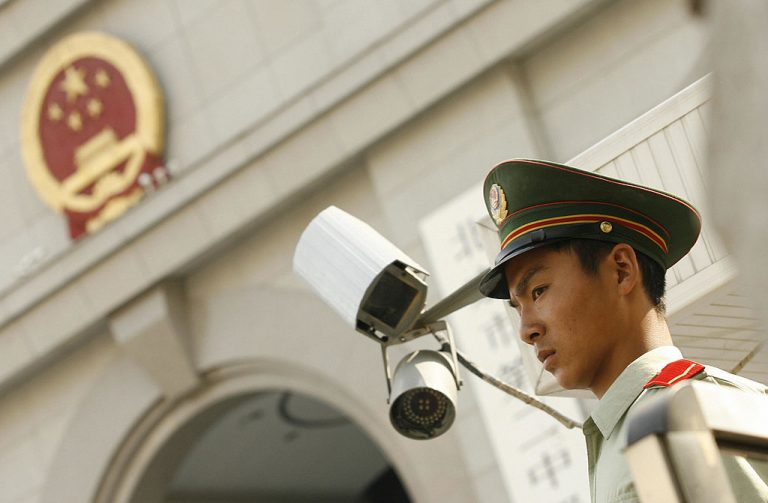
Chen Xi:The Party’s Inquisitor and a Barometer of Xi’s Power
Success
You are now signed up for our newsletter
Success
Check your email to complete sign up
Chen Xi’s prominence is clearly a poisonous warning to officials within the system, aligning with Zhang Youxia’s military “party rectification” orders.
Viewed through the lens of CCP history, the regime’s internal “rectification campaigns” have evolved dramatically. What began in Yan’an as open ideological purges — “struggle against one’s comrades” — has now morphed into a bureaucratic inquisition disguised as routine discipline.
Today, the man presiding over this system is Chen Xi, Xi Jinping’s longtime confidant and the de facto head of the Party’s internal enforcement apparatus — the twin “East Factory” and “West Factory” of modern authoritarian control.
Holding the dual titles of head of the CCP’s Organization Department and president of the Central Party School, Chen Xi wields power once reserved only for Politburo members.
In his hands, the tools of Leninist orthodoxy — the hammer and sickle — have become both symbols of loyalty and instruments of punishment.
Before Xi Jinping’s rise, a Central Party School president would never have exercised such unrestrained power. Under Xi, however, the Party’s internal rules — once sacrosanct even within its authoritarian structure — have been shattered.
By elevating Chen to this position, Xi effectively centralized the fate of more than 90 million Party members and nearly 9 million officials under a single chain of command.
Chen’s authority over promotions, demotions, and investigations has turned him into the barometer of Xi’s dominance — a living indicator of how far the Chinese leader’s cult of control has penetrated the Communist Party’s bloodstream.
The recent state-media coverage of Chen Xi was impossible to miss.
With its bold headlines and unmistakably authoritarian tone, the report functioned less like a news article and more like an imperial edict — a public proclamation of where loyalty must now be directed.
One curious detail stood out: the article quietly omitted the slogan of the “Four Confidences.” Whether this signaled that the doctrine was deemed redundant, internally contradictory, or simply already embedded in the neural circuitry of CCP officials, the implication was unmistakable — it no longer needed to be repeated.
Far more important was the new ideological command embedded in Chen Xi’s remarks, now elevated to the status of a publicly issued Party decree:
“Leading cadres must uphold the ‘Two Establishes’ with unwavering conviction,
and resolutely fulfill the ‘Two Safeguards.’”
Within the Party’s political culture, such language carries a clear message for the millions of officials operating inside the system:
material security comes only at the price of unquestioning loyalty.
For those pursuing power, wealth, or romantic entanglements, the expectation is absolute:
they must be willing to expend their lives and reputations in service to the leader, and in return, they may receive nothing more than a lavish funeral draped in a blood-red Party flag — an honor devoid of spiritual meaning in a system that officially denies the existence of an afterlife.
The report notes that “cadres from China’s Pudong, Jinggangshan, and Yan’an training academies” watched the video simultaneously. These are three CCP-level training bases for in-service officials, including expert training for promotion. Political screening is the essence; revolutionary tradition and party cultivation are mere cult terms.
If following this line of thought, Xi aims to make the CCP a “listed party” whose value could surpass any other, even if that chance is infinitesimal.
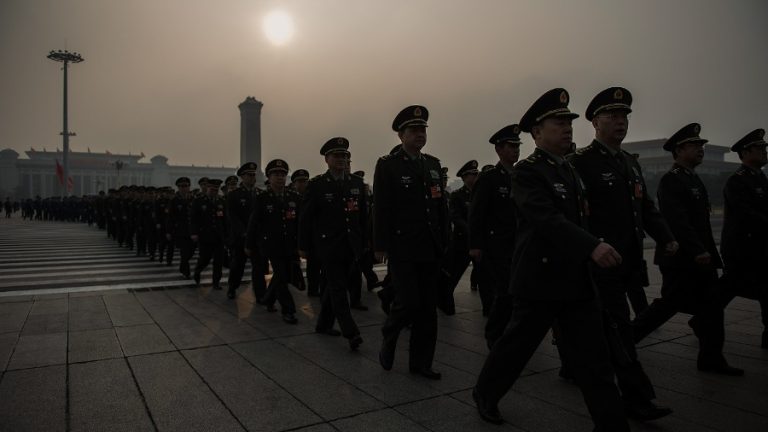
Regarding the violent arm of the regime, the gun comes first. On Nov.12, CMC First Vice Chairman Zhang Youxia published an article in the People’s Daily, though some external analyses are debatable.

Zhang Youxia & He Weidong
There is no direct evidence supporting external rumors about Zhang Youxia. The article, drafted by Zhang’s secretary, follows the party template and adds words and phrases according to CCP culture. Under the 15th Five-Year Plan, “faithfully implementing Xi’s decisions” fits perfectly within party logic. It also implicitly addresses recent issues, particularly identifying “two-faced” or pseudo-loyal generals, implying that cases like He Weidong and Miao Hua stem not from corruption but from absolute disloyalty.
The article repeats the familiar slogan: “carry out the anti-corruption struggle to the end,” which is laughable in theory and a pretext in practice. Xi’s anti-corruption purges are routine; corruption is not the main problem—it is the unstoppable wave of disloyalty. Many generals awaken like spring mushrooms. Xi’s dictatorship faces a shortage of blindly loyal talent.
Jokes aside, Zhang’s secretary’s political essay crushes traditional essay forms, forcing party-culture indoctrination—a clear sign of cult-like mental control.

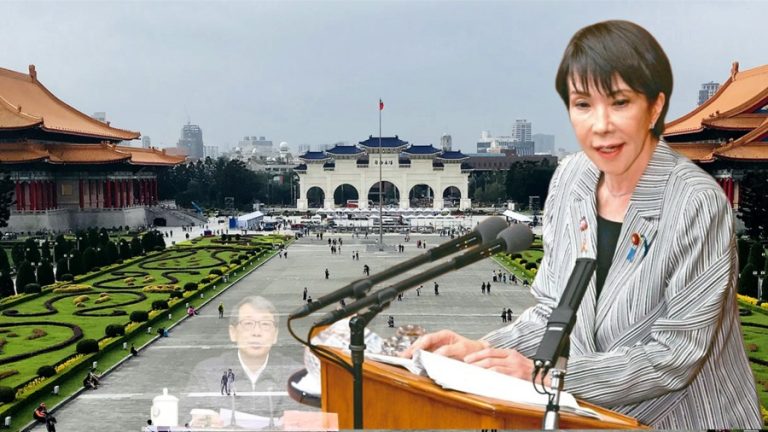
Takaichi’s remarks
The secretary’s article sets broad orders for the PLA, treating soldiers as machines or draft animals. Soldiers in the CCP army survive only by selling their integrity, abandoning beliefs, and blindly obeying enslavement, ready to become cannon fodder.
The mandatory tone of the article exposes the PLA’s inability to fight effectively. Even with cult-like ideological control “internally,” the PLA’s three-day live-fire exercises in the Yellow Sea wasted tens of millions of RMB, preventing Chinese from seeking the truth in Japan—doing nothing for “external security.” Takaichi may even indirectly aid “Heaven’s punishment of the CCP.”
Divine will cannot be resisted.
The views expressed here are solely those of the author and do not necessarily reflect the views of Vision Times.