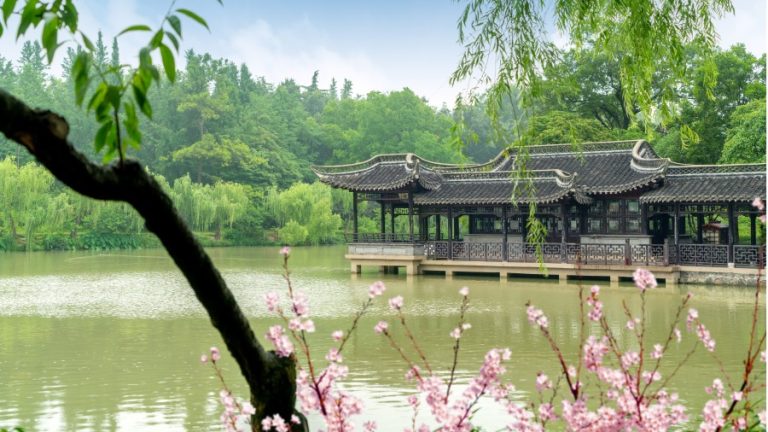
In the heart of Jiangnan, where gardens breathe with mist and willow branches float over winding waterways, unfolds one of the most poignant stories of the Southern Song. It begins with a scholar-poet whose loyalty to his country shaped his life, a gifted woman whose talent matched his own, and a nobleman whose quiet devotion has long remained in the shadows.
This is the story of Lu You, Tang Wan, and Zhao Shicheng — a tale woven with poetry, parting, destiny, and the moral choices that transcend even the deepest heartbreak.
A marriage born of childhood companionship
Lu You was born in 1125 in Shanyin, modern-day Shaoxing, into a distinguished scholarly lineage. From an early age he demonstrated extraordinary literary genius and a fierce sense of patriotic duty. His childhood companion, Tang Wan — born into a cultured household of officials — shared his love of poetry. Raised within the same extended family, the two grew up reciting verses, composing lines, and shaping the beginnings of a tender affection.
According to traditional accounts, the family kept an ancestral phoenix hairpin, which later became the token sealing their engagement. At twenty, Lu You married seventeen-year-old Tang Wan — a union celebrated as the perfect match of talent and beauty.
A mother’s decision that altered their lives
But happiness proved fragile. Only a year (or three, according to some accounts) after their wedding, the couple’s peaceful life was broken by the stern intervention of Lu You’s mother. In a household where academic achievement meant everything, she feared Tang Wan had become a distraction. Lu You’s repeated examination failures compounded her anger.
Success
You are now signed up for our newsletter
Success
Check your email to complete sign up
Unable to persuade his mother, Lu You hid Tang Wan in a separate residence, hoping to keep their bond intact. But the secret did not last. Under unrelenting pressure, he was forced to send her away. Another version claims she was dismissed for failing to bear a child.
Whichever account one follows, the outcome was the same: a young couple torn apart by authority and circumstance.
Tang Wan’s departure marked the end of their brief marriage, but not the end of the feelings they carried for each other.
Two separate lives, one unbroken thread
To ease her son’s sorrow, Lu’s mother arranged a new marriage for him, and he later took a concubine, eventually fathering eight children.
Tang Wan, cast out through no fault of her own, faced a future clouded by heartbreak. Yet in time, her life took a gentler turn. In 1147, she married Zhao Shicheng — a nobleman of imperial descent, refined, well-educated, and a contemporary admirer of Lu You’s literary gifts.
Zhao knew of Tang Wan’s past and the injustice she had suffered. Defying social expectations and the objections of his own powerful family, he insisted on marrying her. For a man of his status, taking in a dismissed woman was considered unacceptable. But he chose her regardless.
In Zhao’s home, Tang Wan found something she had lacked during her brief marriage to Lu You: patient affection, respect, and stability. They shared nearly ten years together. She bore him a son and a daughter, and Zhao treated her literary talent with genuine admiration.
Tang Wan slowly recovered from her earlier sorrows — yet the memory of Lu You remained somewhere inside her heart, as his memory of her remained within his.
A chance encounter at Shen Garden
Meanwhile, Lu You continued to chase academic and political success. In 1155, after being obstructed in the examination system by the powerful Qin Hui, he returned to Shaoxing, weighed down by disappointment.
One spring day, he wandered into Shen Garden — a tranquil estate near Yujisi Temple — seeking solace. Fate intervened. There, nearly a decade after their separation, he saw Tang Wan again, now accompanied by Zhao Shicheng.
Accounts vary, but all describe a moment of silent, inevitable pain.
Touched by their old bond, Zhao sent wine and dishes to Lu You — a gesture of courtesy, or perhaps compassion. As the couple departed, Lu You remained in the garden, overcome by emotion. On a wall, he wrote the poem that would define the tragedy of their lives:
“Phoenix Hairpin — Crimson Hands.”
A poem of regret, longing, and the irrevocable wrongness of their forced parting.
Tang Wan’s heartbreak in her own hand
The following spring, Tang Wan visited Shen Garden alone. She saw the poem on the wall — the pain, the remorse, the memory of their shared youth. Overwhelmed, she answered it with a matching lyric, “Phoenix Hairpin — The Ways of the World Are Harsh.”
Her words spoke of tears, of forced smiles, of emotional burdens she could neither express nor escape. Soon afterward, Tang Wan passed away at the age of twenty-eight. Tradition holds that sorrow had consumed her.
Zhao Shicheng — The forgotten loyal heart
If Tang Wan’s death devastated Lu You, it crushed Zhao Shicheng completely. For thirteen years he secluded himself in his study, surviving on memories of the woman he cherished. He never remarried. When the pain became unbearable, he volunteered for military service and eventually died on the battlefield, still thinking of her.
He had vowed never to take another wife or concubine, in life or death — and he kept his vow to the end.
Lu You’s lifelong mourning
After Qin Hui’s death, Lu You’s career slowly resumed, but his patriotic ambitions were never realized. He spent years wandering through official posts, fighting political obstruction, and ultimately living in seclusion.
In his poetry, memories of Tang Wan resurfaced again and again:
- In the “Chrysanthemum Pillow” poems
- In the paired “Shen Garden” verses
- In the dreamlike “Night Visit to Shen Garden” couplets
- In his final “Spring Outing” at eighty-five
Across forty-four years, Shen Garden remained the place where youthful love had once blossomed — and where sorrow lingered like a gentle shadow.
A folk account of past-life debts
The story’s final layer comes from traditional belief. Some spiritual practitioners claim that Lu’s mother and Tang Wan had shared a past life: one as a favored wife, the other as an unloved concubine suffering humiliation. In this view, their conflict in the present life reflected a cycle of karmic compensation.
Such accounts belong to folklore, but they echo a long-standing cultural intuition:
people do not meet by accident, and bonds — even painful ones — extend beyond a single lifetime.
A legacy not of romance, but of virtue
Judged by modern concepts, Lu You, Tang Wan, and Zhao Shicheng might be seen as a tragic romantic triangle. Yet their story is far more than that. After their separation, both Lu You and Tang Wan behaved with dignity and self-restraint, honoring the moral codes of their age. Tang Wan began anew with grace; Lu You never crossed the boundaries of propriety; Zhao Shicheng offered unwavering kindness without complaint.
They left behind a legacy not of scandal or betrayal, but of loyalty, restraint, righteousness, and quiet moral courage.
Their lives remind us that not all love can be fulfilled — but even unfulfilled love can inspire beauty, poetry, and virtue that endure across centuries.