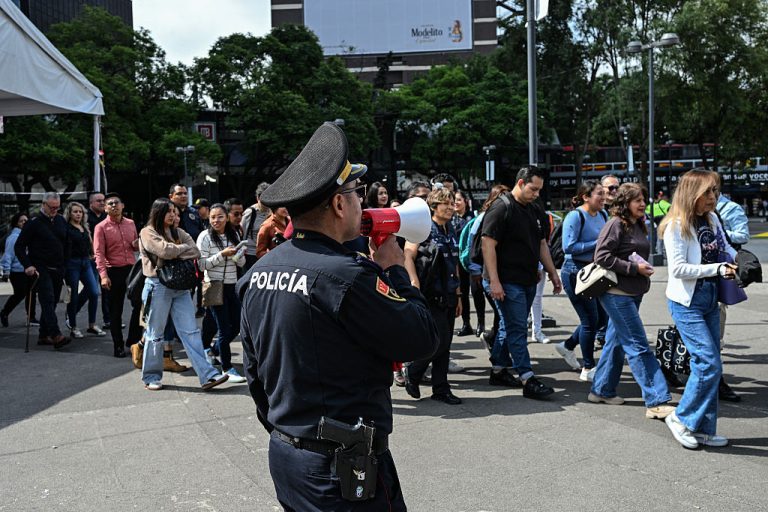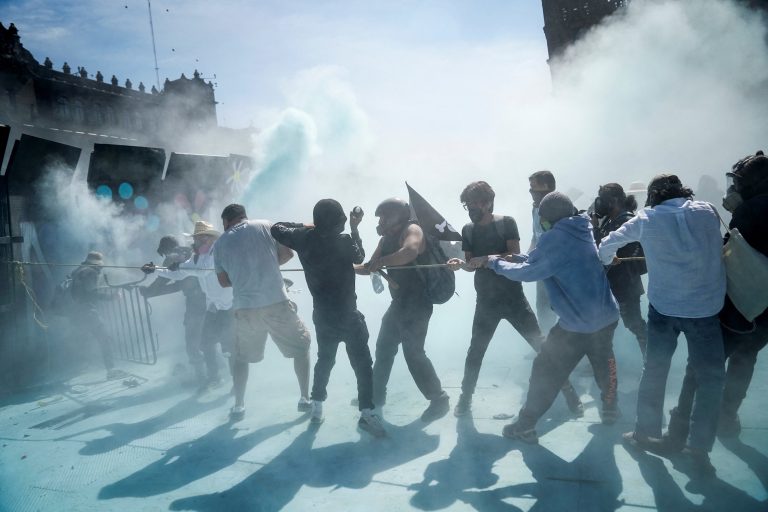
Large-scale protests broke out across Mexico on Saturday, Nov. 15, as thousands of mostly young demonstrators gathered outside the National Palace to denounce cartel violence and what they described as an increasingly complicit government under President Claudia Sheinbaum.
The unrest followed the assassination on Nov. 1 of prominent anti-cartel mayor Carlos Manzo, whose killing has galvanized public anger toward powerful criminal groups and state institutions widely seen as unable or unwilling to restrain them.
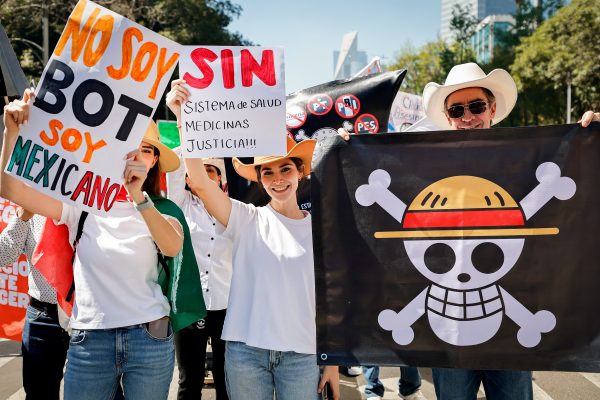
Crowds converged on Mexico City’s historic center, breaching temporary walls and clashing with riot police. Protesters hurled rocks, swung metal pipes, and used barricades as makeshift battering rams in an attempt to push through police lines. Amid the chaos, a striking number of demonstrators waved black flags emblazoned with the skull-and-crossbones insignia of the Straw Hat Pirates, from the popular and long-running anime series One Piece.
Mexico City’s public safety secretary Pablo Vazquez said in a press conference that 100 police officers were injured, including 40 who required hospital treatment. Another 20 civilians were also injured, Vazquez told local media outlet Milenio.
The public safety secretary also said 20 people were arrested and another 20 “referred for administrative offenses.”
Success
You are now signed up for our newsletter
Success
Check your email to complete sign up
Other marches took place in various cities across Mexico, including in the western state of Michoacan, where anger has flared over the murder of Uruapan city Mayor Carlos Manzo, who was shot dead at a public Day of the Dead event.
The symbol, first adopted by youth activists during protests in Indonesia in 2023, has since become a global emblem of Gen Z political dissent. It has appeared in recent demonstrations in Nepal, the Philippines, France, and Peru. Its presence in Mexico underscores the generational character of the movement.
Confronting the ‘Narco-state’
The immediate catalyst for the protests was the killing of Carlos Manzo, known for his uncompromising stance against organized crime.
Uruapan, where Manzao was mayor, is the second-largest city of the Mexican state of Michoacán, located in the south-central part of the country on the Pacific Ocean.
Manzo had publicly advocated what supporters described as a “full-frontal approach” that included armed crackdowns on cartel operations. Though controversial for his use of extralegal violence against the cartels, Manzo had developed a reputation for confronting the criminal groups more aggressively than federal authorities.
His assassination added to a grim pattern. According to the nonprofit Armed Conflict Location & Event Data Project (ACLED), Mexico has become one of the most politically violent countries in the world, with levels of targeted killings reaching a scale comparable to conflict zones in Syria and Ukraine. During Mexico’s most recent election cycle, 38 political candidates were assassinated, the deadliest on record.
Public frustration has also focused on long-standing government policy. Former president Andrés Manuel López Obrador introduced the strategy of “abrazos, no balazos” (“hugs, not bullets”) in 2018, shifting federal security efforts toward social programs rather than direct confrontation with cartels. His administration expanded welfare spending, educational aid, and job programs, arguing that poverty was the root cause of organized crime.
But according to government data, more than 185,000 people were murdered during Obrador’s six-year term — the highest total in modern Mexican history. Analysts say many cartels expanded territorial control during this period, benefiting from fewer high-level arrests and a government reluctant to engage them militarily.
President Claudia Sheinbaum, who took office earlier this year, has largely maintained Obrador’s approach. Though there is no evidence linking Sheinbaum to cartel groups, critics argue that her administration has not challenged their influence. Protesters have increasingly labeled the government a “narcoestado” — a narco-state — accusing officials of turning a blind eye to criminal organizations embedded within the police, military, and local governments.
Public fear of violence and economic trouble
Sheinbaum and her allies have dismissed the demonstrations as politically motivated. Officials suggested that opposition parties, foreign actors, and automated social media accounts helped amplify the protests. Supporters point to polls showing Sheinbaum maintaining high approval ratings, though analysts caution that survey data in areas controlled by criminal groups may reflect fear rather than genuine support.
A national survey by Mexico’s National Institute of Statistics and Geography (INEGI) found that a majority of citizens report feeling unsafe in their own communities. Many have stopped reporting crimes, particularly extortion, due to widespread belief that local police collaborate with criminal groups. Business owners who file complaints risk retaliation, including arson attacks.
Mexico’s economic outlook is also worsening. Remittances from the United States — long a major support for local families — have declined sharply. U.S. border crossings have fallen to their lowest levels since 1970, limiting the flow of migrants whose earnings historically bolstered Mexico’s economy. GDP growth has slowed to around 1 percent, raising concerns that fewer economic opportunities could push more young people toward activism, or to the cartels themselves.
Saturday’s unrest suggests that Mexico’s youth are increasingly unwilling to accept the status quo. The spread of protest symbols across borders reflects a wider generational movement defined by frustration with corruption, impunity, and deteriorating public safety.
Reuters contributed to this report.