By Vision Times TV
A viral video circulating online shows a middle-aged woman walking through Shanghai’s formerly bustling commercial districts. Storefronts are shuttered, once-packed cafés sit empty, and entire blocks lack even basic foot traffic. Once hailed as China’s economic and commercial hub, the once-glitzy city has become a ghost town of its previous self.
“Shanghai used to be full of life. Now the malls are empty, the streets are empty — everywhere is empty. Where did 25 million people go?” she asks in the video. “Did they all move back to the countryside? Or go overseas? Nobody knows.”
For decades, Shanghai symbolized wealth and opportunity — a magnet for dreamers and entrepreneurs. But rising job insecurity, consumer pessimism, and a worsening economic climate have drained the city’s energy. Once-confident residents now scale back spending, and many quietly pack up and leave.
A city of empty storefronts
One vendor shows her sales tally: “It’s already afternoon, and we’ve only made 100 yuan. Since the Starbucks across the street closed, foot traffic dropped overnight.” She gestures toward nearby blocks showing the once bustling Xingfu and Changle Roads completely devoid of foot traffic. “A once-thriving chain that had 10 branches in Shanghai now survives with only one,” she says. “It’s really desolate. You can feel it.”
Success
You are now signed up for our newsletter
Success
Check your email to complete sign up
RELATED: China Deploys Censorship, Police Threats to Maintain Control Over ‘Zero-COVID’ Narrative
This creator, born in 1979, once ran a company of 300 employees. Now she sells cheap goods at a sidewalk stall just to cover monthly mortgage payments that “almost suffocate” her.
Her Shanghai dream began in 2013. “I came to Shanghai with 60,000 yuan in debt. People said Shanghai was full of gold. But I spent four months eating steamed buns just to survive.” Then, in late 2013, the boom in online micro-businesses brought her first major income. By 2014, she ran a company with hundreds of employees.
But in 2020, the pandemic destroyed everything as her business collapsed after two years of losses, and her husband lost over 3 million yuan in a single night on stock market bid that went sideways. In August 2022, the family was forced to leave Shanghai entirely as they couldn’t keep up with the living costs.
“Being able to make money doesn’t mean you’re capable,” she says. Sometimes you’re just riding the wave.” She also advises viewers not to splurge when times are going well. “When you make money, save it. Don’t splurge,” she says. “You need reserves for the bad years.”
Gucci shutters stores
Even top-tier brands are fleeing. This year alone, Gucci closed its stores in the Reel Mall and the New World Daimaru, leaving only one location in the once-elite Nanjing West Road district. Across China, Gucci shut nine major stores last year. Parent company Kering reported that:
- Operating profits were down 46%
- Net profit down 62%
“Weakness in the Chinese consumer market” is a major factor,” said Kering. Luxury is no longer a status symbol. Practicality now dominates consumer psychology, including items like: Cigarettes, groceries, and daily necessities. Another shop owner lamented the collapse of everyday consumption: “10 years ago, old men would wait outside for new cigarette shipments. One car would arrive and boom!, each one of them would grab a carton and leave.”
RELATED: Beijing Pushes Loan-Driven Consumption: How Xi Jinping Is Undermining China’s Economy
Now? Many have quit or have resorted to rolling their own cigarettes at home. Even 20-30 yuan packs are hard to sell, and mid- to high-end cigarettes barely move. The shopper listed three main reasons for the decline:
- Fake goods flooding social media and livestream markets
- Gift-giving culture has all but collapsed
- Inventory varieties exploded, but sales didn’t
A housing market in freefall
Real estate agents and homeowners alike say the crisis is worse than anything they’ve seen. One woman recalled a property she nearly purchased years ago, back when she believed Shanghai’s housing market was invincible. The home was listed at 6.5 million yuan in 2020, and she offered five million — a lowball even by the standards of the time. The seller refused.
RELATED: The Politics of Evergrande’s Collapse
Six months later the price slipped to six million, and another six months after that, to 5.87 million. By last year, it had dropped to five million. This year, the same property is listed at just 3.8 million — and still has no buyers. She says she’s grateful she didn’t buy when she had the chance. “Go visit any Shanghai sales office; it’s emptier than a library,” she said. “Staff outnumber customers. Second-hand homes? A bloodbath.”
After more than a decade working in Shanghai’s real estate sector, she’s stunned that people still accuse her of “fearmongering” when she’s simply describing what’s happening in front of her eyes.
Chongming Green Island: Now a modern ghost city
Nothing captures Shanghai’s downturn more sharply than Chongming Green Island, a gigantic development on the northern edge of the city. Once marketed as a future ecological paradise, the project sprawls across 23,500 acres and was designed to hold more than 100,000 housing units with an estimated total investment of 200 billion yuan.
RELATED: Asia’s Wealthiest Woman Loses $12 Billion in China’s Real Estate Crisis
At launch in 2016, the buzz was electric — over a thousand units sold within the first two hours. But the illusion didn’t last. Buyers soon discovered that the “scenic river view” actually faced a dense cluster of chemical plants across the water, and strong winds often carried the harsh smell of industrial exhaust straight into the residential area.
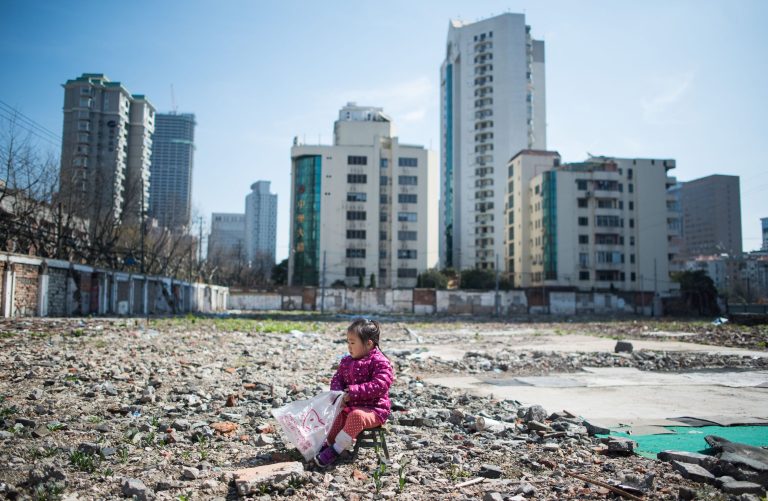
Much of the infrastructure was makeshift, with some neighborhoods relying on temporary water and power lines. The location itself was desolate: ten kilometers of empty fields and mudflats in every direction, no supermarkets, no schools, no public transit; nothing resembling a functioning community. By nightfall, the entire district sinks into total darkness, silent and abandoned.
Today, almost no one lives there, and the development has become a textbook example of how China’s urban boom spun out into overbuilding, speculation, and collapse.
A deeper sickness plaguing China’s economy
Shanghai’s decline is not an isolated phenomenon; it’s a symptom of something larger and more troubling, experts note. Consumer confidence has collapsed. The middle class is shrinking. College graduates face mass unemployment. Companies are slashing salaries, cutting staff, or shutting down entirely as they wait for the economy to recover.
More people are “lying flat” just to survive, a term that refers to doing the bare minimum in life and work to avoid being crushed by pressure they can no longer withstand.
Millions are leaving the city or leaving the country. And the real estate market — once the engine of China’s growth — is now marred by deflation and economic turmoil. The city that once embodied China’s rise is now revealing the fragility underneath.
“Shanghai used to represent hope,” says the woman in the video. “Now even hope feels like it’s disappearing.”