By Jianyi, Vision Times
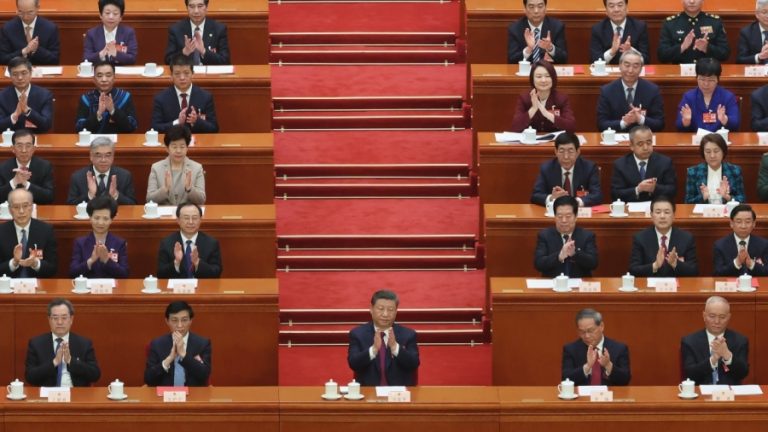
On Nov. 28, the Chinese Communist Party’s (CCP) top ruling body, the Politburo, convened for its 23rd “collective study session” on what it called “internet ecosystem governance.” In essence, it was yet another push to tighten online controls and stifle free expression. But viewers quickly noticed something unusual in the CCTV broadcast: Both Li Xi and Ma Xingrui were absent, rekindling rumors of a political rift within the CCP’ highest ranks.
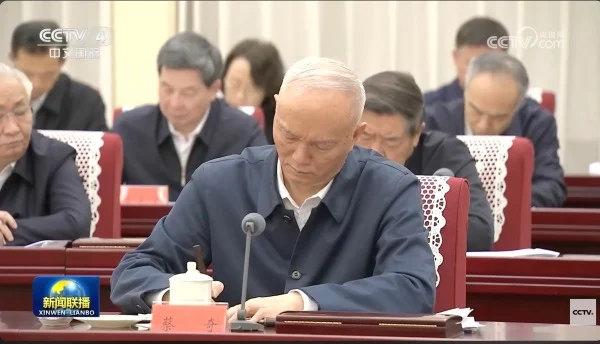
What many missed, however, was an even more striking detail. Cai Qi — himself engulfed in mounting rumors of corruption probes — appeared on camera sporting noticeable unshaven stubble. In the footage, the right side of his face showed that Cai appeared nervous and disheveled.
RELATED: CCP Military on Edge: Analysts Warn the PLA May Move on Xi by Toppling Cai Qi First
Just a week earlier, after disappearing for 12 days, Cai resurfaced at the seminar commemorating Hu Yaobang’s 110th birthday. CCTV cameras showed him with heavy eye bags and a visibly haggard appearance. Around the same time, a major development unfolded: Two top leaders under Cai Qi at the State Secrets Bureau, Director Li Zhaozong and Deputy Director Shi Yingli, were simultaneously dismissed.
Trouble at the top
Success
You are now signed up for our newsletter
Success
Check your email to complete sign up
Taken together — Cai’s disappearance, the purge of his subordinates, his exhausted appearance, sunken eyes, and now uncharacteristically unkempt beard — these signs point unmistakably to serious trouble for leader Xi Jinping’s most trusted enforcer, analysts note. And because Cai oversees one of the most sensitive organs in the Party-state, his apparent downfall signals turbulence deep within Zhongnanhai.
During the Politburo session, nearly every official appeared tense and severe. Combined with the theme of the meeting, it underscored a deeper truth: The internet is now one of the greatest existential threats the CCP faces in its bid to continue ruling with an iron fist.
RELATED: Beijing on Edge: Purged Generals Tied to ‘Secret Coup Plans’ as Military Dissent Grows
Xi himself once openly admitted, “If we cannot cross the hurdle of the internet, we cannot secure long-term rule.” On Dec. 2, state media repeated that phrase — and even labeled the internet the “greatest variable,” a rare admission that as long as ordinary people can speak freely online, the CCP risks total collapse in any battle of public opinion.
At the very moment Xi was lecturing cadres about “internet governance,” a massive online storm was erupting, sparked not by foreign forces, but by the CCP’s own heavy-handed actions. And this storm would soon sweep across China, Japan, Taiwan, and the overseas Chinese diaspora, uniting millions of netizens in unprecedented ridicule targeting Xi Jinping himself.
An empty concert
On Jan. 28, organizers for Japanese pop icon Ayumi Hamasaki announced the cancellation of her 2025 Shanghai tour stop, citing “force majeure.” All tickets would be fully refunded, the artist said.
Hamasaki responded with a message that immediately went viral: “14,000 empty seats, but I felt the full love of fans around the world. To me, this is one of the most unforgettable performances. Thank you to the 200 Japanese and Chinese staff, musicians, and dancers. You made this stage possible. —ayu”
On Instagram, she wrote: “After receiving the cancellation request yesterday, we still completed the full performance — from the first song to the encore — with no audience.” Every dancer, musician, and staff member, she said, threw themselves into the show “as if the 14,000 fans who should have been there were still sitting in those seats.”
Photos showed her team performing professionally on stage while 14,000 empty chairs stretched into the distance. One particularly striking image captured Hamasaki bowing in gratitude to a vacant arena, her expression filled with sadness and resolve.
Her response astonished audiences worldwide. Many praised her dignity, artistry, and respect for fans in the face of CCP arbitrariness — against which the regime’s behavior appeared all the more petty and crude. Netizens called the moment a “once-in-a-century spectacle.”
Though no fans were allowed inside, the performance dominated the internet. As one comment put it:
“Originally this was meant to be a celebration for 14,000 fans — now the audience is far larger than that.”
Online reactions poured in, both praising Hamasaki and mocking Beijing:
- “This is what honor and professionalism look like. The contrasting thuggery says everything.”
- “Ayumi Hamasaki performed brilliantly in an empty venue; the Communist Party performs terribly in a venue full of people.”
- “Xi tried to destroy her, but ended up making her a legend. Meanwhile he can only sit in his maggot pit seething in frustration.”
Others called it her artistic peak:
- “A simple concert has now become art.”
- “This performance will enter the history books.”
Some emphasized the political symbolism:
- “Her apology to 100 Chinese staff and 14,000 fans hurts the CCP more than missiles in Yonaguni.”
- “A Japanese artist just slapped Xi Jinping with pure art.”
A wave Beijing couldn’t stop
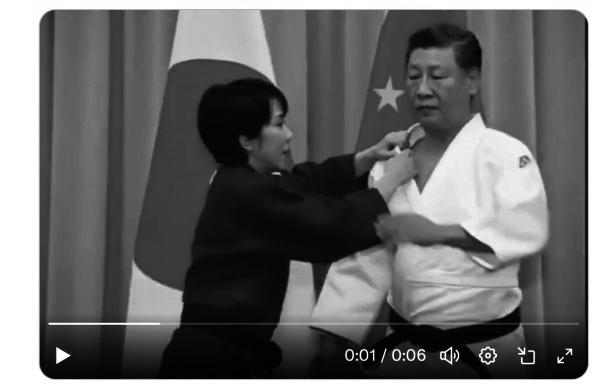
The incident unleashed a new tactic netizens at home and abroad quickly embraced: Short videos provoking the CCP at its most sensitive pressure points, with Xi Jinping unintentionally cast as the male lead. One clip circulating in Japan showed “Xi Jinping” being thrown to the ground in a judo match by “Sanae Takaichi.” It received 110,000 views within a day.
But what Beijing feared most was something much larger: the sudden unity of netizens across Japan, Taiwan, mainland China, and overseas Chinese communities, all mocking the CCP in real time.
One popular comment read: “Despots can empty a venue, but they cannot empty Ayumi Hamasaki’s heart—or the hearts of the Chinese people. Xi has failed again.” That single comment garnered over 1.6 million views and 18,000 likes—exceeding the number of seats in the canceled venue.
Another widely shared post praised Hamasaki’s perseverance during the Hong Kong fire crisis and the last-minute costume changes she made, noting: “Ayu and her team supported people’s emotions and created a legend.” The post drew 1.9 million views and over 42,000 likes.

“Turning a canceled concert into a recorded art piece is the perfect rebuttal to the CCP,” said one user. Another wrote: “China may have made a grave mistake. They didn’t want domestic protests—yet this pushed public anger to a new level.”
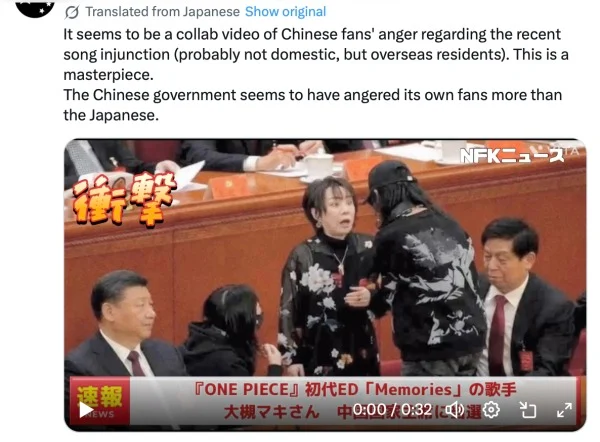
Videos mocking Xi skyrocketed, including re-edited footage of Hu Jintao being escorted out of the 20th Party Congress, parodies of Xi asking, “Any objections?” followed by “None… none… none…,” Xi dancing in a patterned cotton jacket to upbeat music, etc. As one Japanese user noted: “Chinese fans seem even angrier than the Japanese fans.”
History has long warned that “suppressing the people’s voice invites disaster.” This Politburo session may go down as a rare moment when the CCP unwittingly acknowledged its deepest vulnerability. The internet — open, borderless, spontaneous — has become Beijing’s greatest nightmare. In a space where millions can unite within minutes, the CCP’s tightly-controlled narrative quickly crumbles.