By Cai Siyun, Vision Times
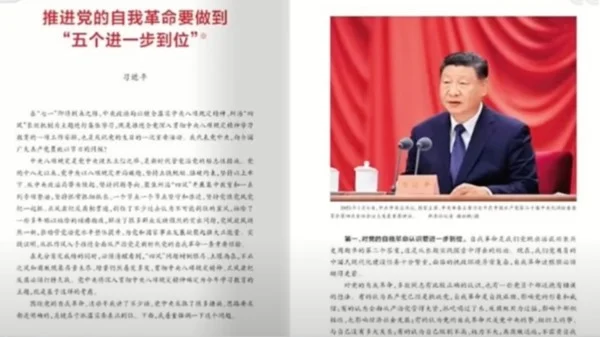
On Dec. 1, state mouthpiece “Qiushi” magazine released an article penned by Chinese President Xi Jinping himself. Titled: “推动党的自我革命要做到‘五个进一步到位’” (“To Advance the Party’s Self-Revolution, We Must Achieve ‘Five Further Attainments’”), political analysts are noting that both its tone and political intent evoke Mao Zedong’s infamous call to “Bombard the Headquarters.”
The article reads like a thunderous mobilization order, demanding the entire Party wield the knife of “self-revolution” against itself. Xi warns that unless the Party purges “viruses” corrupting its body, the result will be catastrophic: “The party will cease to be a party, and the country will cease to be a country!”
RELATED: Yang LanLan Mystery Deepens Amid Court Absences, Alleged Ties to Xi Jinping
Xi outlines five existential battlegrounds:
In the manifesto, Xi highligts five areas that must be prioritzed for the good of the nation:
- Ideological cleansing: Launch a new “revolution in the depths of the soul,” uprooting all impure thoughts.
- Absolute loyalty: Return to the standard of “absolute loyalty, absolute purity, absolute reliability,” allowing not even a shred of hesitation.
- Power discipline: Lock power inside the “cage,” and remove any official who abuses it—“not including himself,” commentators note.
- Perpetual anti-corruption: Maintain a permanent state of high pressure—“宜将剩勇追穷寇”,never stopping, never retreating.
- Harsh accountability: Revive an iron-fisted regime of “strict investigation and strict punishment,” forcing cadres to feel “thorns on their backs.”
Success
You are now signed up for our newsletter
Success
Check your email to complete sign up
To analysts, the message is unmistakable: a new Cultural Revolution is being ushered in. Xi also describes “self-revolution” as the Party’s tool or answer to “break free from the historical cycle of order, chaos, rise, and fall.” Only by cutting deep into “stubborn and intractable diseases” can the CCP ensure its “red rivers and mountains” remain unchanged for eternity, he says.

He declares this a “a new soul-touching revolution,” while promising that Beijing “will not withdraw until we achieve complete victory!” Xi also insists such internal purges will not damage the Party but will rather instead strengthen it politically, organizationally, and economically.
A political manifesto
Observers note that the article is not a standard Party mobilization message as it reads more like a manifesto akin to a second Cultural Revolution.
Many Chinese assumed another Cultural Revolution was impossible. Decades of reform and opening exposed the population to new ideas, foreign cultures, and new prosperity. Meanwhile, Xi’s fierce internal purges were interpreted as merely targeting corrupt officials, not society at large. But as analysts ask: Is that assumption correct?
RELATED: A Trio of Events Puts Xi Jinping Under Scrutiny at Home and Abroad
China’s own political history offers a cautionary note. After Mao’s Cultural Revolution devastated the country, the CCP passed the “Resolution on Certain Questions in the Party’s History Since the Founding of the People’s Republic of China”, declaring the Cultural Revolution neither revolutionary nor progressive in any sense. The resolution established “emancipating the mind” and “seeking truth from facts” as guiding principles and paved the way for reform and opening.
Yet former Premier Wen Jiabao, in his final press conference, delivered a stark warning. He noted the lingering residue of Mao-era ideology and rising corruption, inequality, and moral decay: “The mistakes of the Cultural Revolution and the influence of feudalism have not been completely eliminated,” says Wen. He also notes that without political reform, economic reform would not succeed.
“Historical tragedies like the Cultural Revolution could happen again,” he warns.
History’s unsettling parallels
Mao Zedong launched the Cultural Revolution in 1966 at age 73. In 2026, Xi Jinping will also be 73, exactly 63 later. Is this a coincidence, or a historical recurrence? Now, Xi finds himself facing a political environment similar to Mao’s, including:
- Entrenched bureaucratic resistance,
- Widespread corruption,
- Growing public distrust of the government,
- A fractured Party elite
Despite consolidating near-absolute power after abolishing term limits, rumors of internal resistance and crisis continue to swirl. Xi feels besieged by bureaucratic inertia, which he describes as “mediocre, lazy, and servile officials fill the officialdom.” He says China faces unprecedented domestic and international headwinds as its “surrounded by enemies on all sides.”
To many analysts, Xi’s new article is a political alarm bell that he’s preparing for a mass ideological campaign, or perhaps even a controlled (or uncontrolled) repeat of the Cultural Revolution. Whether he succeeds or fails, the article itself signals escalation.
Editor’s Note: This article by Xi Jinping was written before July 1 but published nearly six months later, suggesting his attempt to emulate Mao Zedong is far from smooth. His signature projects — Xiong’an New Area and the Belt and Road Initiative — have become stalled or abandoned; the “Fengqiao Experience” he revived from Mao’s era has produced no lasting results; even the “Study Xi Strong Nation” app campaign fizzled out. Its publication now appears to be Xi’s own effort to force it forward. Yet while Xi may have Mao’s ambitions, he does not possess Mao’s power.
If he fails to ignite a second Cultural Revolution, the attempt risks revealing his waning support, and accelerating his path toward political decline.