By Li Jingyao
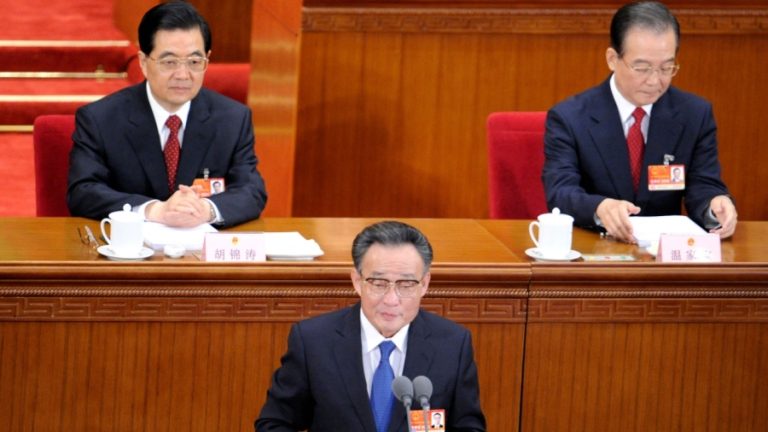
For months, rumblings inside Beijing’s political establishment have been growing louder. This week, those tremors surfaced publicly after the Communist Party’s Politburo held a meeting and study session on Nov. 28—an event that usually reinforces Xi Jinping’s authority but this time revealed unusual gaps.
The official summary reviewed findings from the 20th Central Committee’s inspection of provinces and municipalities. Yet one of the Party’s most ideological slogans—“the two establishments”—was missing. At the same time, two of Xi’s most trusted allies, Ma Xingrui and Li Xi, were absent from the Politburo’s group study.
These omissions have intensified speculation that China’s elder statesmen may be using the inspection process to weaken Xi’s political machinery—and that the removal of Xi’s loyalists may already be underway.
A missing slogan and an altered script
The meeting, chaired by Xi, emphasized the need to “uphold the two safeguards” and tighten scrutiny of leading officials across all levels. But it did not mention the “two establishments,” a phrase Xi has strongly protected because it ties his personal authority directly to Party doctrine.
Success
You are now signed up for our newsletter
Success
Check your email to complete sign up
Commentator Jiang Feng said such an omission would normally be unthinkable.
“Xi would never allow that phrase to be removed in this context,” he argued. “It suggests the Politburo is no longer operating under his total control. The drafting group set the script—cutting the ‘two establishments’ and retaining only the ‘two safeguards.’”
The provincial chessboard shifts: technocrats replace Xi loyalists
Jiang said the directive to strengthen oversight of “top leaders” signals that provincial Party chiefs and governors are entering a period of serious risk—particularly those promoted for their loyalty rather than their competence.
“This report is essentially a political death register,” he said. “Those who served Xi’s Zhejiang and Fujian networks—the slogan-repeaters and the loyalist appointees—are now the first in line.”
Across multiple provinces, new appointments reinforce a single trend: the rise of technocrats and nonaligned cadres.
Shanxi:
Two new vice governors—Wang Haizhou and Zhu Xiaodong—were approved on Nov. 26 and 27. Both, along with Governor Lu Dongliang, lack any ties to Xi’s provincial networks and come from either the Communist Youth League system or professional backgrounds, signaling a clear shift toward expertise over factional loyalty.
Guangxi:
Also on Nov. 27, Cao Zhiqiang and Lan Xiao were named vice chairmen of the region. Cao previously chaired Hunan Valin Steel; Lan is a local Yao cadre who rose through educational institutions, reflecting the same pattern of elevating administrators with functional experience.
Jiangsu:
Data and planning specialist Shen Jianrong, formerly the head of Nanjing’s Development and Reform Commission, was appointed vice governor.
“Every case follows the same logic,” Jiang said. “The anti-Xi bloc is replacing political loyalists with neutral administrators. Once all 31 provinces are filled with such figures, Xi’s security chiefs in Beijing will find themselves politically isolated even if they still hold institutional power.”
The Vanke crisis pulls Ma Xingrui and Li Xi into the spotlight
Concern deepened after both Ma Xingrui and Li Xi—the Party’s top anti-corruption chief—were missing from the Politburo’s group study session.
Commentator Zhang Tianliang noted a rising online narrative tying the debt crisis at real estate giant Vanke to several senior officials.
In 2016, when Shenzhen Metro Group made a major investment in Vanke, Ma Xingrui was serving as Shenzhen’s Party secretary. Zhang argued that such a move could not happen without his sign-off. With Vanke now in deep financial distress and Shenzhen Metro facing significant losses, Ma may be implicated in the fallout.
At the time, Guangdong’s provincial Party secretary was Hu Chunhua, who may also face political consequences.
From 2017 to 2022, as Shenzhen Metro continued investing, Li Xi held the same top Party position in Guangdong. His absence from the Politburo event has fueled speculation that he, too, is now under scrutiny, given the timing.
Is Peng Liyuan’s circle the next target?
Another commentator, known as “Ordinary Person Inside the Wall,” said the campaign against Xi’s military loyalists has now reached his political allies.
Ma Xingrui’s wife is widely reported to be close to Peng Liyuan, and Ma is often described as a key figure in Peng’s so-called “Shandong circle.”
“If the anti-Xi group is moving against Ma, they are preparing to move against Peng Liyuan,” the commentator argued. “Xi may eventually be forced to distance himself.”
The commentator added that while nothing publicly links Peng to the Li Keqiang case, any inquiry into Ma’s family could indirectly affect Peng’s network.
Targeting Ma, he said, is the first step in dismantling Xi’s political apparatus.
“If Xi cannot protect Ma, he won’t be able to protect Peng Liyuan. After Ma, the next likely targets are Wang Xiaohong, He Lifeng, and Cai Qi. Xi may remain a ceremonial figure—just as he remains commander-in-chief even after his military loyalists were removed.”