By Jintao Paian
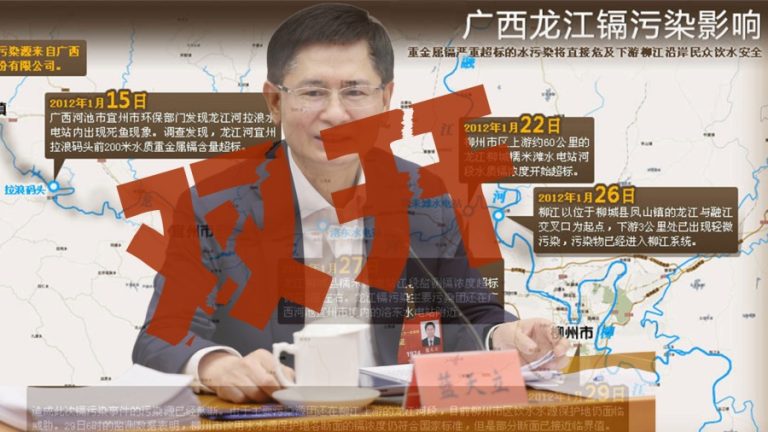
Beijing had spent months hinting at a sweeping campaign that would curb the influence of powerful provincial networks. Yet when the CCDI abruptly announced that Guangxi’s vice Party secretary and regional governor Lan Tianli had been expelled from the CCP and dismissed from office, the long-anticipated storm dissolved almost instantly. His punishment, wrapped in heavy political language but anchored in only one actual criminal charge, reveals both the narrow limits of the current anti-corruption push and the deeper contradictions embedded in Xi Jinping’s model of governance.
CCP accuses Guangxi governor Lan Tianli of defying Xi’s policies
The CCDI’s statement used familiar ideological phrasing — verbs such as “abandoned,” “betrayed,” and “violated” — to paint Lan as someone who had strayed from Party orthodoxy. But one sentence stood apart from the boilerplate accusations: Lan was said to have “violated the new development philosophy and the requirements of high-quality development.”
Within the Party, this language carries unmistakable weight. The “new development philosophy” is Xi Jinping’s signature economic doctrine, introduced during the 13th Five-Year Plan and later elevated as the guiding logic behind China’s supposed shift toward “high-quality development.” Including it in a disciplinary notice reframed Lan’s misconduct not as personal failings, but as a direct challenge to Xi’s program.
The warning to officials nationwide was clear: failing to follow Xi’s agenda is not simply poor governance – it is political defiance.
Success
You are now signed up for our newsletter
Success
Check your email to complete sign up
The notice pressed further, accusing Lan of “discounting and distorting” central directives. In doing so, it acknowledged a problem Beijing rarely admits publicly: even in an increasingly centralized system, provincial governments routinely bend, reinterpret, or resist Xi’s policies. Whether out of self-interest or because local realities conflict with Beijing’s demands, strict compliance often proves impossible.
Tension between provincial power and central authority
Beijing’s struggle to control its own bureaucracy is not new. During Hu Jintao’s tenure, authority frequently “stopped outside Zhongnanhai.” Jiang Zemin’s continuing influence overshadowed formal leadership, leaving Hu to navigate a system in which real power lay elsewhere. His adherence to Jiang’s “get rich quietly” consensus was less a policy preference than a survival tactic.
Xi Jinping came to power determined to prevent a repeat of that dynamic. He centralized authority on an extraordinary scale, strengthened personal loyalty networks, and turned anti-corruption into a political instrument. The “Eight-Point Regulation” reshaped official behavior, while the rhetoric of “strict Party governance” supplied ideological justification for sweeping purges.
Yet after more than a decade of consolidation, Xi’s rule has not produced meaningful improvements in people’s lives. Zero-COVID left deep scars. Local governments face mounting financial desperation. Economic stagnation has diminished public confidence. Beneath the political architecture of “Xi Jinping Thought,” the foundation is growing unsteady.
In this environment, provincial leaders cannot always execute Beijing’s directives as written. Sometimes they modify them to preserve local interests; sometimes they simply cannot reconcile central demands with local economic or social conditions. Either way, deviation becomes unavoidable – and the CCDI framed Lan Tianli’s fall squarely around this tension.
Guangxi’s entrenched political networks
Lan’s case also reflects the persistence of Guangxi’s long-standing political culture. Historically dominated by the “Gui warlords,” the region retained entrenched networks that evolved rather than vanished under CCP rule. These alliances blended Party officials with local business elites, functioning as modernized feudal blocs.
From Wei Guoqing onward, Guangxi developed quasi-familial political structures, where loyalty to local networks often outweighed allegiance to Beijing. The CCDI’s language — accusing Lan of forming cliques, cultivating personal power bases, and associating with “political fraudsters”— pointed directly to these patterns. Criticism of his family’s “improper conduct” hinted at a budding hereditary system akin to the historical “menfa” gatekeeping clans.
Taken together, the notice suggested that Lan was moving toward creating an autonomous regional power center — a development Xi’s leadership would not tolerate.
Lan Tianli’s fall served political goals beyond the bribery charge
After peeling away the ideological layers, only one legally defined accusation remains: bribery.
Everything else in the notice is political branding.
In effect, Lan’s fall served two political purposes at once: reinforcing Beijing’s authority over unruly provincial structures, and signaling that a broader campaign against regional power bases might be on the horizon.
Lan had built considerable influence over decades — through family ties, municipal connections, port operations, and commercial networks. The associates who were detained represent only fragments of a much larger apparatus extending across Guangxi’s 237,600 square kilometers and its 1,500-kilometer coastline.
Guangxi is too strategically important for Beijing to accept semi-independent leadership. It anchors China’s access to ASEAN, connects directly to Vietnam, and forms part of Xi’s Belt and Road and “land–sea corridor” initiatives. Lan’s failure to uphold these political priorities only accelerated his demise.
In a system where corruption is pervasive, downfall often hinges on timing rather than conduct.
The timing of the ouster raised expectations of a larger purge
Lan’s case became even more intriguing because of the date attached to it: May 16, 2025 — the anniversary of the 1966 notice that launched the Cultural Revolution.
Even more striking, his downfall first surfaced on YouTube. A blogger reported it on May 12, and the story spread widely by May 13, days before the official announcement. That evening, Guangxi Party Secretary Liu Ning convened an emergency meeting and declared: “No one is an iron-hat king.”
The phrase, echoing imperial-era punishments, suggested that even those who once enjoyed protection could be stripped of immunity. For a moment, it appeared that Beijing was preparing a major purge of provincial power networks — a contemporary echo of a “5/16 operation.”
But the movement never materialized.
A political campaign that collapsed before it began
In retrospect, the entire initiative dissolved as quickly as it appeared.
Lan Tianli became the campaign’s lone casualty.
The absence of further action suggests behind-the-scenes bargaining and political compromises. In Xi’s China, sweeping movements require unanimity among top leaders. When such alignment fails, momentum evaporates.
Lan’s removal ended up serving primarily as a symbolic warning, not the first step in a broader offensive.
Guangxi officials reacted almost instantaneously to the CCDI announcement — a sign they had been informed in advance.
Current Party Secretary Chen Gang quickly demonstrated loyalty, positioning himself as someone who “understands the moment.” His behavior suggests he may have been prepared for Lan’s fall and could even be positioning himself for future elevation, perhaps even a Politburo seat.
Selective enforcement cannot address systemic corruption
The Lan case ultimately highlights a structural paradox:
Anti-corruption in China is not a judicial remedy — it is a political tool.
Under Xi, those aligned with him tend to rise, while those who challenge or inconvenience the system are pushed aside. Each such purge may strengthen Xi’s grip temporarily, but it also leaves the system more fragile.
Selective enforcement redistributes power; it does not address the root causes of corruption. In a political structure held together by ideological rigidity and enforced obedience, corruption functions simultaneously as a lubricant for the system and a toxin that destabilizes it. Purges can rearrange beneficiaries, but they cannot repair the underlying architecture.
Lan Tianli’s fall, therefore, is not simply another corruption case.
It is one more sign that the political structure itself is shifting – and not necessarily toward stability.