By Dai Dongni
Screens are among the oldest forms of furniture in Chinese civilization, appearing as early as the Western Zhou period. Originally known as di, they stood behind the seat of the king—an emblem of imperial authority. Over the centuries, screens evolved from ceremonial objects into practical and symbolic fixtures, used to divide space, block drafts, and display decorative art, becoming an integral part of daily life and court culture.
Some screens, however, carried meanings far deeper than their physical form.
At the start of his reign, Tang Emperor Taizong was determined not to repeat the downfall of the Sui dynasty, whose last ruler, Emperor Yang, collapsed under the weight of extravagance. His early commitment to simplicity laid the groundwork for the famed “Reign of Zhenguan.”
But as the empire prospered, caution faded.
Success
You are now signed up for our newsletter
Success
Check your email to complete sign up
Court minister Wei Zheng, renowned for his fearless demonstrations, noticed this shift. He submitted a memorial titled Ten Gradual Failings That Prevent a Good End, warning the emperor against slipping toward luxury.
Taizong read the document repeatedly.
Moved by its clarity, he ordered the entire memorial inscribed on a screen and placed behind his bed—a constant reminder to reflect, correct mistakes, and preserve the discipline that sustained the dynasty.
The screen became known as the Frugality Screen, an enduring symbol of imperial self-restraint and of Taizong’s reputation for accepting honest counsel.
Centuries later, Ming Dynasty founder Zhu Yuanzhang encountered Tang poet Li Shanfu’s Recalling the Shangyuan Festival, a poem lamenting how the rulers of the Southern dynasties lost their kingdoms to indulgence and decadence.
Struck by the message, Zhu had the poem written onto a screen in his bedchamber.
Like Taizong, he used it as a visual warning—an ever-present reminder that luxury invites downfall.
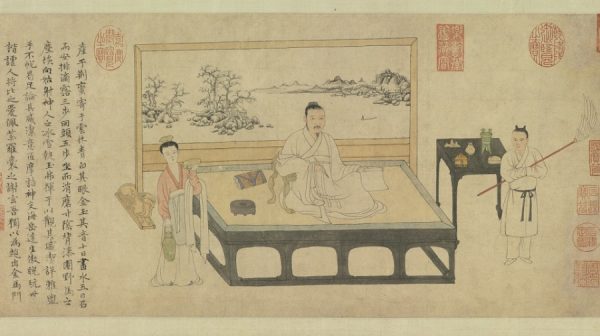
Screens as records, gifts, and masterpieces of craft
Screens once served as discreet record-keeping tools. Records of the Grand Historian notes that Lord Mengchang held conversations while a scribe stood behind a screen, documenting his words.
By the Qing and late Ming periods, screens had become status symbols and prestigious gifts. In Dream of the Red Chamber, Grandmother Jia received dozens of screens for her 80th birthday, including sixteen free-standing screens and multiple folding and bed screens.
Screens came in two main forms:
- inserted screens (single-panel), and
- folding screens (multi-panel), typically two to twelve leaves.
Their construction reflected the finest craftsmanship of their time—wooden frames covered with silk, embellished with painting, carving, inlay, or embroidery. Imperial screens were especially opulent: mica screens, glass screens, jade-and-turtle shell screens, enamel screens, ivory screens, and more.
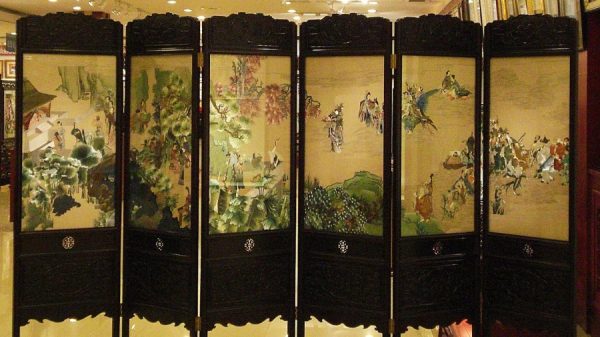
In the Forbidden City, nearly every throne was backed by an ornate screen. The Hall of Supreme Harmony features a gold-lacquered dragon-carved screen that magnifies the solemnity of the emperor’s seat. Other examples—such as zitan wood screens inlaid with boxwood dragons or Qianlong-era ivory-carved folding screens—showcase the heights of Qing decorative arts.
Throughout history, the Chinese wove their cultural values, philosophies, and aesthetics into the screens they crafted.
These objects became more than furniture—they became the carriers of memory, warning, symbolism, and imperial identity.