By Li Muzi, Vision Times
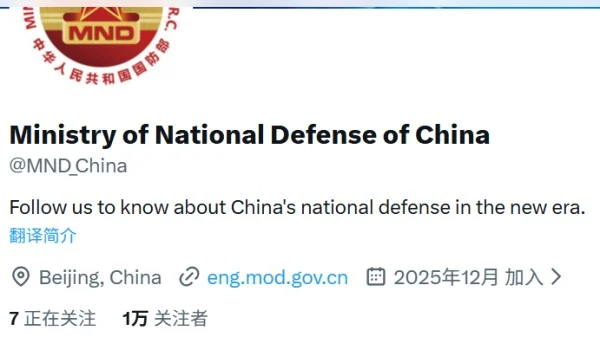
On Dec. 8, China’s Ministry of National Defense launched an official account on the U.S.-based social media platform X, posting its first English-language message: “Witness history, we are here.” The move triggered a slew of criticism from netizens, many of whom questioned why Chinese authorities can access foreign platforms with impunity while ordinary citizens face punishment for doing the same.
Some users responded with anger: “Don’t you know climbing the firewall is illegal? Get out!” The user refers to China’s “Great Firewall” system, under which accessing foreign platforms and social media apps like X or Instagram is prohibited for citizens, but permitted for government agencies.
A glaring double standard
According to state-linked announcements, the Ministry of National Defense opened its official X account on Dec. 8 and published a debut post stating: “Witness history, we are here. The official account of the Ministry of National Defense of the People’s Republic of China is now online. On this platform, we will share stories about China and the Chinese military.”
The post was accompanied by a 1-minute-10-second promotional video. By the time of publication, the video had garnered more than 143,000 views, attracted 10,000 followers, and generated over 830 replies. However, many comments critical of the CCP appear to have been rapidly removed.
Success
You are now signed up for our newsletter
Success
Check your email to complete sign up
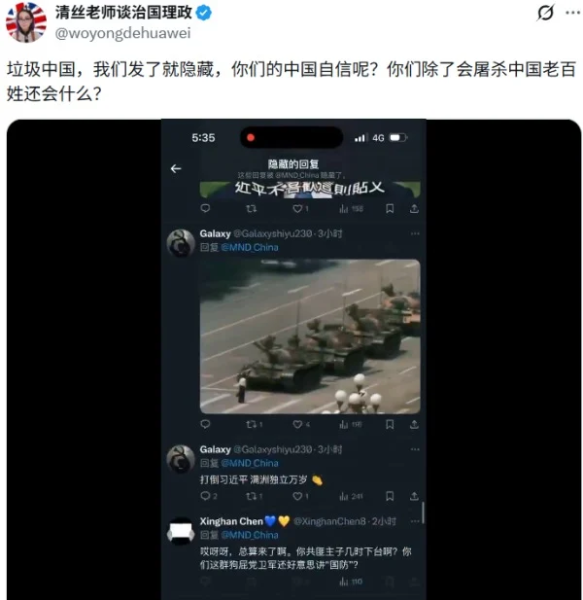
Despite moderation efforts, a number of pointed responses surfaced. A user operating under the name “Teacher Qing Si Discusses Governance and Statecraft” (“清丝老师谈治国理政”) released a video directly condemning the ministry, saying: “Trash China. We post something and it gets hidden. Where’s your so-called confidence? What else can you do besides slaughter your own people?”
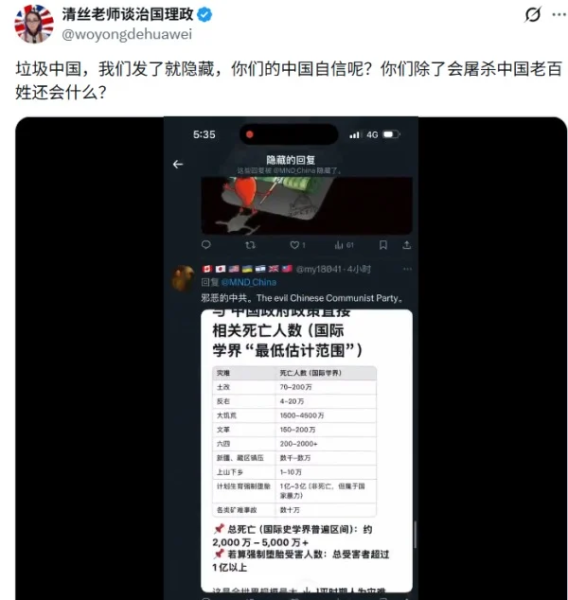
The video included images of June Fourth (the Tiananmen square massacre that saw China’s army brutally gun down hundreds of peaceful student protesters), references to tens of millions of deaths caused by CCP policies, and slogans from Sitong Bridge protester Peng Lifa, including “No more lies, we want dignity.”
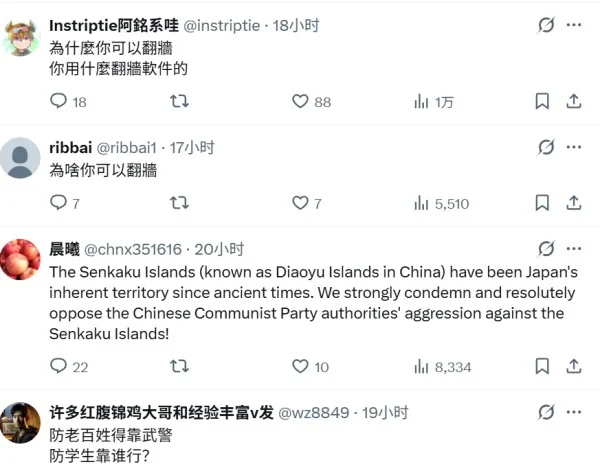
Many netizens posted sarcastic or accusatory comments in both Chinese and English:
- “Why are you allowed to climb the firewall?”
- “So it turns out the Chinese Communist Party has crossed the wall—it’s dangerous out here.”
- “The Chinese military climbs the firewall too? No wonder the Rocket Force keeps getting purged.”
- “You finally came out to do business.”
- “Don’t you know climbing the firewall is illegal? Get out!”
Others mocked the double standard more directly, while some users from mainland China expressed their frustration at the censorship controls:
- “Only officials may set fires — ordinary people can’t even light a lamp.”
- “Don’t arrest me, I just want to read the news.”
- “Why can’t we access it?”
- “How do you download X?”
- “Where was this posted? How do you see it?”
Hypocrisy on display
The defense ministry is not the first Chinese authority to trigger backlash on X. On Feb. 10 this year, Mao Ning, director-general of the Foreign Ministry’s Information Department, launched a new X account, posting: “Happy to join X! I look forward to sharing China’s foreign policy, international relations, and more. Let’s work together to enhance understanding and friendship.”
She was quickly ridiculed by netizens, who commented:
- “The external propaganda workload must be heavy.”
- “This is going abroad on official orders.”
To maintain regime stability, the CCP began constructing the Great Firewall (GFW) in the late 1990s — a comprehensive system of internet censorship restricting access to foreign information.
A widely circulated overseas petition in March 2023 titled: “An Appeal to Tear Down China’s Internet Brainwashing Wall for 1.4 Billion People” stated: “Since 2000, the CCP has spent US$6 billion annually to block over 310,000 websites, forcibly isolating 1.4 billion people from 6.6 billion others. This monstrous crime can be proven instantly and should be brought before the United Nations for trial.”
RELATED: Inside China’s ‘Internet Control’ Meeting: Missing Officials Point to Internal Turmoil
One of the movement’s initiators, Qiao Xinxin (real name Yang Zewei), later became the target of unprecedented transnational repression. He was abducted and brought back to China, where he was sentenced to five years in prison. Born in August 1986 in Qidong County, Hunan Province, Qiao was a former Southeast Asia correspondent for “Radio Free Asia.”
While Chinese authorities now actively engage global audiences on platforms banned at home, millions of Chinese citizens remain cut off from the same spaces, criminalized for attempting to see what their own government routinely posts abroad.
The Ministry of National Defense’s arrival on X may have been framed as “witnessing history,” but for many observers, it instead exposed one of the CCP’s most persistent contradictions: Absolute control at home, unrestricted access abroad, and zero accountability between the two.