By Yang Tianzi
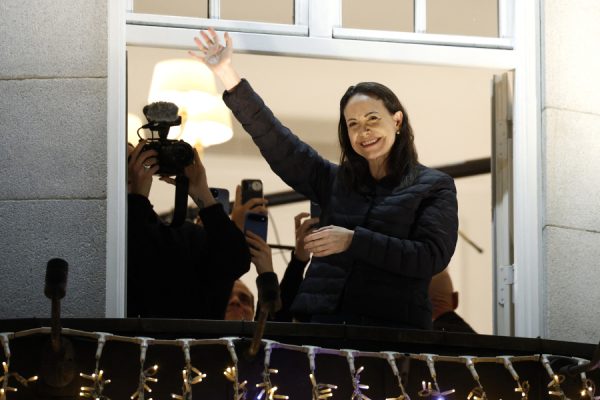
Late at night on Dec. 10, 2025, outside a grand hotel in Oslo, Norway, a stunning scene unfolded: María Corina Machado, dressed in a white suit, suddenly appeared on the hotel balcony, smiling and waving to supporters gathered below. This moment came nearly two years after her last public appearance.
“María! María!” supporters shouted excitedly, raising their phones to capture the historic moment. The 58-year-old Venezuelan opposition leader not only waved and blew kisses to the crowd but also sang with them. At an even more dramatic moment, she broke through the security barriers to personally interact with supporters. This theatrical appearance added an unexpected climax to the day’s Nobel Peace Prize ceremony.
Just hours earlier, the Norwegian Nobel Committee had stated publicly that Machado’s whereabouts were unknown and that it was uncertain whether she could attend the ceremony. As a result, her daughter, Ana Corina Sosa, accepted the award on her behalf. Yet Machado ultimately appeared, shocking everyone present and demonstrating her extraordinary courage and determination.
Nobel Peace Prize winner Machado: I knew traveling to Oslo was ‘risky’
As Machado appeared on the Oslo balcony, the crowd erupted in deafening cheers. “María! María!” The 58-year-old “Iron Lady of Venezuela” not only blew kisses but sang with supporters. At a particularly emotional moment, she even crossed the security barrier to mingle directly with the crowd.
Success
You are now signed up for our newsletter
Success
Check your email to complete sign up
For Machado, this was not just a political appearance but a long-delayed family reunion. For her children’s safety, she had sent them out of Venezuela years ago. In a subsequent BBC interview, she emotionally stated: “For over 16 months, I couldn’t hug or touch anyone. I missed my children’s graduations, missed my daughter’s and son’s weddings. But suddenly, within just a few hours, I could see my loved ones, touch them, cry and pray together.”
During the interview, she wore multiple rosaries around her neck, each gifted by supporters outside the hotel. Every string symbolized a Venezuelan family’s prayers for freedom and democracy, carrying the hopes and trust of countless citizens placed upon her.
A Hollywood-style daring escape: Surviving ten checkpoints
Machado standing in Oslo was itself a near-impossible miracle. The Venezuelan Maduro government had imposed a decade-long travel ban on her and labeled her a “fugitive,” accusing her of terrorism and treason. Just last month, Venezuela’s attorney general publicly threatened that if Machado traveled to Norway to receive the award, she would be immediately arrested and charged with “plotting, inciting hatred, and terrorism.”
According to details reported by The Wall Street Journal and confirmed by Machado, her journey was a two-month-long secret operation involving multiple collaborators. To evade authorities, she had to disguise herself. During her escape, she passed at least ten checkpoints controlled by the Venezuelan military. Eventually, she chose an extremely dangerous route—departing from a remote fishing village on a small wooden boat to cross the border waters and leave Venezuela.
This escape relied not only on an underground network assisting dissidents but also on secret support from the U.S. government. When asked about this at a press conference, Machado admitted: “Yes, we did receive support from the U.S. government.” She reflected: “They [the Venezuelan government] call me a terrorist, say I deserve life imprisonment, and are actively pursuing me. Leaving Venezuela today under these circumstances was extremely dangerous. I can only say that reaching Oslo was possible because many men and women risked their lives to help me.”
Norwegian Nobel Committee Chairman Jørgen Watne Frydnes, sitting beside Machado during a BBC interview, described the journey as “extremely dangerous” and remarked: “Seeing you at night was unbelievable. It’s hard to describe what this means to the Nobel Committee and all of us.”
From engineer to symbol of democracy: Two decades of struggle
To understand Machado’s determination, one must look back at her extraordinary path from professional engineer to a thorn in the side of Venezuela’s dictators. Born on Dec. 7, 1967, with a degree in industrial engineering, she initially excelled in the private sector. In 2002, she co-founded the NGO “Súmate” (Join Us) to promote electoral transparency and civic participation in Venezuela, marking her first step into the public eye and the beginning of a twenty-year struggle against the Chávez and Maduro regimes.
Elected to the National Assembly in 2010, she became known for outspoken criticism and uncompromising democratic stances, frequently confronting Chávez and later Maduro. She publicly questioned economic policies and denounced infringements on private property, earning the nickname “Venezuela’s Iron Lady.” This unyielding stance came at a cost: she was stripped of her parliamentary seat in 2014, restricted from leaving the country, and repeatedly barred from running for office.
In 2023, despite disqualification orders, Machado participated in the opposition primaries, winning with over 90 percent of the vote, demonstrating her immense support among Venezuelans. When the Supreme Court confirmed her ban from the 2024 presidential election, she showed political wisdom by fully supporting alternative candidate Edmundo González. Though preliminary results showed González winning overwhelmingly, Maduro declared victory, with the election widely condemned internationally as neither free nor fair.
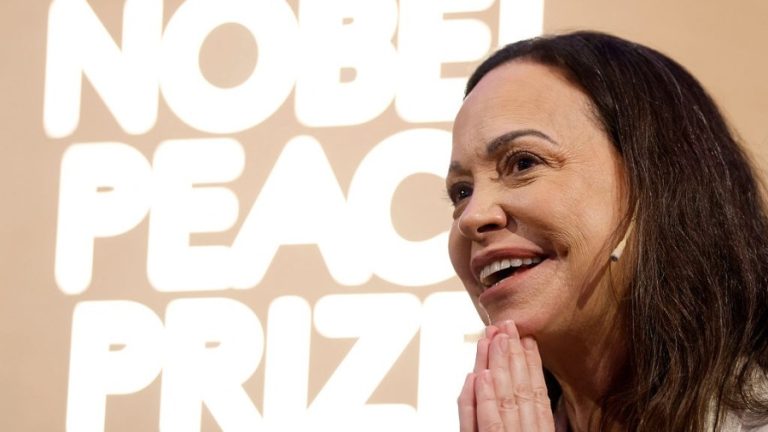
For her “efforts toward a just and peaceful democratic transition in Venezuela,” the Nobel Committee awarded her the 2024 Peace Prize.
The Maduro regime: More than dictatorship, a transnational crime network
On the global stage, Machado sent a clear message: the Maduro regime is not just a dictatorship but a transnational criminal organization.
“We must treat this regime as a criminal organization, not a traditional dictatorship,” Machado stated in the BBC interview. She accused Maduro of relying on drug trafficking, illegal gold mining, and human trafficking to maintain power and again called on the international community to help Venezuela “cut off these criminal resources.”
This characterization has major political and legal implications. If accepted, the international community’s approach to Venezuela could shift from traditional diplomatic pressure to stronger anti-crime measures. Machado stated that she and her team were ready to form a government in Venezuela and had even proposed meeting Maduro’s team to discuss a peaceful transition, but “they refused.”
Asked if she supported a U.S. military strike on Venezuelan soil, Machado did not answer directly, instead accusing Maduro of “handing over our sovereignty to criminal organizations.” She emphasized: “We do not want war and have not sought war… it is Maduro who declared war on the Venezuelan people.”
The Trump factor and the US role
The U.S. played a key role in Machado’s journey and Venezuela’s crisis. Former President Trump’s hardline stance on Venezuela aligned strategically with her appeals.
After the Peace Prize announcement in October, Machado praised Trump. On the same day she arrived in Oslo, Trump announced that U.S. forces seized a Venezuelan tanker near the coast for violating sanctions and participating in “illegal oil transport supporting foreign terrorist organizations.” This action was seen as a major escalation of U.S. pressure on Maduro and a real-world validation of Machado’s “cut off criminal resources” argument.
Trump’s focus on Venezuela also stems from concerns over Latin American migration. Venezuela’s political and economic crisis has driven millions to flee, creating one of the hemisphere’s worst refugee crises. Supporting Venezuela’s democratic transition aligns both with U.S. values and national interests.
The ripple effect of the Oslo moment
Machado’s dramatic appearance in Oslo had effects far beyond the ceremony itself. It demonstrated the resilience and determination of Venezuela’s opposition. Despite severe repression, they can organize complex operations and gain international support. It also brought Venezuela’s crisis back onto the international agenda, reminding the world that the country’s democratic struggle continues.
Third, it inspired opposition movements in other authoritarian states. Machado’s story proves that even in the darkest moments, perseverance and courage can bring change. Her successful escape and international recognition encourage activists worldwide to continue their fight for democracy.
Latin American leaders, including Argentina’s President Milei and Ecuador’s President Noboa, attended the ceremony, showing broad regional support for Venezuela’s democratic movement. This international solidarity is crucial for the opposition, signaling they are not alone.
Determined to return: ‘Of course, I will go back’
Despite Oslo’s applause and the precious reunion with her family, Machado made a shocking decision—she will return to Venezuela. When asked by BBC about her plans, she replied firmly:
“Of course, I will go back. I fully understand the risks I am taking. I will be where I can contribute most to our cause. Until recently, I thought I needed to be in Venezuela; but today, for our cause, I believe I must be in Oslo.”
Her words reflect a dual calculation: returning means near-certain arrest or worse; yet as a leader committed to standing with her people, living in exile conflicts with her political principles. Speaking on the world stage is necessary, but her ultimate home remains among her people.
A woman intertwined with a nation’s fate
Machado’s appearance on the Oslo hotel balcony will become one of the most iconic images in Venezuela’s struggle for democracy. Her white suit symbolizes purity, peace, and hope, contrasting sharply with the Maduro regime’s darkness and violence. The rosaries around her neck carry the prayers and hopes of Venezuelan families. Her hugs and tears with supporters tell the story of a nation maintaining unity and faith amid suffering.
This Nobel Peace Prize journey was more than an award ceremony—it was a declaration of the opposition’s resilience and determination. Like a phantom slipping past the blockade, she briefly stood under the global spotlight before preparing to return to dangerous territory.
Venezuela’s path to democracy remains long and challenging, but with warriors like Machado and millions of citizens yearning for freedom, hope will never extinguish. As the Norwegian Nobel Committee chairman said, seeing her at night was “unbelievable.” This “unbelievable” moment embodies the capacity to create miracles in despair and the courage to bring light amid darkness.
Machado’s story continues, and Venezuela’s fight for freedom is far from over. Her resolute promise, “Of course, I will go back,” is not only a commitment to her people but an inspiration to all who pursue liberty and democracy. In an uncertain world, she proves that true courage is not fearlessness, but the determination to move forward despite danger.