By Jingrong
A stele that greets every visitor
At the entrance of the Xi’an Stele Forest Museum stands a monument that quietly commands attention. Towering, dark, and polished to a jade-like sheen, the Stone Platform Classic of Filial Piety is the first stele most visitors encounter—and the one they are least likely to forget.
Known as the museum’s “First Welcoming Stele,” the monument has occupied this position for more than eight centuries. Yet its story begins much earlier, in the High Tang dynasty, when imperial authority, Confucian ideology, and the art of calligraphy converged in a single work of stone.
Two emperors, one monument
Erected in 745, the fourth year of the Tianbao era, the Stone Platform Classic of Filial Piety is extraordinary for uniting the calligraphy of two Tang emperors on one stele.
Emperor Xuanzong of Tang personally transcribed the complete text of Confucius’ Classic of Filial Piety, including the preface and his own annotations, using clerical script. The title inscription crowning the monument—“The Great Tang Kaiyuan–Tianbao Sage, Civil and Martial Emperor’s Annotated Classic of Filial Piety Platform”—was written in seal script by Crown Prince Li Heng, who would later ascend the throne as Emperor Suzong.
Success
You are now signed up for our newsletter
Success
Check your email to complete sign up
The result is a rare synthesis of imperial authorship and artistic collaboration. Four script styles—clerical, running, regular, and seal—coexist on a single monument, arranged with a structural balance that is both stately and confident. Few surviving works embody Tang imperial calligraphy with such completeness.
Emperor Xuanzong and the rise of bafen shu
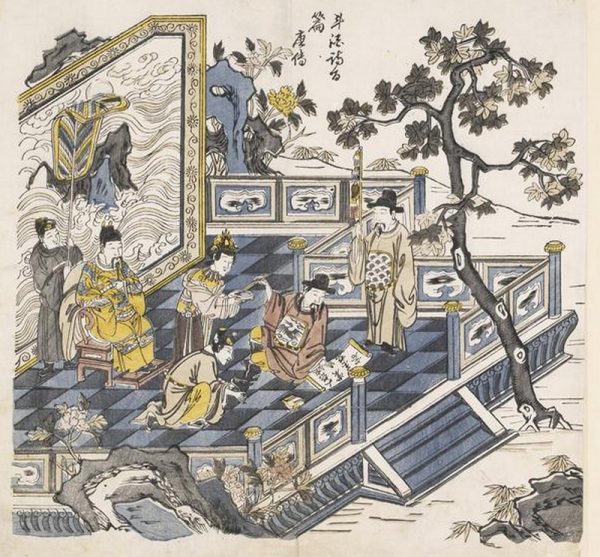
Emperor Xuanzong (685–762) was the longest-reigning and longest-lived ruler of the Tang dynasty, and one of its most artistically accomplished. Historical records describe him as proficient in multiple disciplines, particularly music and calligraphy. The Old Book of Tang praises his mastery of clerical script, while calligraphy critic Zhang Huaiguan later wrote that his brushwork was “refined and inspired, with thought reaching heaven and humanity.”
Clerical script, or bafen shu, traces its origins to the Han dynasty. Its broad, flattened forms and distinctive wave-like strokes—often described as “silkworm head and wild goose tail”—were rooted in earlier seal script traditions. During the early Tang, calligraphy favored lean, angular strength. By the High Tang period, however, clerical script underwent a transformation.
Rather than imitating Han models directly, Tang calligraphers began applying the structural principles and compositional discipline of regular script to clerical writing. Strokes became fuller, wave forms more pronounced, and characters expanded laterally, creating a style that was at once monumental and expressive.
Xuanzong was an enthusiastic patron of this new aesthetic. Under his reign, institutions such as the Jixian Academy and the Hanlin Academy produced a cohort of accomplished clerical-script calligraphers, forming what later scholars described as a “court calligraphy circle.” Their influence extended beyond the palace, shaping the visual culture of the High Tang era.
Filial piety as political philosophy
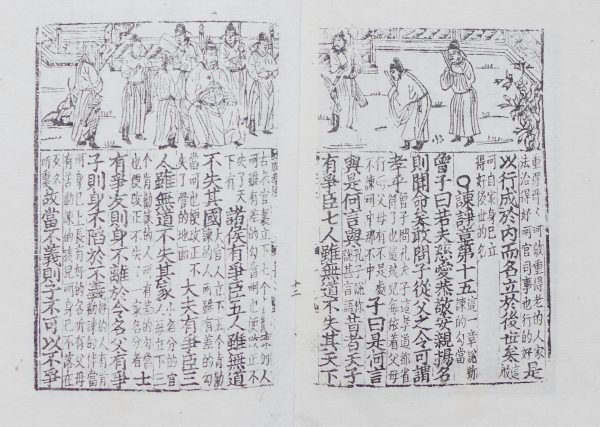
The choice of text carved into the stele was no accident. The Classic of Filial Piety is one of Confucianism’s most influential works, despite being the shortest of the Thirteen Classics, at just over 1,800 characters.
Traditionally attributed to Confucius—though scholars debate its precise authorship—the text presents filial devotion as the foundation of moral life. Filial piety begins with caring for one’s parents and preserving one’s body, but it ultimately extends outward: honoring family through reputation, serving the ruler with loyalty, and sustaining the moral order of the state.
In his preface to the Stone Platform Classic of Filial Piety, Emperor Xuanzong made this philosophy explicit. He presented filial piety not merely as a private virtue, but as a governing principle—an ethical framework through which the empire itself should be ordered.
Monumental design in stone
Physically, the stele is as imposing as its message. It is carved from four massive rectangular stone slabs, each approximately 590 centimeters high and 120 centimeters wide. The surface is dark and finely polished, said to reflect light like black jade.
The crown of the stele is adorned with intricately carved lingzhi and swirling cloud motifs arranged in a double-layered floral design. Auspicious dragons and mythical beasts occupy the upper register, while the base consists of three square stone platforms stacked in tiers—the feature that gives the monument its name.
Each tier is richly decorated. The lowest level is densely carved with powerful lion-like creatures and curling vines, their movement suggesting wind, clouds, and surging vitality. The imagery captures the bold, exuberant spirit characteristic of High Tang art.
Along the sides of the stele are running-script annotations by Emperor Xuanzong himself. On the reverse, neat lines of small regular script record the names of the institutions and officials responsible for carving the monument, anchoring this imperial artwork within the administrative machinery of the Tang state.
A legacy that still welcomes the world
The Stone Platform Classic of Filial Piety was relocated to the Xi’an Stele Forest more than 800 years ago and is the earliest artifact in the museum’s collection. It now stands within the Xiaojing Pavilion, beneath a plaque inscribed with the characters “Stele Forest” by the Qing dynasty statesman Lin Zexu.
As the first stele that visitors encounter, it functions not only as a masterpiece of calligraphy, but as a threshold—introducing the moral ideals, artistic ambition, and imperial confidence of the High Tang dynasty.
Elegant yet powerful, disciplined yet expressive, the monument exemplifies the mature bafen shu style at its height. Its concealed strokes are rounded and restrained, its wave forms exaggerated without excess. Influenced by Han tradition yet unmistakably innovative, it remains one of the most complete and resonant expressions of Tang imperial calligraphy.More than a stone monument, the Stone Platform Classic of Filial Piety continues to do what it has done for centuries: welcome the viewer into a world where art, ethics, and authority were once carved into stone as one.