By Cai Siyun
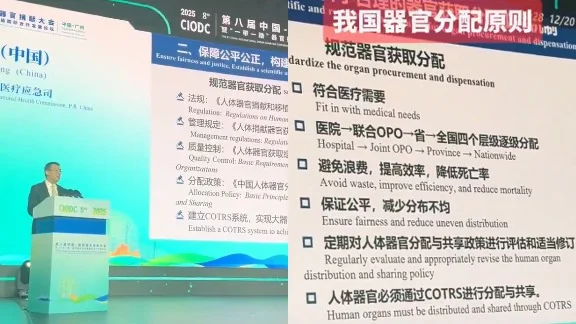
From Dec. 6 to 8, the Eighth China International Organ Donation Conference was held in Guangzhou. But a photograph circulating from the event, which shows six official “principles” governing organ allocation, has left many viewers deeply unsettled, sparking widespread outrage from Chinese netizens. Critics say the rules resemble an operational manual for harvesting organs on demand, effectively placing long-standing allegations of live organ harvesting in plain sight.
According to reports by Toutiao and China Newsweek, the Eighth China International Organ Donation Conference (CIODC) was held alongside the “Belt and Road” Forum on International Cooperation in Organ Donation and Transplantation.
RELATED: China’s Surge in Teen ‘Brain Death’ Cases Renews Fears of Live Organ Harvesting
Dubiously-procured organs
The event was guided by the Chinese Communist Party’s (CCP) National Health Commission and the Red Cross Society of China, and jointly-organized by the China Organ Donation and Transplantation Committee and the China Organ Transplant Development Foundation. Nanfang Hospital of Southern Medical University served as the host institution.
Success
You are now signed up for our newsletter
Success
Check your email to complete sign up
Chinese authorities said the conference aimed to implement the Regulations on Human Organ Donation and Transplantation and to showcase what they described as China’s achievements in reforming its organ donation and transplant system. Official statements emphasized the goal of “building a global community of health for all,” aligning the event with the medical narrative of the Belt and Road Initiative. Conference topics included organ donation system development, transplant technology exchanges, and international cooperation.
However, China’s organ transplant system has long been the subject of international controversy, particularly over the transparency of organ sources and the credibility of its donation framework. Multiple international medical and human rights organizations have repeatedly called on Chinese authorities to release complete and verifiable donation data.
Organ allocation ‘principles’ trigger alarm
Displayed prominently at the conference was a chart outlining six so-called principles for organ procurement and distribution, including:
- “In line with medical needs”
- “Step-by-step allocation through hospital, joint OPO, provincial, and national levels”
- “Avoiding waste and improve efficiency”
- “Ensuring fairness and reduce distribution imbalance”
- “Regular evaluation of organ allocation and sharing”
- “All organs must be allocated and shared through the COTRS system”
Taken together, these principles indicate that the CCP has established a highly centralized system in which all organs must be distributed through a single official platform. All human organs are required to pass through intermediary procurement agencies, be reported through provincial channels, and ultimately be submitted to a national allocation system.
Under international medical ethics, every transplanted organ must be traceable to a real, legal, and voluntary donor. Critics argue that the CCP’s system prioritizes allocation and dispatch while avoiding meaningful requirements for reverse traceability, effectively providing institutional cover for organs obtained through illegal means from unwilling donors.
Online backlash: Who gets priority?
Footage from the conference triggered heated discussion in Douyin comment sections. Some users questioned what “ensuring fairness” truly meant in practice. “Does it mean officials at division level and above can get a free kidney, department-level officials can get a free heart, and vice-ministerial officials can replace organs at will?” questioned one user. Another added, “This is terrifying — organs are distributed like candy.”
Others sarcastically asked whether organs would be ranked by age, education, income, or genetic background, “even more detailed than a matchmaking service.” One netizen lamented the state of China’s organ harvesting system: “People in China live such a miserable existence that even their own organs don’t belong to them.”
Some comments went further, condemning the CCP in harsh terms and warning that without resistance, “the next person whose organs are taken could be you or your family.”
A mass push for organ donations
In recent years, the CCP has aggressively promoted organ donation nationwide. In November 2020, a former vice minister of health publicly declared the goal of turning China into the “world’s number one organ transplant power.” Authorities have also issued directives to promote organ donation on school campuses, even incorporating donation-related content into elementary school textbooks as part of moral education.
In December 2023, the CCP released the Regulations on Human Organ Donation and Transplantation, which took effect on May 1, 2024. The regulations formally legalized organ transplantation and portrayed donation as entirely voluntary.
Public resistance, however, remains strong. A poll conducted last year on the legalization of organ transplantation showed that nearly 98 percent of respondents opposed it, while only 1.49 percent expressed support—reflecting widespread distrust of official claims.
Wang Zhiyuan, head of the World Organization to Investigate the Persecution of Falun Gong (WOIPFG), told The Epoch Times that the CCP has deliberately constructed a public narrative portraying the rapid expansion of China’s organ transplant industry as the result of civilian donations.
Crimes against humanity
For more than two decades, he said, the CCP has concealed what he described as genocide and crimes against humanity involving the live harvesting of organs from Falun Gong practitioners and other prisoners of conscience including Uyghur Muslims, Tibetans, Christians, and other religious minorities.
“Through live organ harvesting, the CCP has destroyed humanity’s moral bottom line,” Wang said. “Doctors who should save lives have been turned into demons, driven by greed and stripped of conscience. Once a wolf has tasted human flesh, whom would it not want to eat? Anyone living alongside such evil is in danger.”
In recent years, allegations suggest that victims of organ harvesting have expanded beyond Falun Gong practitioners to society at large. Increasing numbers of children and young people have gone missing without explanation. Some patients reportedly sought treatment for minor illnesses only to be declared brain-dead, after which multiple organs were removed.
Wang argued that the CCP treats live organ harvesting as a state-run crime campaign, using propaganda to normalize killing as something legal and even honorable. He said the narrative of “voluntary donation” is used to divert public attention.
“No matter how it is disguised,” he said, “the crime of live organ harvesting cannot be concealed, and it will not escape global condemnation.”