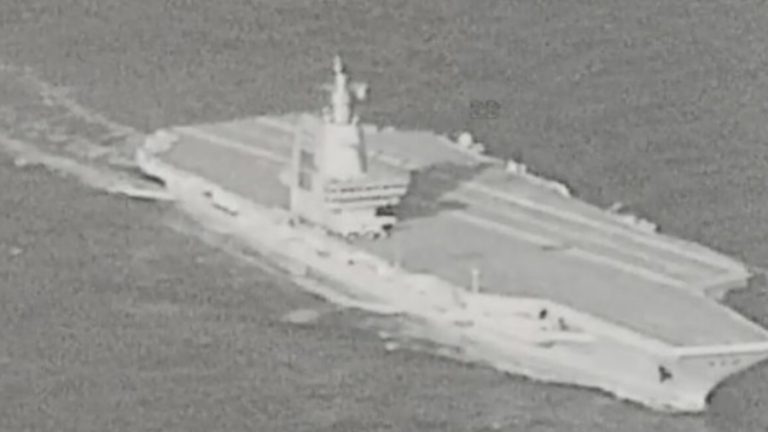
On Tuesday, Dec. 16, the Chinese Communist Party’s aircraft carrier Fujian transited the Taiwan Strait. Monitoring photos released by Taiwan’s Ministry of National Defense show that no carrier-based aircraft were deployed on the flight deck. Defense Minister Wellington Koo stated that assessments indicate there was no special military action, but rather a routine return to port. At the same time, 16 CCP aircraft and vessels were active around the Taiwan Strait.
The Director-General of the National Security Bureau reported that this year saw a record high of 3,570 CCP aircraft intrusions into airspace surrounding Taiwan, along with 39 joint air–sea exercises. Meanwhile, the CCP claimed that in early December it conducted search-and-rescue drills at the “Taiwan Shoal,” using the activity to hype jurisdictional claims. The National Security Bureau refuted this, stating the claim does not match the facts.
National Security Bureau Director-General Tsai Ming-yen said: “The CCP has falsely claimed that this exercise specifically covered the Taiwan Shoal. After our comparison—and as shown in a graphic we provided to legislators—the patrol route did not enter the Taiwan Shoal. This clearly shows the CCP deliberately confusing the location of maritime areas to hype its claimed jurisdiction over Taiwan.”
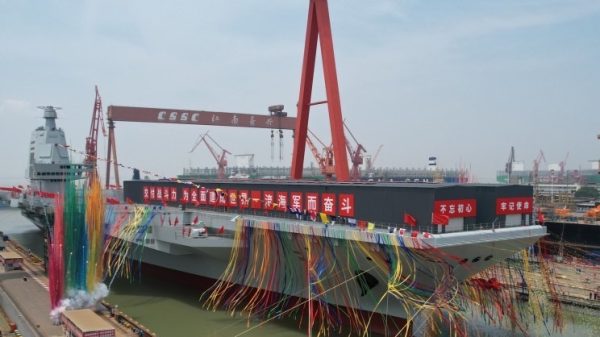
Taiwan tracks Fujian’s movements as CCP ‘extreme pressure’ fails to achieve regional goals
National Security Council advisory committee member Huang Chung-yen said Taiwan’s military has fully grasped all developments. He noted that the CCP’s recent “extreme pressure” against Japan and the region has produced no positive results, and that the special defense budget aims to help Taiwan build a more efficient and sustainable deterrent.
In an interview with Qi You Ci Li host Wang Shih-chi, Huang said the military has fully tracked the Fujian—from its preparation and departure to its sailing route, escort ships, destination, and mission objectives. The Fujian was commissioned in Hainan in November, and according to its work schedule, this northbound voyage was likely a return for testing and corrections to address deficiencies.
Success
You are now signed up for our newsletter
Success
Check your email to complete sign up
Huang said the CCP used remarks by Japanese Prime Minister Sanae Takaichi about “a Taiwan contingency” as a pretext to apply “extreme pressure” on Japan and the region, but this backfired by damaging China’s international image. It ultimately prompted joint U.S.–Japan patrols, with relevant countries beginning related exercises and paying closer attention to their own security—once again proving that “the foundation of peace is strength.”
He analyzed that recent actions by the PLA—such as deploying illumination or flare devices against Philippine aircraft, intermittently locking fire-control radar on Japanese fighters, and conducting joint bomber patrols with Russia—reflect Beijing’s attempt to exploit strategic gaps while the international community focuses on Russia–Ukraine mediation and post–Middle East corridor solutions. The aim is to assert dominance over the First Island Chain or demonstrate a certain sphere-of-influence intent.
Huang added that the CCP continues to launch hybrid threats with the intent that “if you think it’s no big deal and don’t respond,” it will continue to “dig deeper into soft ground.” These are all forms of “extreme pressure.” The primary goal of all infiltration and hybrid threats is psychological intimidation—instilling fear or causing internal division in Taiwan to prevent unity.