By Li Jingyao
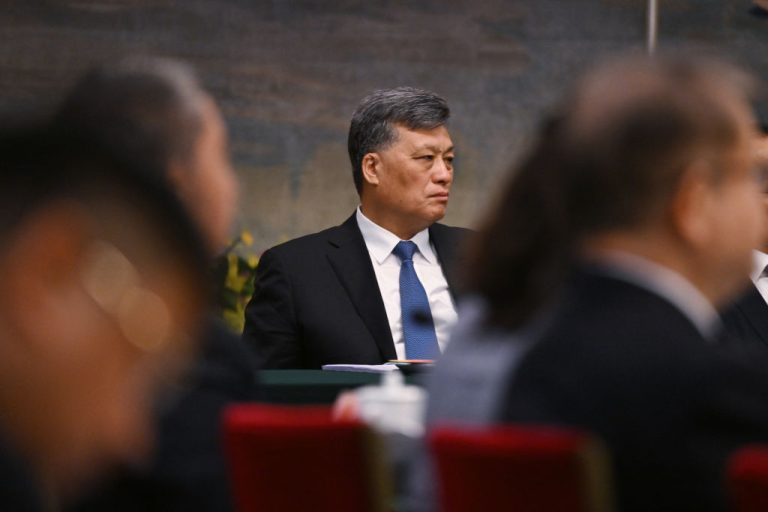
Since the Chinese Communist Party’s (CCP) Third Plenum of the 20th Central Committee, President Xi Jinping’s political base has been steadily weakened as members of the so-called “Xi camp” have been purged one after another. Against this backdrop, movements within the anti-Xi camp have drawn increasing attention. In particular, the recent high-profile appearances of Chinese People’s Political Consultative Conference (CPPCC) Vice Chairman Hu Chunhua have sparked renewed speculation.
Analysts say a “coordinated wave of favorable coverage” by official CCP media suggests that Hu Chunhua’s standing within the Party is rising rapidly — and that his political momentum may now be difficult to reverse.
RELATED: Hu Chunhua Poised for Politburo Entry as CCP Power Reshuffle Looms
80th anniversary
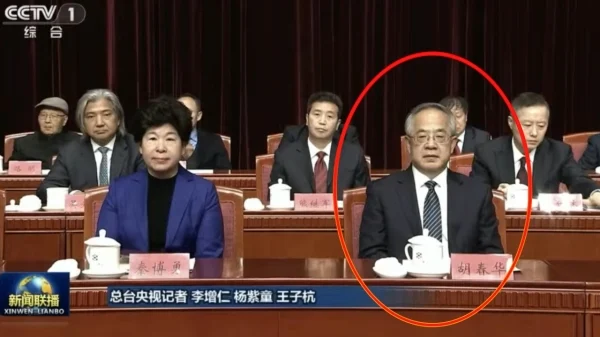
According to state news agency Xinhua, a ceremony marking the 80th anniversary of the founding of the China Democratic National Construction Association (CDNCA) was held in Beijing on Dec. 17. Li Ganjie, a member of the CCP Politburo and head of the United Front Work Department, attended the event and delivered congratulatory remarks on behalf of the CCP Central Committee. CPPCC Vice Chairman Hu Chunhua and NPC Standing Committee Vice Chairman Ding Zhongli, who also serves as chairman of the China Association for Promoting Democracy, were also present.
Success
You are now signed up for our newsletter
Success
Check your email to complete sign up
Public records show that the China Democratic National Construction Association, commonly known as Minjian, is the third-largest of China’s eight “democratic parties.” It is the ninth-largest political organization represented in the National People’s Congress and ranks second among democratic parties in terms of membership size.
Founded on Dec. 16, 1945, Minjian was originally known as the Democratic National Construction Association. Renamed in 1952, it is primarily composed of figures from economic and business circles and operates as a CCP-led “participating party” within China’s political system. The CCP maintains direct political leadership over the organization.
Minjian’s current leadership includes Chairman Hao Mingjin and Executive Vice Chairman Qin Boyong, along with several vice chairpersons.
Hao Mingjin’s absence raises questions
The anniversary event drew attention for two key reasons. First, Minjian Chairman Hao Mingjin was notably absent.
According to Hong Kong 01, Hao has not appeared publicly since late October and has missed a series of important meetings, including briefings on the CCP’s Fourth Plenum delivered by United Front chief Li Ganjie, internal Minjian meetings on implementing plenum directives, and sessions of the NPC and CPPCC Standing Committees. During the same period, Qin Boyong, Minjian’s second-ranking leader and a CPPCC vice chairman, also disappeared from public view.
At an early December symposium at Zhongnanhai where CCP leaders solicited opinions from non-CCP party heads on economic policy, leaders from all eight democratic parties spoke, except Minjian. Instead, Vice Chairman Sun Dongsheng addressed the meeting. Hong Kong 01 also reported that while Qin Boyong reappeared at the 80th anniversary event, Hao Mingjin did not, further fueling speculation about his status.
Political commentator Tang Jingyuan said Hao’s repeated absences, including from Minjian’s own milestone celebration, amount to a “de facto official confirmation” that he has fallen from power.
Hu Chunhua appears on state TV
The second focal point was the presence of Hu Chunhua himself. Tang Jingyuan noted that Minjian holds anniversary celebrations only once every ten years. At the party’s 70th anniversary in 2015, the event was attended by then-Politburo member and United Front chief Sun Chunlan, while the CPPCC was represented by a lower-ranking vice chairman, Lu Zhanguo.
RELATED: Ma Xingrui’s Third Absence Points to Trouble as Hu Chunhua Faces Scrutiny
This time, however, the CCP sent Hu Chunhua, ranked second among CPPCC vice chairmen, a markedly higher-level representative.
Tang said that if Minjian Chairman Hao Mingjin were indeed under investigation, protocol would normally call for a downgrade in representation. Instead, the opposite occurred. “This suggests a deliberate effort to put Hu Chunhua in the spotlight,” Tang said. “The goal was to get him on CCTV’s Evening News, boost his visibility, and send a political signal.”
State mouthpiece backing Hu
But Hu Chunhua’s exposure did not end there. On Dec. 15, state media “People’s Net” published an article titled: “Magnificent Tibet Marches Forward,” lavishly praising governance achievements in Tibet. While the article did not mention Hu by name, analysts say it effectively served as a political endorsement.
The piece highlighted development successes in Lhasa, Nyingchi, and Shannan — regions closely associated with Hu’s earlier postings — and emphasized poverty alleviation, ecological protection, and sustainable growth.
Hu Chunhua served two extended terms in Tibet. From 1983 to 1997, he worked primarily in Lhasa and later held senior posts in Nyingchi and Shannan. He returned to Tibet from 2001 to 2006, serving as a regional Party secretary, executive vice governor, and Party school president.
Notably, Hu Jintao — another former Communist Youth League leader — was Tibet’s Party chief from 1988 to 1992. Tang Jingyuan said the article’s focus on regions governed by Hu was unmistakable. “This is effectively an endorsement of Hu Chunhua and an effort to elevate his political standing.”
Former Wen Wei Po Northeast China bureau chief Jiang Weiping agreed, saying the coverage shows Hu’s momentum is now “unstoppable.”
A coordinated push
After being removed from the Politburo at the CCP’s 20th Party Congress in 2022, Hu Chunhua spent nearly two years sidelined as a CPPCC vice chairman. That changed after the Third Plenum.
In August, Hu was appointed deputy head of the central delegation attending Tibet’s 60th anniversary celebrations and inspected a major hydropower project in Nyingchi — an area previously visited by Xi Jinping himself. Earlier footage from the Third Plenum’s closing session also showed Hu seated beside Xi, a rare arrangement that sparked widespread speculation.
Observers familiar with CCP propaganda operations note that Party media coverage is never accidental. The recent, concentrated effort by People’s Daily and CCTV to showcase Hu Chunhua strongly suggests a recalibration of political messaging.
Analysts say this coordinated media push indicates that Hu Chunhua’s status within the CCP is rising, and that persistent rumors of his return to the Politburo may not be unfounded after all.