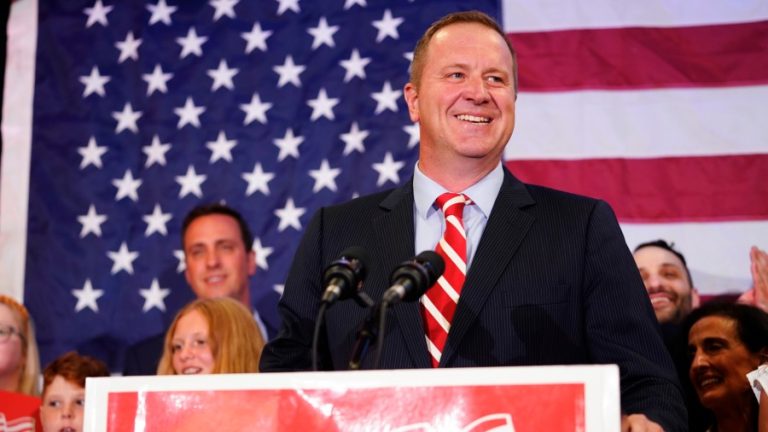
U.S. Senator Eric Schmitt, a Republican from Missouri and the state’s former attorney general, said on Tuesday that he has no intention of apologizing to the Chinese government, marking his first public response to a lawsuit filed against him seeking roughly $50 billion in damages.
Fox News reported that Schmitt views the lawsuit as retaliation for legal action he took against China while serving as Missouri attorney general. The case is widely viewed as a countermeasure following Missouri’s earlier COVID-19–related litigation against Chinese entities.
Speaking on The Ingraham Angle, Schmitt dismissed the lawsuit as “completely absurd,” saying Beijing was angered by efforts to expose what he described as deception and misinformation surrounding the pandemic.
Background of the COVID-19 lawsuits
Schmitt said Missouri had previously secured a $24 billion judgment in U.S. federal court related to the COVID-19 pandemic, a ruling he described as the real source of Beijing’s anger.
He said Missouri sued China over the global spread of COVID-19 and prevailed in court, prompting what he characterized as a retaliatory response.
Success
You are now signed up for our newsletter
Success
Check your email to complete sign up
The plaintiffs in the new lawsuit include the Wuhan Municipal Government, the Chinese Academy of Sciences, and the Wuhan Institute of Virology under the Chinese Academy of Sciences.
Court filings allege that Schmitt, Andrew Bailey—former deputy Missouri attorney general and now deputy director of the FBI—and the Missouri state government harmed the reputation of China, Wuhan, and related research institutions through what the complaint describes as “malicious litigation,” the fabrication of false information, and the dissemination of discriminatory and defamatory statements.
Schmitt characterized the lawsuit as a case of “sour grapes,” saying his legal team is still working through the Chinese-language court filings. He added that he has no intention of apologizing.

$50 billion claim and demand for public apologies
According to The Washington Times, the lawsuit claims that Schmitt’s statements damaged the “brand value and academic reputation” of Wuhan-based researchers and hindered international scientific cooperation.
The plaintiffs estimate their losses at approximately $50 billion USD, and are seeking a court order requiring Schmitt, the Missouri state government, and Bailey to issue public apologies on platforms including CNN, YouTube, People’s Daily, and Xinhua News Agency.
The suit also demands measures such as the cessation of alleged infringement, elimination of adverse effects, restoration of reputation, and financial compensation.

US response: ‘lawfare’
Schmitt said the lawsuit amounted to a form of political “lawfare,” intended to intimidate critics through legal pressure. He described the case as a “badge of honor,” arguing that it underscored Beijing’s efforts to silence criticism.
In an interview with The Washington Times, Schmitt said China’s handling of the COVID-19 outbreak resulted in massive human suffering and loss of life, and that his legal actions as Missouri attorney general were aimed at accountability.
He said the lawsuit, which he described as targeted and lacking factual basis, would not deter him.
Catherine Hanaway, who currently serves as Missouri attorney general, said the lawsuit’s real purpose was to delay enforcement of the earlier $24 billion judgment. She said Missouri would continue pursuing enforcement measures, including the seizure of Chinese assets in the United States if necessary.
Hanaway said the lawsuit itself demonstrated that Missouri’s legal actions were justified.
The case is being heard by a three-judge panel at the Wuhan Intermediate People’s Court, presided over by Jiang Ning, with Yin Wei and Pei Lu serving as panel members