By Li Jingyao, Vision Times
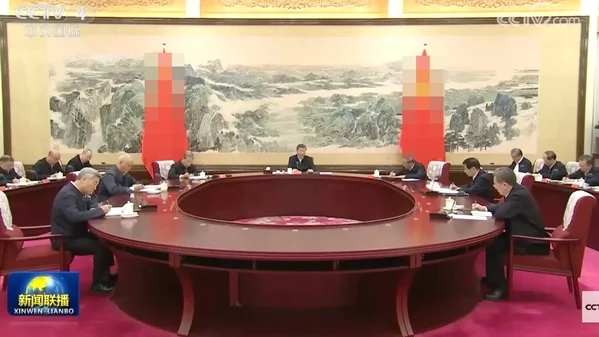
On Dec. 26 and 26, the Chinese Communist Party’s (CCP) Politburo met for its annual “democratic life meeting.” But while Chinese President and leader Xi Jinping presided over the meeting and delivered remarks, official coverage was noticeably pared back, and Xi’s traditional “commentary” on Politburo members was significantly weakened. The Politburo serves as China’s top ruling body.
Meanwhile, unverified but detailed reports circulating in political circles claim that Xi faced unusually sharp, collective criticism from fellow Politburo members during the closed-door session.
A symbolic gesture, or a shift in tone?
The Politburo’s democratic life meeting is typically viewed as a ritualized display of loyalty to Xi, as well as a platform for him to assert his status as the Party’s unquestioned “core” while reprimanding subordinates from above.
RELATED: Yuan Hongbing Alleges Xi Jinping Ordered Secret Executions of CCP Officers, Including Gao Zhisheng
Success
You are now signed up for our newsletter
Success
Check your email to complete sign up
According to Radio France Internationale (RFI), the specific content of Politburo members’ speeches remains unknown. However, official Xinhua summaries emphasized five focal points, beginning with: “Taking the lead in strengthening political loyalty and improving political capability,” followed by phrases such as “revering the people,” “revering the organization,” and “revering discipline and law.”
On their face, these formulations suggest that officials stressed loyalty and deference to leadership. As RFI noted, in recent years, the most serious charge leveled against fallen senior officials has consistently been “disloyalty to the Party.” Under CCP doctrine, specifically the “Two Establishes” and “Two Upholds,” disloyalty to the Party is effectively disloyalty to Xi Jinping himself, a point well understood by the highest ranking Politburo members.
Reports of an explosive meeting
However, overseas Chinese political commentator Chen Pokong argues that the repeated invocation of “Two Establishes, Two Upholds, Four Consciousnesses, and Four Confidences” at this meeting was largely symbolic, aimed at smoothing the handling of the Ma Xingrui case.
“They still have to process Ma Xingrui under Xi’s banner,” Chen said, adding, “It’s flying the red flag to oppose the red flag by using Xi to deal with Xi.”
RELATED: Exclusive: Xi Jinping Faces Signs of Military Defiance in Rare Official Footage
Chen further argued that the emphasis on “political loyalty” no longer refers to loyalty to Xi personally: “Most of Xi’s own faction has already been taken down. The people most loyal to Xi, such as Miao Hua and He Weidong, have fallen. So this loyalty can only be loyalty to the Party, not to Xi.”
More striking are claims that Xi was fiercely criticized during the meeting. Political commentator “Ordinary Person Inside the Firewall” claimed Xi was subjected to repeated humiliation and direct criticism. According to this source, prior to the meeting, the CCP’s central decision-coordination body tasked Wen Jiabao and Wang Yang, acting on behalf of Hu Jintao, to separately meet with all 22 Politburo members.
They were instructed to conduct serious self-criticism and mutual criticism, reviewing problems since the 20th Party Congress and submitting written statements for inspection. Hu Jintao reportedly stressed: “Each Politburo member must seriously criticize at least one other Politburo member.”
Drafts were required to exceed 5,000 characters, followed by no less than 15 minutes of evaluation per speaker. Mutual flattery, superficial criticism, or “raising issues lightly and dropping them quickly” was explicitly forbidden. All handwritten statements were reportedly archived centrally after the meeting—creating what insiders described as a high-pressure, confrontational atmosphere.
Criticisms abound
According to the same source, criticism counts included Xi Jinping (11 times), Cai Qi (6), Wang Huning (4), and Li Qiang (1). Self-criticisms focused on weak Party discipline and failure to restrain family members from exploiting political influence for personal gain. Xi reportedly addressed issues involving Peng Liyuan and Xi Yuanping, while expressing regret that Ma Xingrui had “betrayed the Party’s trust.”
Reportedly: Xi Jinping criticized Li Qiang, accusing him of failing to manage the State Council since the 20th Party Congress, leaving both economic and diplomatic affairs in chaos. Li Qiang criticized Cai Qi, accusing the Central Office of overstepping its authority and disrupting government operations.
Meanwhile, Zhao Leji criticized Xi, accusing him of factionalism and worsening Party culture while undermining the NPC’s supervisory role. Wang Huning criticized Cai Qi for promoting a personality cult and forcing Party-wide loyalty pledges.
Ding Xuexiang was also heard criticizing Cai Qi, stating that Xi’s leadership errors increased markedly during Cai’s tenure as Central Office director. Li Xi criticized Xi, accusing him of tolerating family misconduct that caused major losses to the Party and the people.
At the Politburo level, He Lifeng, Chen Wenqing, and Huang Kunming reportedly sided with Cai Qi and criticized Wang Huning for inventing “Xi Jinping Thought” and distorting Party theory. Meanwhile, Wang Yi, Li Hongzhong, and Chen Miner sided with Li Qiang, condemning Cai Qi for misleading Xi through excessive flattery.
‘Criticized beyond recognition’
According to the source, the remaining nine Politburo members, led by Zhang Youxia and Shi Taifeng, collectively criticized Xi for cronyism since the 20th Party Congress, accusing him of destabilizing the Party, government, and military systems. Zhang Youxia allegedly warned that Xi had attempted to turn the PLA into a personal army, cultivating corrupt military cliques such as those linked to Miao Hua and He Weidong, while disregarding public safety.
It was further claimed that Yin Li, Liu Guozhong, Li Ganjie, Li Shulei, Zhang Guoqing, Chen Jining, and Yuan Jiajun all criticized Xi sharply, arguing that he bore primary responsibility for post-20th Congress failures and should conduct deeper self-examination—or even resign—at the next Central Committee plenum.
“Xi Jinping, Cai Qi, Wang Huning, and Li Qiang were criticized beyond recognition,” the source said, adding that Hu and Wen’s camp allegedly hopes to ‘criticize them down and discredit them’ to pave the way for a Hu Chunhua-led leadership transition.
Historical parallels and a muted Xi
The authenticity of these claims cannot be independently verified. However, CCP history does include precedents where leaders were forced out following democratic life meetings, most notably Hua Guofeng and Hu Yaobang. Separately, official media trends are verifiable.
Coverage of the meeting has shrunk sharply year by year, and Xi’s authority appears increasingly muted:
- 2023: Xi spoke for over 1,800 characters, personally commenting on each Politburo member.
- 2024: Speech reduced to under 1,200 characters, commentary simplified.
- 2025: Speech cut to under 800 characters, with Xi’s “commentary” described only as “enhancing cohesion and combat effectiveness.”
Political commentator Zhong Yuan noted that Xi can no longer openly point out Politburo members’ “problems” or conduct individual “political inspections.”
“The once all-powerful ‘Xi core’ posture is gone,” Zhong said, adding, “And the Politburo’s attitude toward Xi has clearly changed.” Zhong concluded that the altered tone of the 2025 year-end meeting not only reflects a shift in top-level power dynamics, but also signals that even fiercer internal turmoil may lie ahead for Zhongnanhai.
Editorial note: This article is based on publicly circulating reports and commentary from independent analysts and reports. The claims described have not been independently verified by Vision Times, and relevant authorities have not publicly confirmed the allegations.