By Li Muzi, Vision Times
Following two recent infant death cases that have rocked China, the Ningbo “Xiao Luoxi” case and the 22-day-old baby at Xiangya Second Hospital in Changsha, another tragedy has now emerged from the country’s Heilongjiang Province.
A 74-day-old baby girl died after being hospitalized for just four days due to nasal congestion at Mudanjiang Women and Children’s Hospital. The child’s mother alleges that the hospital altered nursing records more than 1,900 times and emergency treatment records over 60 times. She says she has sought justice for nearly three years without result, drawing renewed public attention to the case.
RELATED: Chinese Infant’s Death After Heart Surgery Sparks Outrage, Deepens Public Distrust of Medical System
Baby dies after just 4 days at the hospital
According to information circulating on Chinese social media, the baby — named Xiu Heran — was admitted to Mudanjiang Women and Children’s Hospital because her nose was congested. But just four days later, she died.
Success
You are now signed up for our newsletter
Success
Check your email to complete sign up
The child’s mother alleges that the child’s medical records were “altered beyond recognition.” She said, “Just the nursing records were changed more than 1,900 times, and the emergency records were altered more than 60 times.”
RELATED: Helicopters Land Daily at Xiangya Hospital Amid Organ Harvesting Allegations
The mother further claimed that many of these changes were made more than a week after her daughter died, and that some consultation records contained signatures from doctors who never appeared. “I’ve been fighting for my child’s justice for nearly three years,” she said, adding, “No matter how long it takes or how hard it is, I must see this through.”
On April 29, the Douyin account “Xiu Heran’s Mom” posted a video filmed outside the hospital’s main entrance, declaring: “A major medical accident occurred at Mudanjiang Women and Children’s Hospital, we need justice! My daughter, Mom misses you so much.”
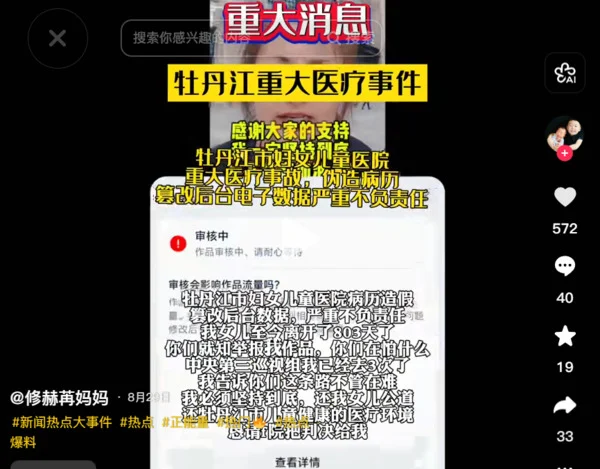
On Aug. 29, she posted another video accusing the hospital of fabricating medical cases and tampering with backend data. “My daughter has been gone for 803 days.” she wrote. “What are you afraid of? The Central Inspection Team has already come three times. No matter how difficult this road is, I will continue to the end.”
Ningbo case: Five-month-old baby dies after heart surgery
Public rage was first ignited by the death of Xiao Luoxi, a five-month-old baby girl in Ningbo, Zhejiang Province. On Nov. 14, Ningbo University Affiliated Women and Children’s Hospital performed heart surgery on the infant for what it described as a “coronary sinus atrial septal defect.” The child died on the operating table that night.
RELATED: China’s Flu Wave Overwhelms Hospitals as Netizens Claim ‘It’s Actually COVID-19’
After the tragic incident, the family requested access to surveillance footage but were reportedly blocked by large numbers of hospital security personnel.
Xiao Luoxi’s mother, Ms. Deng, later posted videos under her real name, accusing the hospital of medical malpractice and questioning the surgeon’s professionalism. She said the hospital described the condition as critical and insisted that “surgery was urgently required,” with costs reaching 40,000–50,000 yuan.
Ms. Deng tearfully recalled: “We were told before surgery it would take two and a half to three hours. In reality, the surgery lasted seven hours and ten minutes. My child was in the operating room for nine hours.” She added, “I don’t know what inhuman suffering my child endured during those nine hours. When she died, there were still tears at the corners of her eyes. Her mouth couldn’t close. She died full of grievance.”
She further alleged: “The doctors claimed the surgery was successful and tricked us into signing documents, but the incision between her ribs wasn’t even stitched. She bled to death.”
“This isn’t a medical accident. This is murder—and a group murder. The entire Ningbo Women and Children’s Hospital committed murder.”
Her posts were repeatedly scrubbed and deleted from social media. The case struck a deep chord among netizens, with many doctors posting operating-room videos in solidarity. Singer Han Hong also spoke out, saying the hospital’s medical records were “outrageously wrong” and “infuriating.”
Xiangya Second Hospital: Newborn baby dies after two surgeries
Another widely discussed case involved a 22-day-old newborn in Hunan Province, who died after undergoing two open-chest surgeries at Xiangya Second Hospital. According to mainland media reports and family statements, the infant — named Wang Ruize, born on Nov. 2 — was diagnosed with congenital heart defects, including aortic coarctation and patent ductus arteriosus.
Doctors told the family the surgery was “simple, with a success rate above 90 percent,” warning that failure to operate could lead to intestinal necrosis or kidney failure. The first surgery took place on Nov. 5, but family members later discovered through medical records that the child remained in critical condition every day afterward, despite doctors saying the procedure went smoothly.
On November 21, after being told that the blood vessels had narrowed again, the baby underwent a second emergency open-chest surgery. Doctors promised it would take three hours, but it lasted eight hours. One hour after surgery, the hospital suddenly informed the family that the baby was critically ill and refused to allow the father to see the child one last time.
The family says the hospital has never clearly explained the cause of death nor provided key operating-room surveillance footage. “All we want is to find out what happened and get justice,” the child’s father said.
Netizens react: ‘Shocking and terrifying’
The cases prompted an outpouring of personal accounts from across China. A Heilongjiang netizen wrote: “My son was born at Mudanjiang Maternal and Child Hospital. Right after birth they said he had pneumonia and forced us into the neonatal ICU. After seven days, his voice was hoarse from crying and his limbs were covered in bruises. Doctors kept pushing CT scans even after the first showed nothing.”
Meanwhile, a Jilin netizen shared: “My son had pneumonia and was sent straight to ICU on day one. After nine days of IVs, nothing improved. We transferred to Changchun — doctors there said it was just a viral infection. Three days of fluids and he was fine.”
A Jiangxi netizen wrote: “My six-month-old had a fever and was hospitalized repeatedly. They gave him three packs of oseltamivir. After we forced discharge, he recovered at home. Hospitals drag things out because they earn commissions.”
A Shandong netizen said: “I had appendicitis and was hospitalized in Mudanjiang. They wouldn’t let me eat and pumped nutrition fluids for 17–18 hours a day. I spent over 20,000 yuan. If I hadn’t asked, they would’ve kept going.”
On X (formerly known as Twitter), users commented:
- “They’re stealing organs, blood, and bone marrow.”
- “How much suffering did these babies endure? These doctors are utterly heartless.”
- “The CCP’s existence is not only a disgrace to China but a threat to the world.”
- “The Communist Party has lost all humanity.”
Taken together, these cases have intensified public fears over medical accountability, transparency, and patient safety in China’s hospital system, especially where infants and children are concerned.
While official investigations remain opaque or absent, grieving families continue to seek answers, and public anger continues to mount.